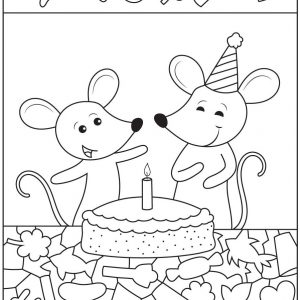
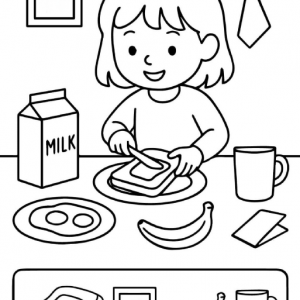
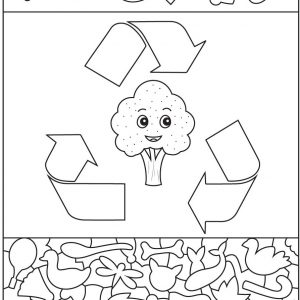
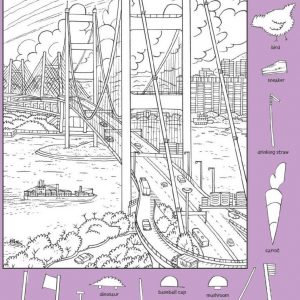
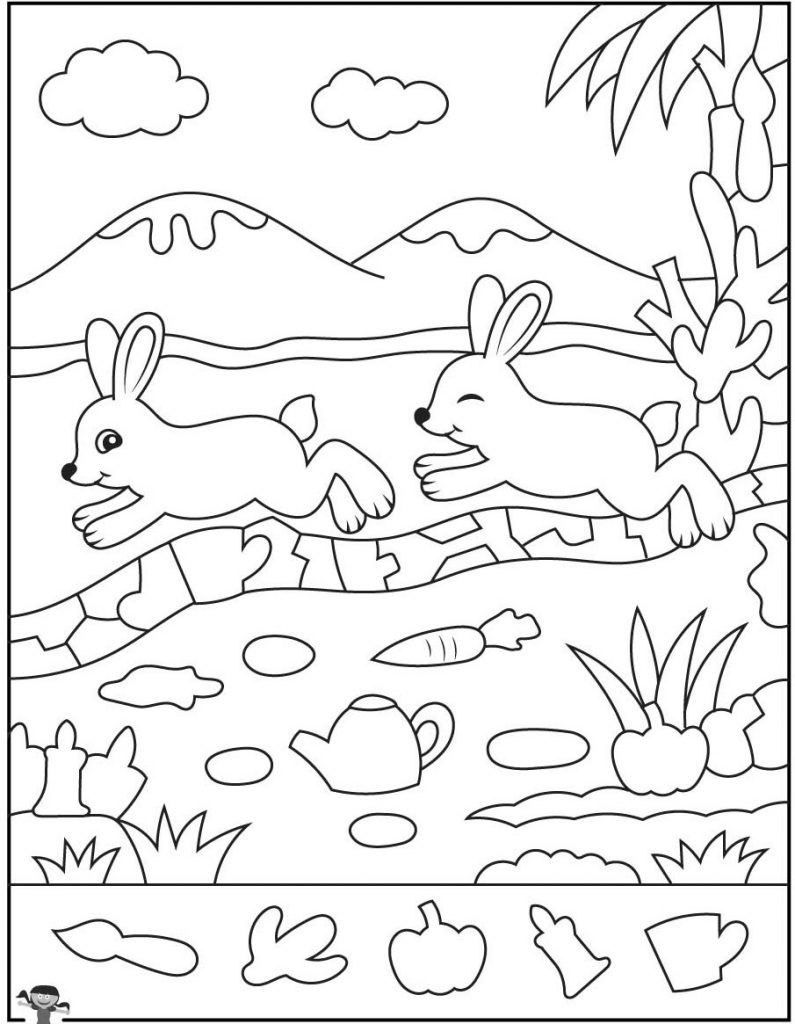
At first look, this peaceful black and white illustration feels simple and sweet. Two rabbits leap happily across a winding path, surrounded by hills, clouds, plants, and gentle scenery. But this calm surface hides a clever challenge. Tucked into the landscape are everyday objects disguised as natural shapes, waiting for sharp eyes to uncover them. This is not just a drawing. It is a hidden picture puzzle designed to stretch attention, spark curiosity, and turn quiet moments into meaningful play.
If you love activities that feel relaxing but still keep your brain switched on, this rabbit themed hidden object puzzle hits the perfect balance.
Why rabbits create a soothing puzzle atmosphere
Rabbits naturally signal gentleness, speed, and playfulness. Their movement across the page draws your eyes forward, guiding how you scan the image. That motion helps prevent visual fatigue and keeps the search feeling light instead of stressful.
Unlike busy city scenes or chaotic cartoons, this environment feels open and breathable. That calm backdrop makes the puzzle inviting for younger children while still offering enough complexity to challenge adults.
Why nature scenes hide objects so effectively
Nature is full of organic shapes. Curves repeat. Textures blend. Lines overlap in unpredictable ways. That makes landscapes ideal for hiding objects without breaking immersion.
In this puzzle, a carrot blends into the ground, a watering can becomes part of the terrain, and other familiar shapes quietly merge into rocks, plants, and clouds. Nothing looks out of place, yet nothing is obvious either.
Your brain has to slow down and truly observe.
Why black and white puzzles strengthen visual skills
Without color cues, your eyes rely entirely on shape recognition and contrast. This forces deeper processing. You trace outlines. You compare angles. You notice negative space.
This kind of visual work improves pattern recognition, attention to detail, and visual memory. It is especially useful for children developing early reading and math skills, but adults benefit just as much.
Black and white puzzles do not distract. They demand focus.
Why object lists turn searching into a satisfying mission
At the bottom of the page, you see the shapes you need to find. Each one becomes a mini goal. Instead of wandering aimlessly through the image, your brain locks onto a purpose.
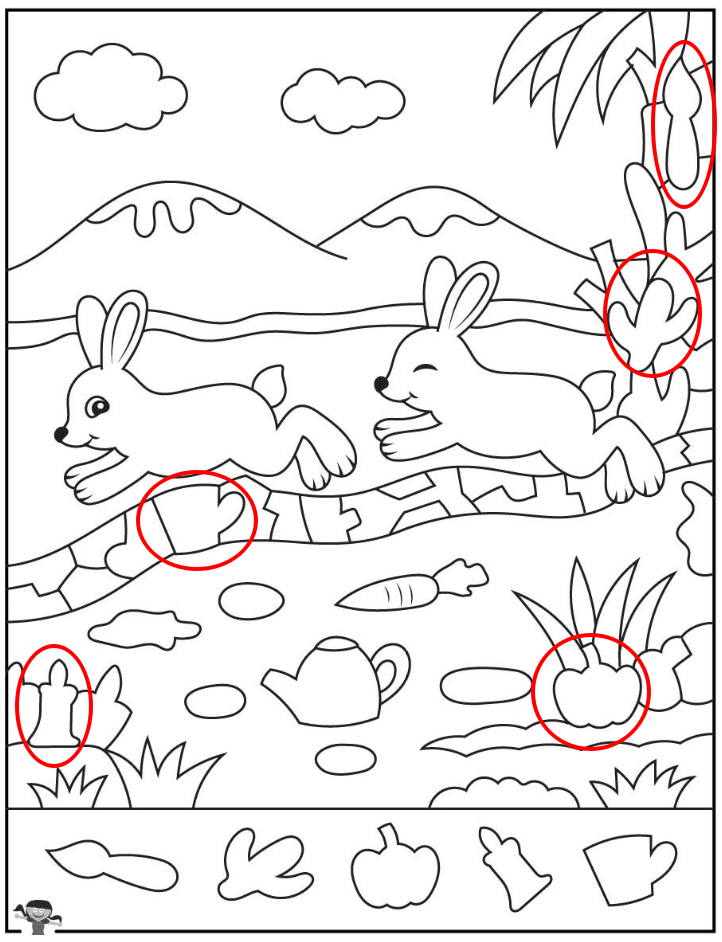
Find the leaf. Spot the apple. Locate the glove. Identify the missing shape hiding in plain sight.
Each success gives a small reward. That steady rhythm of effort and payoff keeps motivation high and frustration low.
Why puzzles like this encourage patience naturally
This puzzle does not rush you. There is no timer. No flashing alerts. No penalties for missing something.
You move at your own pace. You pause. You scan again. You return to areas you thought you finished.
That gentle loop builds patience and perseverance without pressure. Over time, this kind of focused calm becomes a habit, not just a moment.
Why this puzzle works across age groups
Children enjoy the rabbits and the playful setting. They often spot larger shapes quickly, which builds confidence. Adults enjoy the subtle disguises and the satisfaction of finding the most cleverly hidden objects.
The same image adapts to different skill levels without changing rules. That makes it perfect for families, classrooms, and shared quiet time.
Everyone plays together, just at their own depth.
Why repetition improves attention instead of causing boredom
The first time through, you might miss several objects. The second time, you notice patterns. The third time, your eyes move faster and more deliberately.
This repeated scanning trains your visual system. You become more efficient, more confident, and more accurate. That sense of improvement feels rewarding and encourages continued engagement.
The puzzle grows with you.
Why hidden picture puzzles support emotional regulation
Activities like this create a state of relaxed focus. Your breathing slows. External worries fade into the background. Your attention rests fully on the task.
That mental state helps regulate emotions, especially for children who struggle with overstimulation. It also helps adults decompress after busy days.
Calm does not come from doing nothing. It comes from doing one thing well.
Why educators and parents value puzzles like this
Teachers use hidden picture puzzles to support visual discrimination, fine motor preparation, and sustained attention. Parents use them as screen free activities that still feel engaging.
They work as quiet time tools, transition activities, or rewards that still support learning.
Fun and development happen together.
Why this content performs well online
Hidden picture puzzles naturally increase time on page. People stop scrolling. They zoom in. They search. They stay.
That extended engagement creates ideal conditions for ads to perform well without feeling intrusive. Family friendly visuals attract broad audiences and encourage sharing.
The result is strong performance driven by genuine interest.
Why simple illustrations stand out in crowded feeds
In a world full of high gloss images, clean line art feels refreshing. It signals creativity and challenge rather than noise.
This rabbit puzzle invites interaction, not passive viewing. That invitation sparks curiosity, which drives clicks and saves.
People want to participate, not just look.
Why finishing the puzzle feels deeply satisfying
Finding the last hidden object delivers a quiet but powerful sense of accomplishment. You earned it through patience and careful observation.
That feeling lingers longer than flashy entertainment. It builds confidence and reinforces the joy of focused effort.
You do not just finish the puzzle. You feel better for having done it.
Conclusion
This hidden rabbit picture puzzle blends calm visuals with clever design to create an experience that is both relaxing and mentally stimulating. Through gentle scenery, playful characters, and thoughtfully hidden objects, it invites players to slow down, sharpen their focus, and enjoy the simple pleasure of discovery. Whether used for learning, relaxation, or shared family time, this puzzle proves that quiet challenges can deliver some of the most rewarding moments of all.