What happens when you combine a lively classroom scene with a clever hidden object challenge? You get an engaging brain teaser that sharpens young minds while keeping learning playful and interactive.
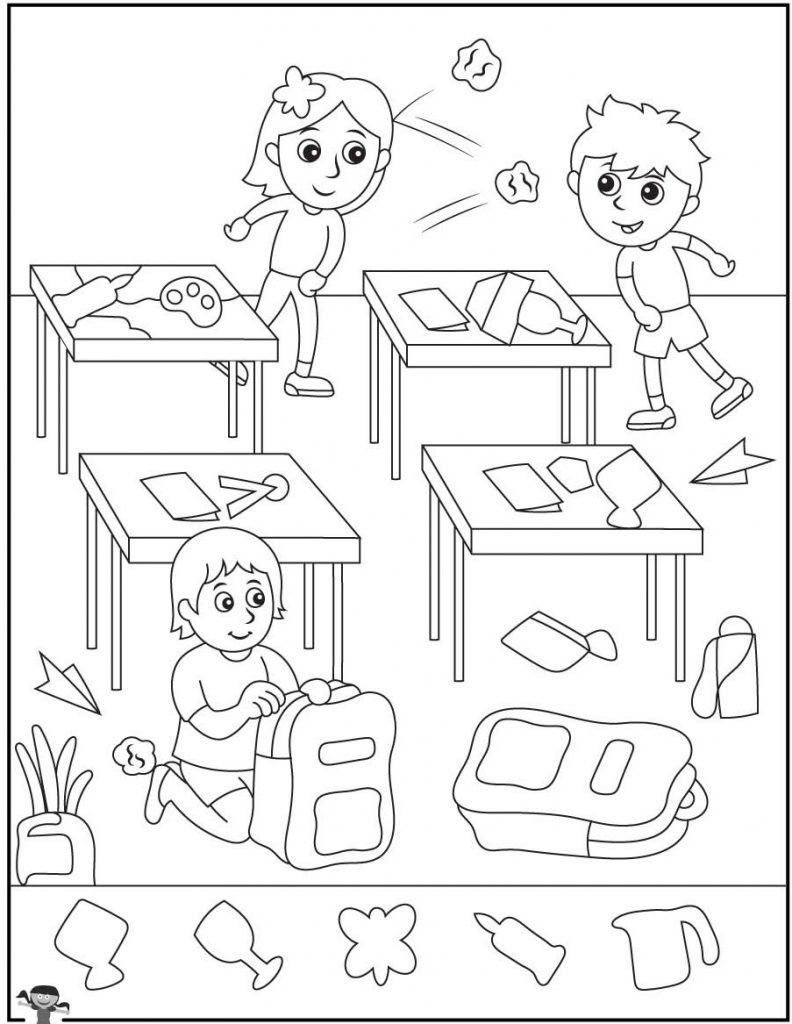
At first glance, this illustration shows a typical school day. Children stand beside their desks. Papers, art supplies, and backpacks are scattered around. One child kneels on the floor organizing a school bag. Another appears to toss a crumpled paper across the room. Desks hold notebooks, paint palettes, and classroom materials.
It looks simple.
But look closer.
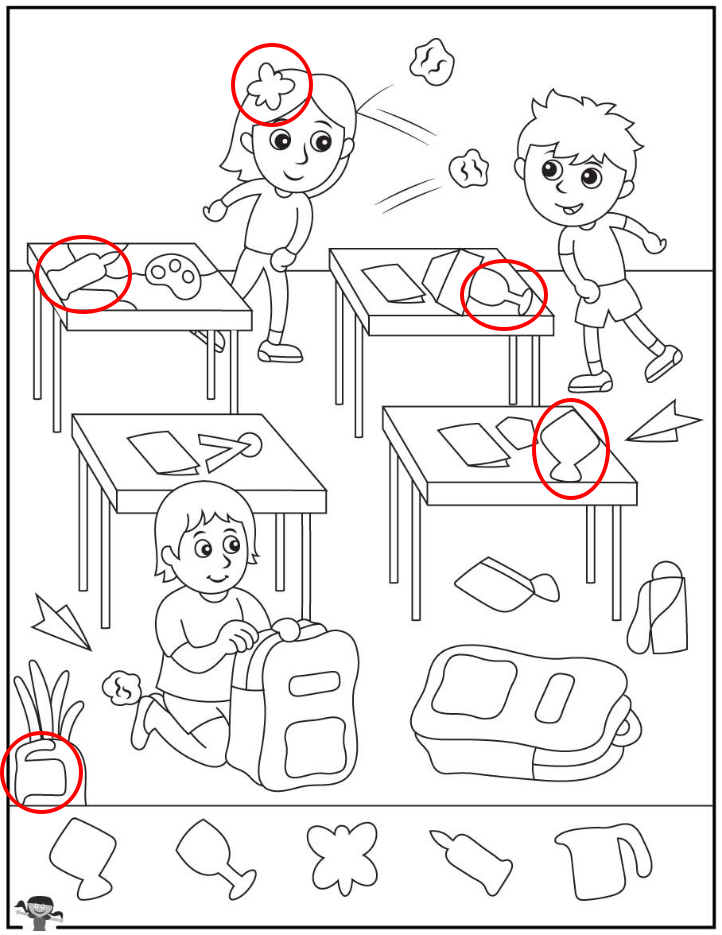
Hidden within this classroom scene are several cleverly disguised objects waiting to be found. The challenge invites children to search carefully, compare shapes, and notice small details they might otherwise overlook.
Let’s explore why classroom-themed hidden object puzzles are such powerful learning tools.
Why Classroom Hidden Object Games Keep Kids Engaged
Children relate instantly to classroom environments. Desks, backpacks, papers, and art supplies feel familiar. When learning materials reflect real-life settings, kids engage more naturally.
This puzzle transforms a normal school scene into an interactive mission.
Instead of just observing the illustration, children ask themselves:
Where is that hidden shape?
Does this object match the outline below?
Is that paper really just paper—or something more?
That shift from passive viewing to active searching makes all the difference.
Familiar surroundings create comfort, while hidden objects create challenge. Together, they build focus without frustration.
How Hidden Object Puzzles Improve Cognitive Development
Hidden object activities strengthen essential thinking skills that children use in school every day.
When kids search for specific shapes in a busy scene, they activate:
Visual scanning skills
Attention to detail
Spatial awareness
Memory recall
Problem-solving strategies
For example, if they’re searching for a flower-shaped object, they must compare that outline with various shapes in the room—perhaps a crumpled paper ball, a design on clothing, or a decorative element.
This mental comparison builds analytical thinking.
Instead of guessing randomly, children begin using strategies. They search from left to right. They scan top to bottom. They divide the page into sections.
These habits improve reading comprehension and math accuracy later on.
The Power of Observation in Academic Success
Observation plays a major role in classroom performance.
Students who notice small details in reading passages answer comprehension questions more accurately. Children who carefully observe math problems avoid careless mistakes. Even science experiments require attention to subtle changes.
Hidden object puzzles train the brain to slow down and observe carefully.
In this classroom scene, multiple desks create layered visual distractions. Papers overlap. Supplies scatter. Shapes partially hide behind furniture.
The brain must filter noise and identify meaningful outlines.
That skill transfers directly to academic tasks.
Encouraging Patience and Perseverance
Not every hidden object reveals itself immediately.
Children may struggle at first. They may scan the same area repeatedly. They might feel unsure.
But when they finally find the hidden shape, the sense of accomplishment feels real.
That “aha” moment builds confidence.
It teaches an important lesson: persistence pays off.
In a world where instant answers are common, puzzles like this encourage delayed gratification. Children learn to stick with a challenge instead of giving up quickly.
Why School-Themed Activities Work So Well
Using a classroom setting adds another layer of educational value.
The environment reinforces positive associations with learning. Instead of separating fun from schoolwork, the puzzle blends them together.
A child organizing a backpack suggests responsibility. Desks with notebooks reflect creativity and productivity. Art supplies encourage imagination.
The setting communicates that learning itself can be playful.
That message matters.
When children view school as a place of exploration rather than pressure, their engagement increases naturally.
Visual Simplicity Supports Skill Development
The clean black-and-white line art makes this puzzle especially effective for younger learners.
Without distracting colors, children focus purely on shape and outline.
This strengthens visual discrimination skills—an early literacy foundation. Recognizing shapes and distinguishing subtle differences prepares children for letter recognition and handwriting development.
After completing the hidden object challenge, the same page can double as a coloring activity, extending the learning experience even further.
Coloring reinforces fine motor skills and creativity while maintaining focus on the details already explored.
Collaborative Learning Through Puzzle Solving
Hidden object puzzles work beautifully in group settings.
Teachers can project the image and guide students together. Parents can search alongside their children. Siblings can compete or cooperate.
Collaborative searching builds communication skills.
“Check under the desk.”
“Look near the backpack.”
“I think I see part of it!”
These interactions strengthen teamwork and language development.
When children explain where they found an object, they practice descriptive vocabulary and spatial awareness terms like “behind,” “under,” and “next to.”
Encouraging Creative Thinking
Sometimes hidden objects are rotated or partially obscured. Children must imagine what the shape looks like from different angles.
This flexibility builds creative thinking.
Instead of seeing a shape in only one orientation, they learn to recognize it in new forms.
That adaptability benefits art projects, geometry understanding, and problem-solving across subjects.
Why Screen-Free Activities Still Matter
In today’s digital world, many children consume fast-moving content. Hidden object puzzles provide a slower, more mindful alternative.
There are no flashing animations. No sound effects. No instant feedback.
Just quiet concentration.
This calm engagement supports emotional regulation and sustained attention—two skills increasingly important in modern classrooms.
Conclusion
This classroom hidden object puzzle transforms an ordinary school scene into a powerful learning experience. By inviting children to search carefully among desks, papers, backpacks, and art supplies, it strengthens focus, patience, and visual discrimination skills.
As young learners hunt for hidden shapes within the busy classroom environment, they build essential cognitive habits that support reading, math, and problem-solving success.
More importantly, they discover that learning can feel like play.
In a world full of distractions, the ability to slow down and truly observe is a skill worth developing.
So take a closer look at those desks and scattered papers.
Something unexpected might be hiding in plain sight—waiting for sharp eyes to find it.