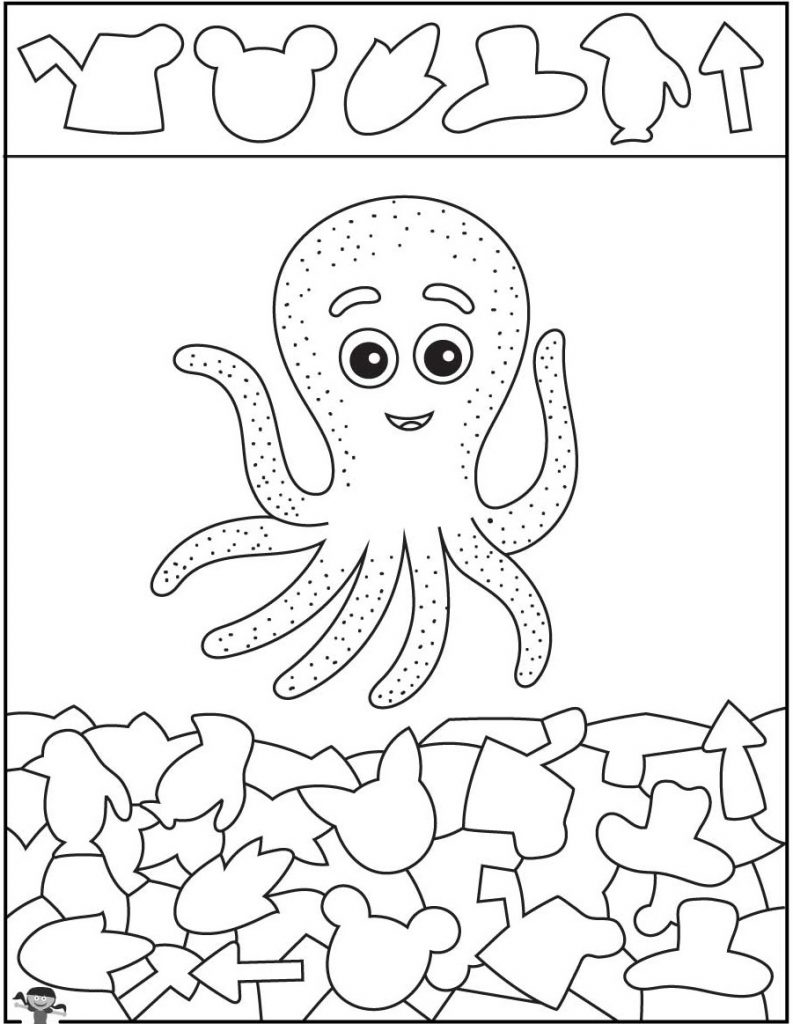
At first glance, it looks simple. A smiling octopus floats cheerfully in the center of the page. Below it lies a pile of mixed silhouettes—arrows, hats, animal shapes, and abstract outlines. At the top, a row of specific shapes appears as your guide.
Your mission?
Find those exact shapes hidden within the messy pile below.
Sounds easy, right?
Take another look.
This clever octopus-themed hidden shape puzzle is more than a cute coloring page. It’s a powerful visual brain teaser designed to test observation skills, focus, and pattern recognition. And once you start searching, you’ll quickly realize it’s much trickier than it seems.
Why Hidden Shape Puzzles Are So Addictive
There’s something incredibly satisfying about spotting a hidden object before anyone else. Your brain lights up when you recognize a familiar shape buried in visual chaos.
Hidden object puzzles work because they activate your brain’s pattern-recognition system. We’re wired to detect familiar outlines quickly—faces in clouds, animals in shadows, symbols in random textures.
But here’s the twist: when too many shapes overlap, your brain struggles to isolate them.
That’s exactly what this octopus puzzle does. It floods your vision with similar outlines, forcing you to slow down and look carefully.
The Octopus Design: Simple, Friendly, and Clever
The smiling octopus at the center creates a calm and playful mood. Its rounded head, wide eyes, and curved tentacles make the page inviting rather than overwhelming.
But don’t let that friendly expression fool you.
The real challenge sits beneath it—a dense pile of overlapping shapes that includes hats, arrows, animal-like outlines, and abstract forms.
At the top of the page, you see the target shapes clearly displayed. They act as your checklist. Your job is to locate those exact silhouettes in the crowded cluster below.
The simplicity of the line art makes the puzzle even more challenging. Without colors or shading to guide you, your brain must rely entirely on contour recognition.
Why Your Brain Gets Tricked
When you first look at the bottom pile, your mind sees chaos. Too many shapes. Too many edges. Too much overlap.
Your brain prefers clean patterns. When it sees clutter, it tries to simplify the image into one large mass instead of individual pieces.
This phenomenon is known as visual grouping. Your brain clusters similar lines together rather than separating them.
That’s why you might stare at the image for several seconds without noticing anything specific.
The solution? Break the image into sections. Focus on small areas at a time instead of scanning the entire pile.
How This Puzzle Strengthens Cognitive Skills
This isn’t just a fun distraction. Hidden shape puzzles like this one actively train important mental skills.
They improve:
Visual discrimination
Selective attention
Spatial awareness
Pattern recognition
Cognitive flexibility
When you search for an arrow shape, your brain isolates straight lines and pointed ends. When you look for a rounded hat outline, it shifts to curved contours.
Each time you change your search focus, you strengthen your brain’s ability to adapt.
It’s like giving your mind a workout without even realizing it.
Why Black-and-White Line Art Makes It Harder
You might assume colorful puzzles are more difficult. Surprisingly, black-and-white illustrations often create greater challenges.
Why?
Because without color contrast, every line has equal visual weight. Nothing stands out automatically.
Your brain must analyze pure shape and form.
That’s why this octopus puzzle feels deceptively tricky. Every silhouette blends into the next. There’s no shading to separate layers.
It’s all about edges.
Tips to Find the Hidden Shapes Faster
If you’re stuck, try these simple strategies:
Cover part of the image with your hand and focus on one small section.
Rotate the page slightly to change perspective.
Trace the outline of the target shape with your finger before searching.
Look for distinctive corners or curves rather than full shapes.
Search for partial matches first, then complete the outline mentally.
Often, the shape is visible but your brain hasn’t “connected the dots” yet.
Shift your perspective, and suddenly it appears.
Why Kids and Adults Both Love Visual Brain Teasers
What makes this octopus puzzle special is its universal appeal.
Children enjoy it because the character feels friendly and playful. Adults enjoy it because it challenges focus and attention.
In a world full of constant scrolling and fast content, puzzles like this encourage slow thinking.
They make you pause.
They make you look carefully.
They make you engage instead of passively consume.
And that’s rare.
The Emotional Reward of Finding the Last Shape
The final shape is always the hardest.
You find one. Then another. Then a third.
But the last one? It hides perfectly.
When you finally spot it, there’s a burst of satisfaction. It feels like solving a mini mystery.
Your brain releases dopamine—a small reward chemical that reinforces the success.
That positive reinforcement is why hidden object puzzles are so shareable and engaging. People want others to experience that same “aha” moment.
Why This Puzzle Works So Well Online
Visual brain teasers perform incredibly well on digital platforms because they’re:
Quick to understand
Safe and family-friendly
Visually engaging
Highly interactive
People naturally comment things like:
“I found them all!”
“The arrow was the hardest!”
“I didn’t see the hat at first!”
That interaction boosts engagement and encourages sharing.
And because the design is clean and appropriate for all ages, it aligns perfectly with major content platform guidelines.
Conclusion
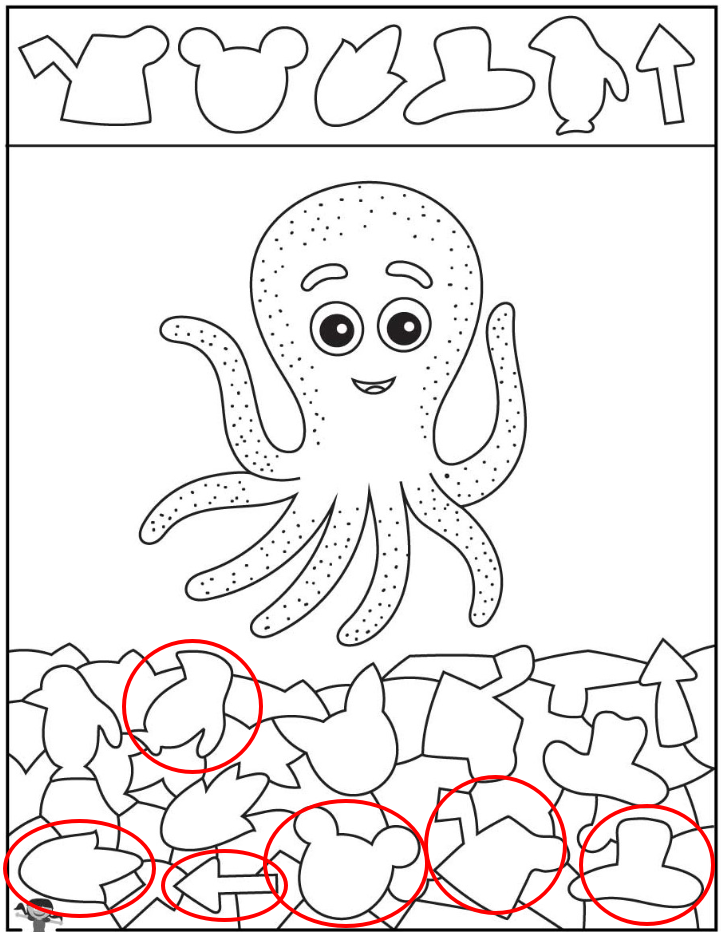
This cheerful octopus hidden shape puzzle transforms simple line art into a powerful visual challenge. By asking viewers to locate specific silhouettes within a cluttered pile, it forces the brain to slow down and focus on details.
The difficulty doesn’t come from complexity—it comes from perception. When shapes overlap and blend together, our brains group them instead of separating them.
But with patience and strategy, every hidden shape becomes visible.
The key is to shift from scanning casually to analyzing intentionally.
So take another look at the pile beneath the smiling octopus. Focus on outlines, angles, and curves.
The shapes are there.
You just have to see them.