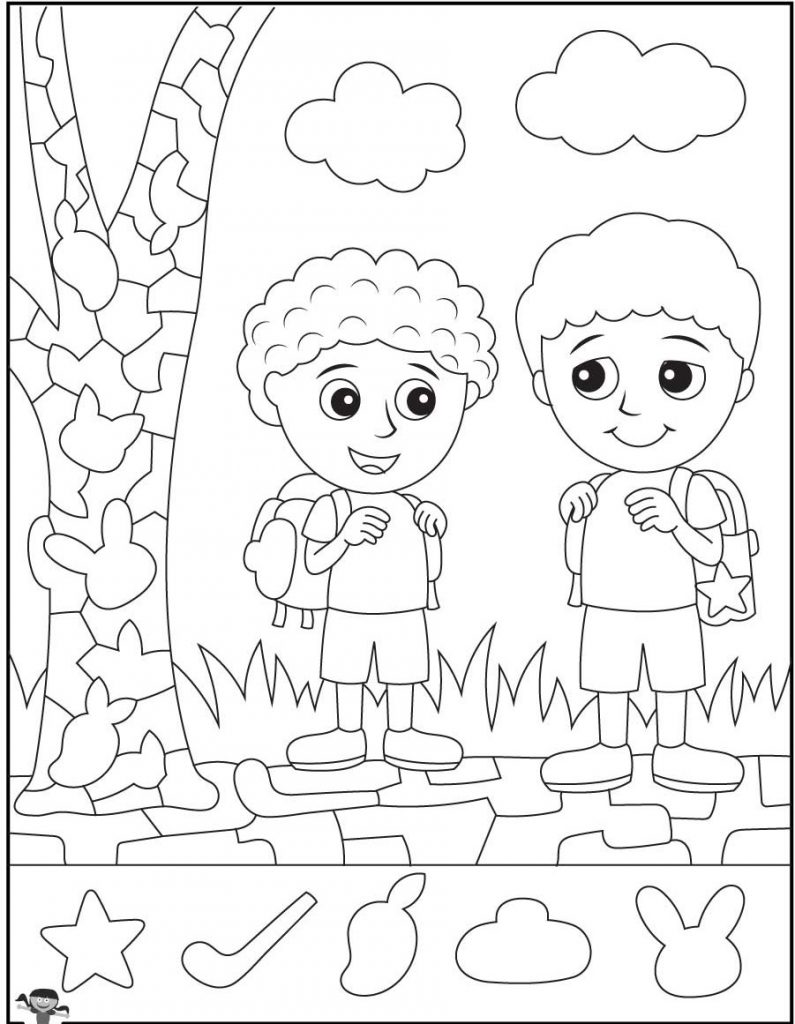
At first glance, this black and white illustration looks simple and sweet. Two cheerful boys stand outdoors with backpacks on, smiling at each other beneath fluffy clouds. A large tree with patterned bark frames the left side of the image. Grass grows at their feet, and stepping stones form a playful path beneath them.
It feels like a classic children’s coloring page.
But look closer.
At the bottom of the image, you will find five shapes: a star, a curved stick, a mango, a cloud, and a bunny head. These are not just decorative icons. They are hidden inside the scene.
This is more than a coloring page. It is a hidden object puzzle for kids designed to sharpen observation skills while keeping things fun.
Why hidden object puzzles for kids boost brain power
You might think this activity is just for entertainment. In reality, hidden picture puzzles play a major role in cognitive development.
When a child searches for a hidden star or bunny shape inside a tree trunk or cloud outline, multiple areas of the brain activate at once. Visual discrimination, attention to detail, pattern recognition, and problem solving skills work together.
Instead of passively looking, kids scan, compare, and analyze.
That mental workout strengthens focus and concentration. And the best part is that it feels like play, not homework.
A simple outdoor scene with clever visual camouflage
The beauty of this illustration lies in its simplicity.
Two boys stand under clouds. They wear shorts, backpacks, and big smiles. The background is minimal with grass, stepping stones, and a textured tree trunk.
But that simplicity creates the perfect hiding ground.
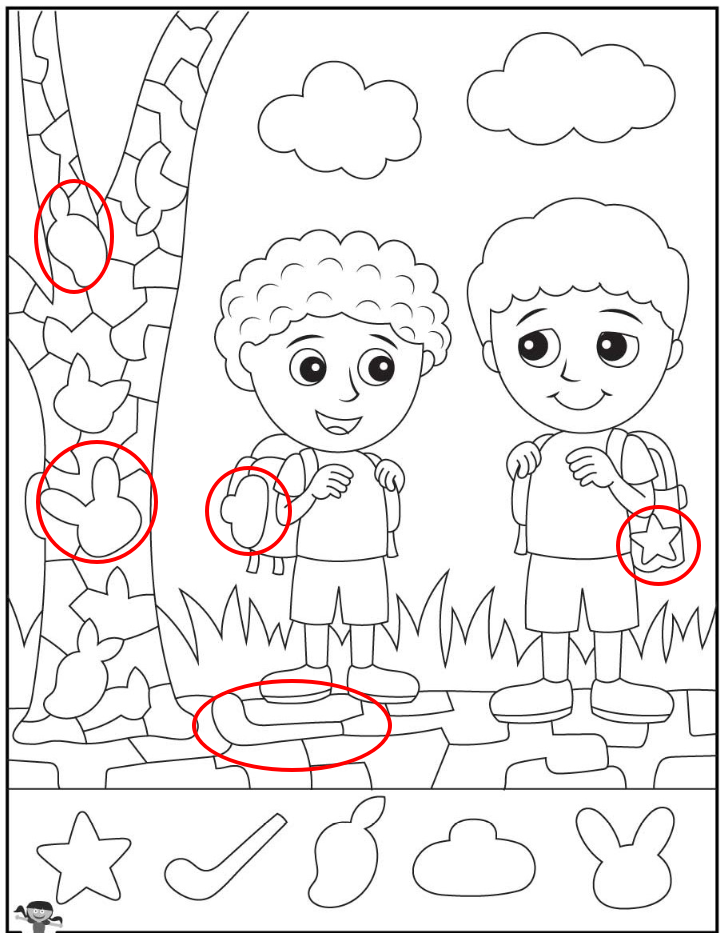
The star might blend into the leaves or tree bark pattern.
The curved stick could disguise itself among the stepping stones.
The mango shape may hide within the contours of the tree.
The cloud shape might overlap with the actual clouds above.
The bunny head could cleverly merge with natural shapes in the bark.
Because the entire drawing uses consistent line art without color, nothing stands out. Children must rely on shape recognition rather than color contrast.
That makes the puzzle both fair and challenging.
Why black and white coloring pages increase engagement
Coloring pages often get dismissed as quiet time activities. But when you combine a coloring sheet with a hidden object challenge, engagement multiplies.
First, kids search for the hidden objects. That activates focus and curiosity.
Then, they color the page. That encourages creativity and fine motor skill development.
It becomes a two layer experience.
The act of searching slows children down. They study each section carefully. They trace outlines with their eyes. They double check shapes.
Then coloring allows them to personalize the scene. Maybe the sky becomes bright blue. Maybe the tree bark turns brown and green. Maybe the backpacks become bold and colorful.
This combination of logic and creativity makes hidden object coloring pages highly effective educational tools.
The power of visual learning activities
Visual learning activities work because children process images faster than text. A hidden picture puzzle speaks directly to how young brains absorb information.
When kids look for a bunny shape, they are not just finding it. They are comparing proportions. They are mentally rotating shapes. They are evaluating curves and edges.
It is like solving a mini visual riddle.
Every time they find one of the objects, they experience a small victory. That reward system keeps them motivated to continue searching.
Think of it like a treasure hunt. Each hidden object becomes a clue. Each discovery builds excitement.
Why outdoor themed puzzles feel relatable
This image uses an outdoor school day theme. Two boys with backpacks suggest friendship, school adventures, or a walk through nature.
That familiarity matters.
Children connect more easily to scenes they recognize. They see themselves in the illustration. They imagine walking on stepping stones. They imagine talking with a friend beneath the clouds.
When a puzzle feels relatable, engagement increases naturally.
Instead of staring at random shapes, kids feel like they are exploring a story.
How parents and teachers can use this puzzle
Hidden object puzzles like this one fit perfectly into classrooms and homes.
Teachers can use them during quiet time to strengthen observation skills.
Parents can print them for after school activities.
Homeschoolers can combine them with lessons about shapes or nature.
You can even turn it into a group challenge.
Who can find the star first?
Who spots the bunny head fastest?
Can anyone find all five shapes without help?
Adding a playful time element increases excitement.
Because the illustration is clean and age appropriate, it works well for educational settings and family friendly environments.
Encouraging focus in a digital world
Today’s kids face constant digital stimulation. Bright screens. Fast animations. Quick scrolling.
Activities like hidden object puzzles slow everything down.
They teach patience.
They teach careful observation.
They encourage children to sit with an image instead of rushing past it.
That skill matters more than ever.
When kids practice slowing down visually, they build attention endurance. That helps in reading, math, and problem solving across subjects.
The emotional benefit of completing the puzzle
There is something deeply satisfying about finding the last hidden object.
At first, the image feels overwhelming. The tree bark looks busy. The clouds seem repetitive. The stepping stones blur together.
Then suddenly, you spot it.
The hidden shape was there the entire time.
That moment of realization builds confidence. It tells a child that careful effort leads to success.
That mindset carries into other challenges.
Conclusion
This charming outdoor hidden object puzzle proves that simple illustrations can create meaningful learning experiences. Two smiling boys, a textured tree, and fluffy clouds form more than just a coloring page. They create an interactive challenge.
By hiding a star, curved stick, mango, cloud, and bunny shape within the scene, the illustration encourages children to slow down, observe carefully, and think critically. It strengthens attention to detail while sparking creativity through coloring.
In a world filled with fast moving distractions, activities like this remind us of the value of focus, patience, and curiosity.
Sometimes the most powerful lessons come from the quietest pages.
All you have to do is look closely enough to find them.