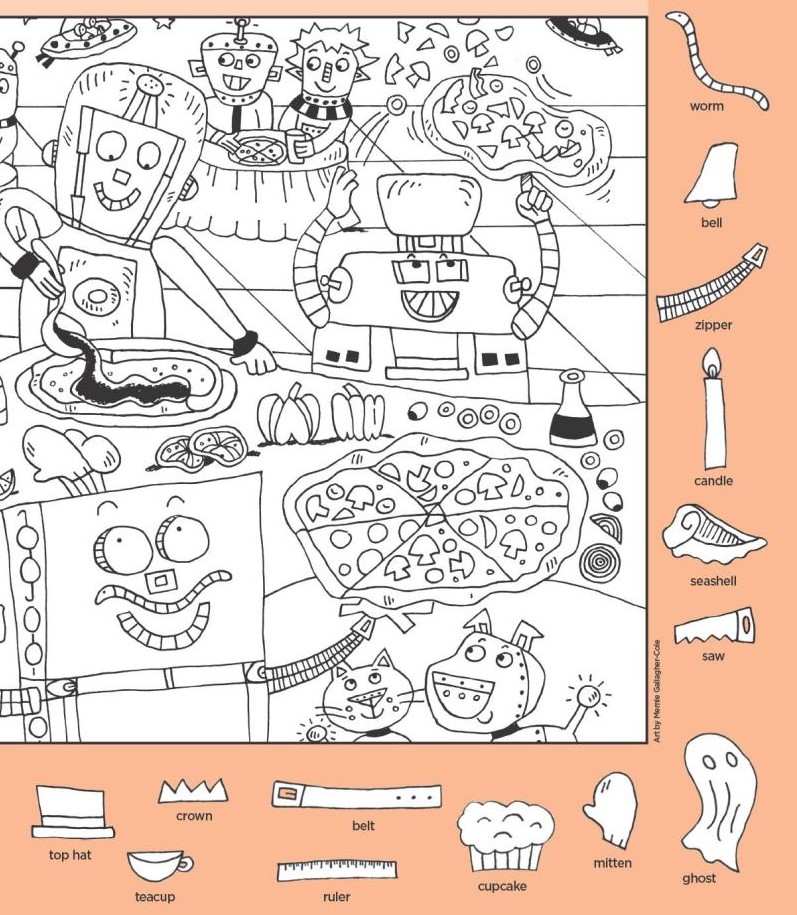
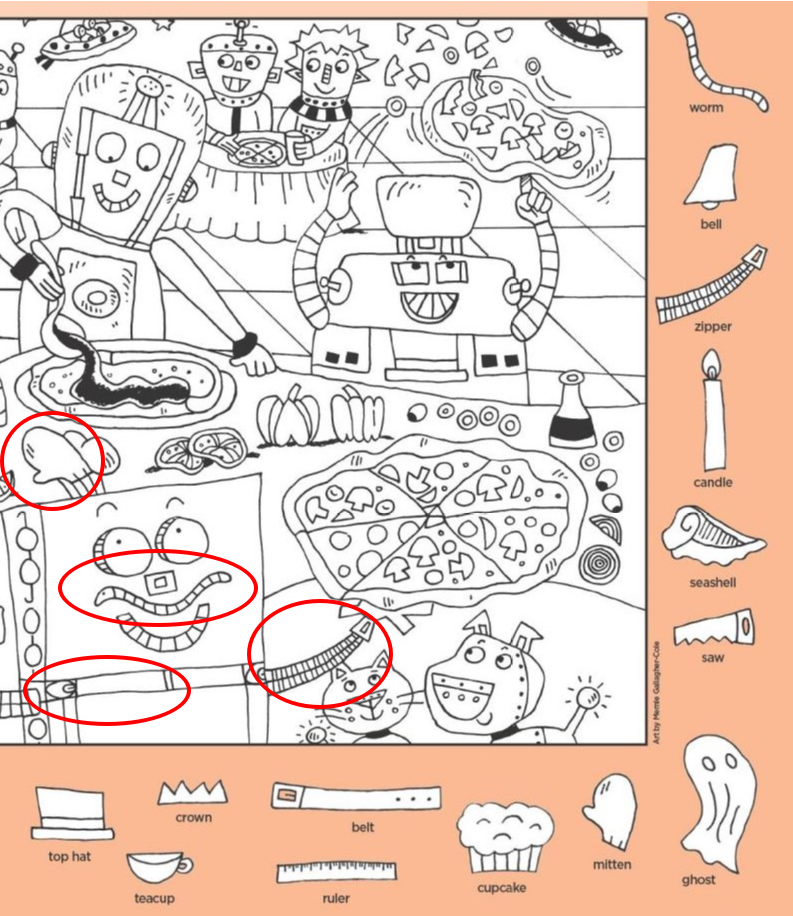
At first glance, this lively black and white illustration looks like a fun cartoon scene. Friendly robots gather around tables covered with pizza slices, drinks, and snacks. One robot waves happily. Another stretches its arms in excitement. A giant pizza sits proudly at the center, loaded with toppings. The atmosphere feels playful, energetic, and slightly chaotic in the best possible way.
But this is not just a robot pizza party.
This is a hidden object puzzle designed to test your observation skills, challenge your concentration, and transform a simple drawing into a brain boosting adventure.
Along the sides and bottom of the image, a collection of objects appears. A worm. A bell. A zipper. A candle. A seashell. A saw. A crown. A belt. A teacup. A ruler. A cupcake. A mitten. A ghost. A top hat. These shapes are cleverly hidden inside the busy robot scene.
Your mission is not to scroll for answers. Your mission is to hunt.
Why Hidden Object Puzzles Are So Addictive
Have you ever wondered why search and find games are so satisfying?
The answer is simple. They turn passive viewing into active discovery. Instead of simply recognizing robots and pizza, you must examine every line, curve, and corner. Your brain shifts from casual observation to focused investigation.
At first, you see a robot party. Then you notice shapes hiding inside pizza toppings, robot arms, and background decorations. Suddenly, the illustration feels alive with secrets.
That mental switch is what makes hidden object puzzles irresistible.
A Robot Party Packed With Visual Clutter
The scene is intentionally busy. Multiple robots fill the space. One holds a slice of pizza. Another waves its arms. A pizza flies dramatically through the air. Small characters peek from corners. Drinks and snacks crowd the tables.
The artist uses repetition cleverly. Circles appear everywhere in the pizza slices and robot eyes. Straight lines form robot bodies and mechanical arms. Curves twist through cables and toppings.
This repetition creates visual camouflage. When shapes repeat, your brain groups them together automatically. That grouping makes it harder to isolate a specific hidden object.
In other words, the chaos is part of the challenge.
How to Approach This Hidden Object Challenge
Before diving into the clutter, pause.
Study the list of hidden objects carefully. Notice their outlines. The ghost has soft flowing curves. The ruler has straight parallel edges. The crown features pointed tips. The zipper shows small repeating teeth.
Memorize these shapes.
Now return to the main image. Instead of looking for the object itself, look for its silhouette.
This distinction matters. A crown might not appear as a literal crown sitting on a robot’s head. Instead, it could be formed by the jagged edge of a pizza slice or the pattern of toppings.
A zipper might be hidden within mechanical details of a robot arm. A worm could twist subtly through food or cables.
Focus on shapes, not meanings.
Why This Puzzle Is Perfect for Kids and Adults
Children love robots. They love pizza. And they love the thrill of finding something hidden.
This puzzle taps into that excitement while strengthening important cognitive skills. Kids improve visual discrimination as they compare shapes. They build patience by scanning carefully through busy areas. They develop problem solving skills by trying different search strategies.
Adults benefit too.
In a world filled with endless scrolling and constant notifications, focusing deeply on a single image feels refreshing. A hidden object puzzle acts like a mental workout. It sharpens attention and provides a satisfying sense of accomplishment.
Think of it as a gym session for your brain, but far more fun.
The Power of Black and White Line Art
This illustration uses simple black and white line art. That choice makes the puzzle more challenging.
Without color to guide you, you must rely entirely on outlines and contours. Every detail blends seamlessly into the next. A seashell could hide within curved pizza crust lines. A saw might appear in the jagged edge of a mechanical part.
Because there are no color distractions, your focus sharpens naturally. You engage more deeply with the drawing.
Tips to Find Every Hidden Object
If you feel stuck, try these strategies.
Divide the image into sections. Start from the top left corner and move slowly across. Then shift downward row by row.
Cover parts of the picture with your hand to reduce visual overload. Isolating smaller areas makes scanning easier.
Rotate your perspective mentally. Imagine turning the page sideways. Some objects may be hidden at unusual angles.
Take short breaks. When you return with fresh eyes, shapes that once blended in may suddenly stand out.
And most importantly, stay patient. The objects are there. You just need to see them.
Turning Fun Into Focused Learning
This robot pizza party hidden object puzzle does more than entertain. It transforms play into focused learning.
Kids practice attention control. Adults sharpen visual perception. Families can work together, turning the search into a cooperative game. Teachers can use it as a classroom activity that combines fun with cognitive development.
It proves that learning does not have to feel like work. It can feel like a treasure hunt.
The Joy of Discovery
There is a special moment in every hidden object puzzle.
You scan and scan. You start to doubt yourself. Then suddenly, your eyes lock onto the exact outline you have been searching for.
It feels obvious once you see it.
That spark of recognition is what makes these puzzles so rewarding. It reminds you that careful observation pays off.
In this energetic robot scene, that moment feels even more satisfying because the image looks so overwhelming at first glance.
Conclusion
This robot pizza party hidden object puzzle turns a playful cartoon scene into an exciting search and find challenge. Amid flying pizza slices, cheerful robots, and busy tables, cleverly disguised shapes like a ghost, crown, zipper, ruler, and seashell wait to be uncovered.
By focusing on outlines instead of objects, scanning methodically, and practicing patience, you can reveal every hidden item. The experience strengthens concentration, sharpens observation skills, and delivers moments of pure discovery.
Take another careful look at the pizza toppings. Study the robot arms. Examine the background details.
The hidden objects are already there.
Now it is your turn to find them.