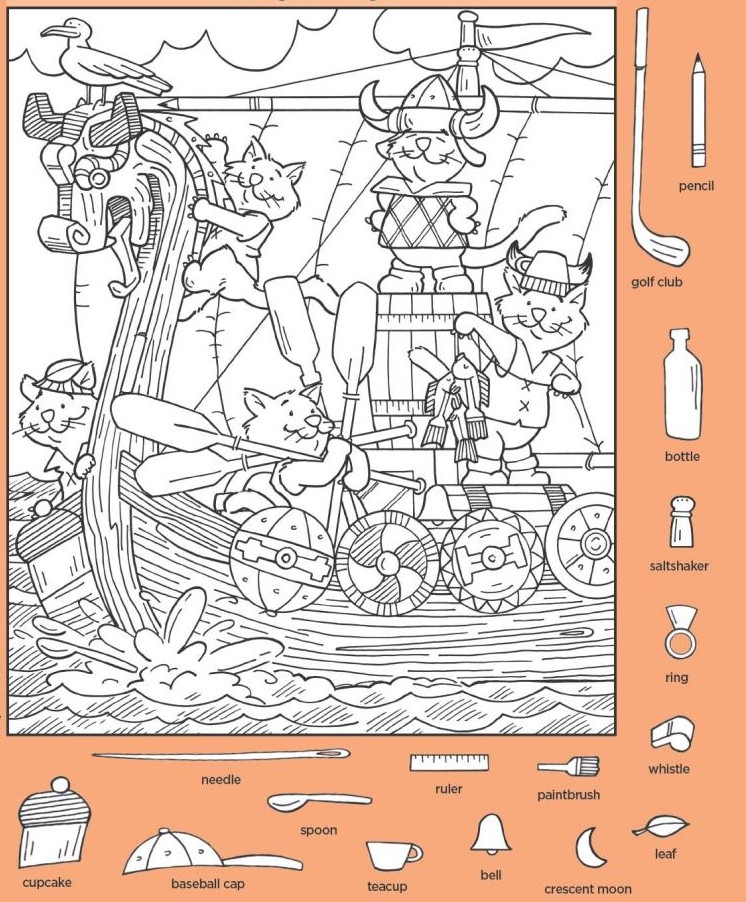
At first glance, this black and white illustration looks like a playful scene from a storybook. A group of adventurous cats sail across the sea in a Viking style ship. One cat beats a drum proudly. Another grips an oar. A third stands tall at the helm wearing a horned helmet. Shields line the side of the boat. Waves splash dramatically against the hull.
It feels like a whimsical pirate tale with feline heroes.
But take a closer look at the border of the image and you will notice something intriguing. Surrounding the scene is a list of everyday objects that do not naturally belong on a Viking ship. A pencil. A golf club. A bottle. A salt shaker. A ring. A whistle. A cupcake. A baseball cap. A teacup. A bell. A crescent moon. A leaf. A needle. A ruler. A paintbrush. A spoon.
This is not just an illustration. It is a hidden object puzzle designed to test your observation skills.
Your mission is simple. Find them all.
Simple rarely means easy.
Why Hidden Object Puzzles Never Lose Their Appeal
Hidden object puzzles continue to captivate readers because they transform a static image into an interactive challenge. Instead of passively admiring the artwork, you become an active participant. You scan. You compare shapes. You question your assumptions.
In this Viking cat ship puzzle, the busy composition creates the perfect environment for visual camouflage. Ropes stretch across the mast. Shields feature intricate patterns. Waves form curved splashes. Helmets and fur add texture and layered outlines.
Every one of these details can conceal something unexpected.
The Psychology of Visual Search and Pattern Recognition
Your brain processes scenes in categories. When you look at this image, you immediately see cats, a ship, shields, oars, and waves. You interpret it as a cohesive Viking adventure.
Hidden object puzzles challenge that instinct.
A pencil does not belong on a medieval ship. A golf club seems out of place. A cupcake feels completely unrelated. That contrast sparks curiosity. If these objects are present, they must be cleverly disguised.
Your brain shifts from storytelling mode to detective mode.
You begin examining the curves of the waves. You analyze the straight lines of the mast. You inspect the round shapes of shields. You mentally match each hidden object icon with possible shapes in the illustration.
That mental effort increases engagement.
How the Viking Theme Elevates the Challenge
The Viking ship setting provides natural camouflage. The shields resemble circular objects, making it easy to hide a ring or a bottle shape within them. The oars and ropes create straight and curved lines that can disguise a ruler or a golf club.
A crescent moon might hide within a wave’s curve. A baseball cap could blend into a helmet. A spoon may align with the shape of an oar handle. A teacup could hide within decorative patterns.
Because the entire illustration uses consistent line weight and monochrome shading, no object stands out through color. You must rely solely on shape and outline.
That increases the difficulty while keeping the puzzle fair.
Why This Puzzle Appeals to All Ages
The cartoon style feels friendly and humorous. The cats have expressive faces and exaggerated poses. The scene suggests adventure without danger.
Children enjoy the playful Viking theme and the challenge of spotting familiar shapes. Adults appreciate the clever disguises and the satisfaction of finding subtle details.
Families can turn the puzzle into a group activity by dividing the object list and competing to see who finishes first.
This broad appeal makes hidden object puzzles ideal for family friendly entertainment platforms.
The Engagement Power of Interactive Visual Content
From a digital perspective, hidden object puzzles naturally increase time spent on a page. Readers cannot skim quickly. They must slow down and examine details.
They scroll back and forth between the object list and the illustration. They double check areas they thought were clear. They reexamine shapes from different angles.
This focused engagement enhances user experience. Instead of consuming content passively, readers feel involved and challenged.
Content that encourages active participation builds stronger connections with audiences.
Why Camouflage Works So Effectively in Busy Scenes
Camouflage thrives in complexity. The more lines and shapes an image contains, the easier it becomes to hide additional forms within it.
In this Viking cat ship puzzle, overlapping ropes, shields, fur textures, and wave patterns create countless hiding spots. A paintbrush might merge with an oar. A whistle could disguise itself among decorative carvings. A leaf might blend into water splashes.
Your brain initially accepts these shapes as part of the environment.
To succeed, you must challenge that assumption and examine each detail carefully.
The Satisfaction of Finding the Final Object
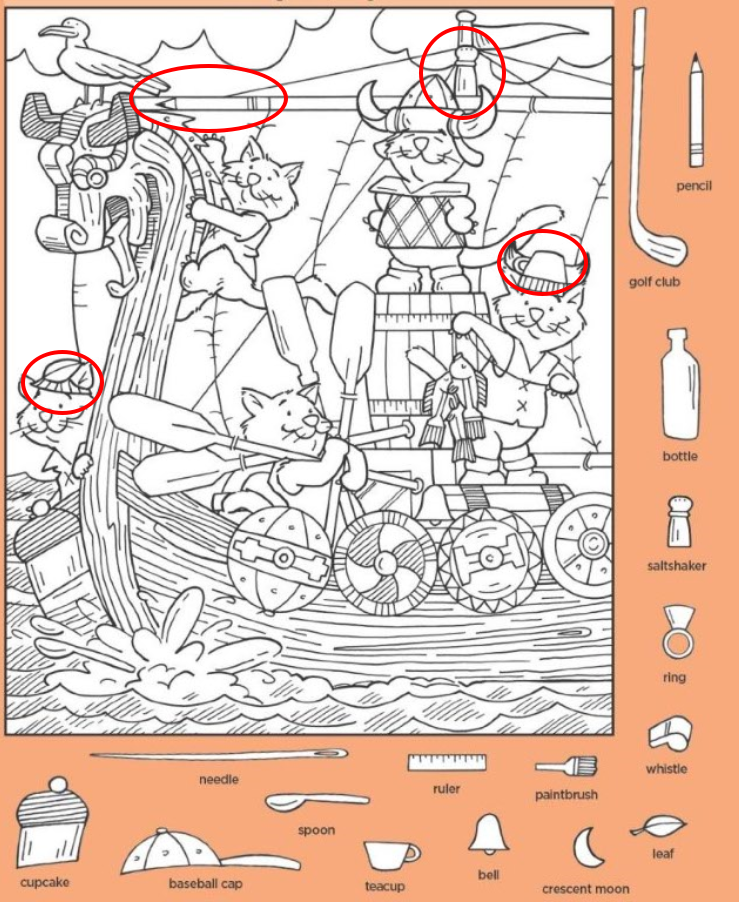
As you work through the hidden object list, each discovery creates a small moment of achievement. You spot the needle hidden in plain sight. You recognize the bell disguised among patterns. You finally identify the elusive cupcake.
When you locate the final object, the sense of accomplishment feels earned.
You sharpened your focus. You resisted distraction. You solved the visual riddle.
In a world filled with fast moving content, that steady concentration feels refreshing.
Conclusion
This Viking cat ship hidden object puzzle proves that compelling visual content does not require flashy colors or dramatic effects. It relies on thoughtful design and an understanding of how the human brain interprets shapes.
By blending a whimsical seafaring adventure with cleverly concealed everyday items, the illustration transforms into an interactive challenge. It invites viewers of all ages to slow down, observe carefully, and enjoy the thrill of discovery.
You begin with curiosity. You continue with concentration. You finish with satisfaction.
And along the way, you discover that sometimes the most exciting treasures are not buried beneath the waves. They are hidden quietly within the details, waiting for you to truly look.