If you love brain teasers, outdoor adventures, and clever hidden object games, this “Moose Tracks” puzzle scene delivers all three in one delightful illustration. At first glance, it looks like a peaceful woodland moment: two children explore nature while a curious moose watches from behind the trees. A playful dog sniffs the ground. Leaves scatter across a forest path. Everything feels calm and storybook-perfect.
But look closer.
Hidden within this charming nature scene are everyday objects cleverly disguised among branches, leaves, and animal shapes. Your challenge? Find them all.
Let’s explore why this woodland hidden object puzzle is more than just a coloring page—it’s a powerful brain-boosting activity wrapped in outdoor adventure.
Why Hidden Object Puzzles Are Perfect for Kids and Families
Hidden object puzzles engage the brain in a way few activities can. They turn passive viewing into active searching. Instead of simply looking at a drawing, you analyze it. You compare shapes. You scan details. You slow down.
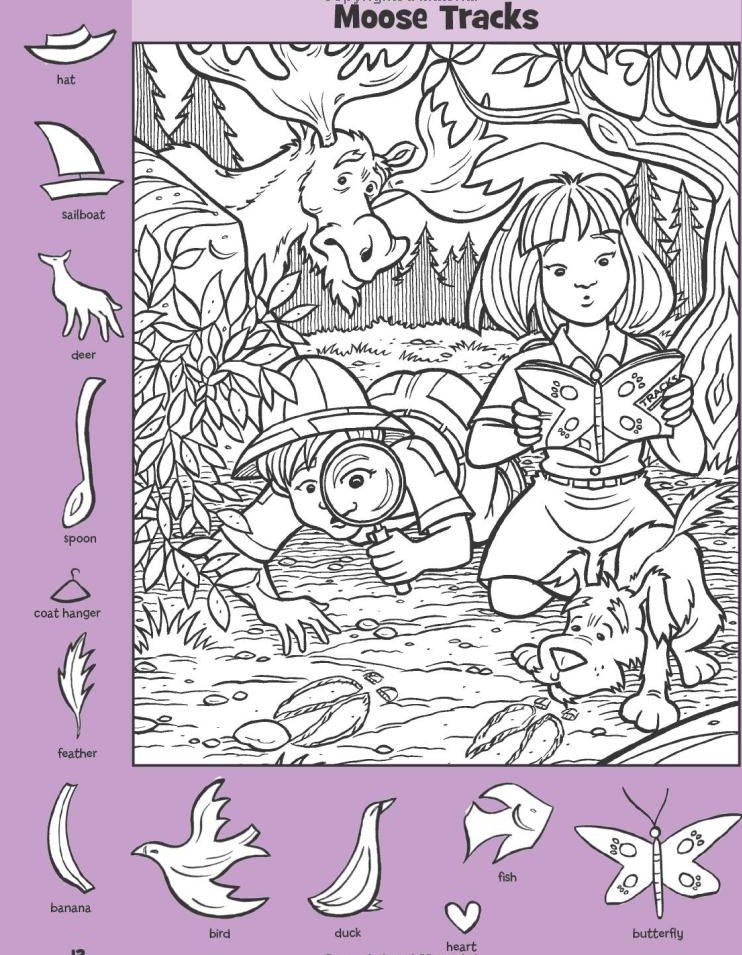
In this “Moose Tracks” scene, children kneel by a forest trail examining footprints. One child uses a magnifying glass to study the ground, while another reads a book titled “Tracks.” The theme centers around discovery and curiosity.
And that’s exactly what the viewer experiences too.
You’re not just looking at a forest illustration. You’re investigating it.
This type of visual puzzle strengthens attention span, pattern recognition, and visual discrimination skills. For kids especially, it builds early problem-solving habits in a fun, pressure-free way.
The Outdoor Woodland Setting Sparks Imagination
The forest scene sets the tone immediately. Tall trees stretch overhead. Branches twist naturally. Leaves overlap in intricate patterns. In the background, a moose peeks out between trunks, adding both humor and excitement.
Nature provides the perfect camouflage for hidden shapes.
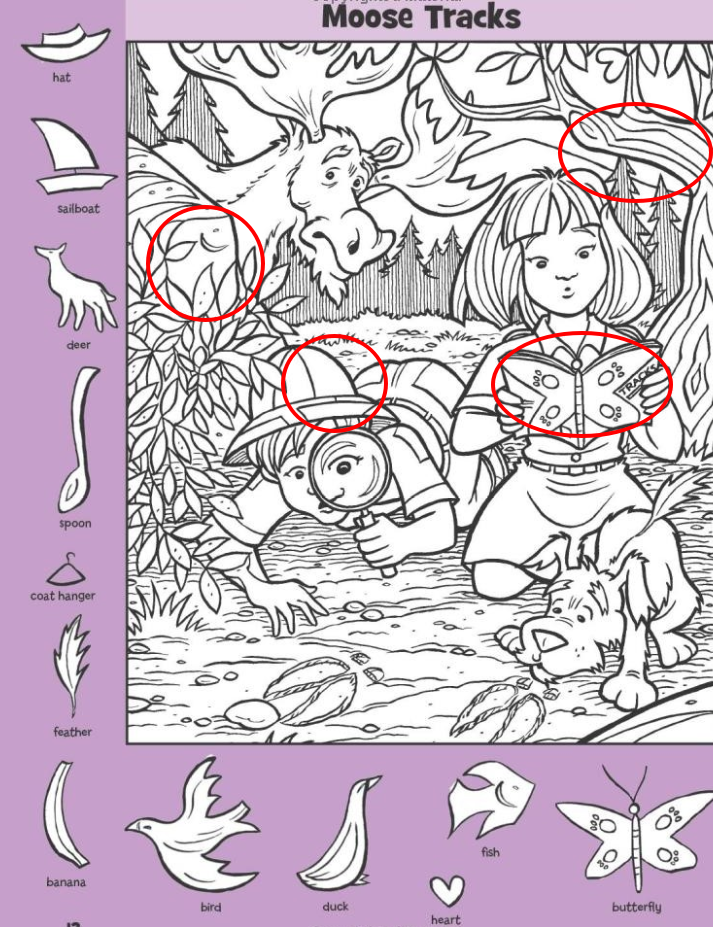
A curved branch might form a spoon.
A cluster of leaves might hide a butterfly outline.
A tree limb might resemble a coat hanger.
The organic shapes of the forest make every object harder to spot, which increases the challenge and keeps you engaged longer.
This clever use of environment makes the puzzle feel immersive rather than artificial.
Educational Benefits of Nature-Themed Brain Teasers
This image combines two powerful learning tools: nature exploration and cognitive training.
When children see animal tracks, wildlife, and forest plants, they begin connecting the activity to real-world experiences. It encourages curiosity about ecosystems, wildlife identification, and outdoor adventures.
At the same time, the hidden object challenge improves:
Visual scanning speed
Detail awareness
Memory recall
Shape recognition
The child using a magnifying glass in the illustration mirrors the viewer’s role. You become the investigator.
That subtle design choice makes the puzzle more engaging. It feels interactive, almost like you’re stepping into the story.
How Hidden Objects Boost Focus and Patience
In today’s fast-paced digital world, attention spans shrink quickly. Hidden object games help counter that trend.
You can’t rush this puzzle.
You must examine branches carefully. You must follow lines slowly. You must question what you see.
Is that curve a feather—or just a leaf vein?
Is that shape a bird—or part of the tree bark?
This deliberate observation builds patience. It teaches the brain to pause before jumping to conclusions.
And that skill extends beyond puzzles. It helps in reading, studying, and everyday decision-making.
Why the “Moose Tracks” Theme Works So Well
The title itself sparks curiosity. “Moose Tracks” suggests tracking wildlife, following clues, and exploring the wilderness. That theme aligns perfectly with hidden object gameplay.
The moose adds a friendly presence rather than a threatening one. The dog adds movement and energy. The children represent curiosity and teamwork.
Together, they create a wholesome, family-friendly atmosphere.
Parents appreciate puzzles that feel safe and educational. Teachers value activities that build cognitive skills. Kids enjoy the challenge without feeling like they’re doing homework.
That balance makes this type of content highly shareable and engaging.
Hidden Object Lists Increase Replay Value
On the left and bottom sides of the image, a list of items appears—objects like a hat, sailboat, deer, spoon, coat hanger, feather, banana, bird, duck, fish, heart, and butterfly.
This list transforms the image from artwork into a mission.
Instead of asking, “What do I see?” you ask, “Where is it?”
That shift changes everything.
The more objects listed, the longer viewers spend examining the image. And the longer someone engages with content, the more satisfying the experience becomes.
Each discovered object feels like a small victory.
Encouraging Screen-Free Entertainment
Printable hidden object puzzles offer an alternative to passive screen time. They encourage quiet concentration and creativity. Children can color the scene after completing the challenge, extending the activity even further.
Unlike many digital games, this type of puzzle doesn’t rely on flashing lights or rapid rewards. It rewards patience and persistence instead.
And that’s refreshing.
You don’t need complicated rules. You just need your eyes and your focus.
Building Problem-Solving Skills Through Play
When a child struggles to find an object, they naturally adjust their strategy. They might:
Look at the image upside down.
Cover parts of the page to reduce distraction.
Search one quadrant at a time.
These self-created strategies build independent thinking.
The puzzle doesn’t tell you how to solve it. It invites experimentation.
That kind of open-ended challenge fosters confidence. Each solution feels earned, not handed over.
The Emotional Connection to Adventure
There’s something timeless about forest exploration. Many of us remember childhood hikes, turning over rocks, following animal footprints, and imagining what creatures might be nearby.
This illustration taps into that nostalgia.
The magnifying glass suggests detective work. The reading child suggests preparation and learning. The moose adds wonder.
It reminds us that curiosity fuels discovery.
And that message resonates with both children and adults.
Conclusion
The “Moose Tracks” hidden object puzzle blends outdoor adventure, cognitive development, and family-friendly fun into one beautifully illustrated scene. By hiding everyday objects within a forest setting, it transforms a simple drawing into an engaging brain challenge.
As you search for shapes like a spoon, feather, butterfly, or heart among branches and leaves, you strengthen focus, patience, and visual perception. The woodland theme sparks imagination, while the investigative atmosphere encourages curiosity and independent problem-solving.
In a world filled with distractions, this type of puzzle reminds us to slow down, look closely, and enjoy the thrill of discovery.
So grab a pencil, sharpen your eyes, and step into the forest.
There’s more hiding in those trees than you think.