At first glance, this lively black and white illustration feels like a playful scene straight out of a children’s storybook. A group of animated birds gathers inside a room with a large window overlooking a city skyline. Outside, an airplane glides through fluffy clouds. Inside, feathers, beaks, and dramatic expressions fill the frame with personality.
But this is not just a charming cartoon.
Surrounding the image is a list of everyday objects you would never expect to find in a room full of birds. A hockey stick. A magician’s wand. A pennant. A ladle. A bell. An elf’s hat. An artist’s brush. An envelope. A ring. A needle. A ruler. A kite. A crescent moon. A piece of popcorn. A crown. And more.
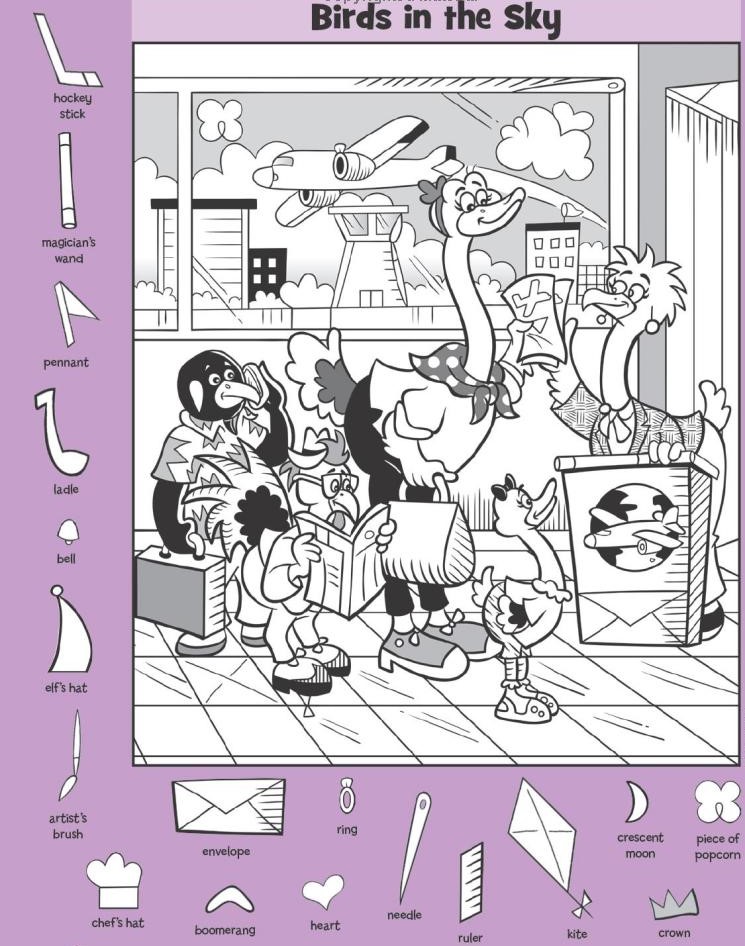
Your mission is simple. Find them all.
Simple rarely means easy.
Why Hidden Object Puzzles Keep People Hooked
Hidden object puzzles work because they shift you from observer to participant. Instead of passively enjoying the illustration, you engage with it. You scan every line. You compare shapes to the object list. You double check corners you thought you understood.
This “Birds in the Sky” puzzle takes that engagement to another level. The environment is already busy. Feathers overlap. Wings curve. Decorative patterns fill clothing and props. The window frame divides the scene into multiple sections.
All of these details create perfect camouflage.
Your brain must decide whether a curved shape belongs to a wing or resembles a boomerang. Whether a pointed angle is part of a beak or hides a kite. Whether a small circle represents an eye or conceals a ring.
The challenge lies in subtlety.
The Psychology Behind Visual Search Games
When you first look at the image, your brain processes it as a whole. You see birds. You see a window. You see buildings and an airplane. Your mind groups these elements into a single story.
Hidden object puzzles disrupt that grouping.
The objects listed around the border do not belong naturally in a bird themed indoor setting. That mismatch sparks curiosity. A hockey stick does not belong near a parrot. A magician’s wand does not fit seamlessly into a window frame. A crescent moon should not hide inside a piece of furniture.
Yet there they are, integrated into the illustration.
Your brain must slow down. Instead of accepting the scene at face value, you analyze shapes individually. You compare outlines. You mentally rotate forms. You ask yourself whether that straight line is just decoration or a ruler in disguise.
This mental shift creates focus.
How the Busy Scene Elevates the Difficulty
The complexity of the setting makes this puzzle particularly challenging. Multiple characters overlap. Clothing features patterns and folds. Objects rest on surfaces at different angles. The city skyline outside the window adds even more visual information.
Each element becomes a potential hiding spot.
A crown might blend into feather tips. A needle could hide along thin lines in the floor. A chef’s hat might resemble part of a cloud. A piece of popcorn could disappear among rounded shapes in the background.
Because everything shares the same monochrome line style, no object stands out with color. You must rely entirely on form recognition.
That increases difficulty while keeping the puzzle fair.
Why This Puzzle Appeals to All Ages
The cartoon style makes this hidden object game approachable. The birds have expressive faces and humorous poses. The setting feels imaginative and safe.
Children enjoy the playful characters and the sense of adventure. Adults appreciate the mental challenge and the satisfaction of spotting well disguised shapes. Families can turn it into a cooperative activity by dividing the object list and racing to complete it.
This universal appeal makes hidden object puzzles ideal for family friendly websites, educational platforms, and casual entertainment blogs.
They entertain without controversy. They challenge without stress.
The Engagement Power of Interactive Visual Content
From a digital publishing perspective, puzzles like this increase time spent on the page. Readers cannot skim through them quickly. They must invest attention.
Instead of scrolling past in seconds, visitors pause. They compare the object list to the image repeatedly. They revisit sections they thought they had already examined.
This extended engagement enhances user experience. People feel mentally involved. They feel rewarded when they succeed.
Content that encourages participation naturally builds stronger connections with readers.
Why Camouflage Works So Effectively Here
Camouflage succeeds in this puzzle because of visual harmony. Every line shares similar thickness. Every object matches the artistic style of the environment. Nothing looks pasted in or out of place.
A magician’s wand might align perfectly with the edge of a window frame. A bell could mimic a decorative curve in clothing. A pennant might resemble a folded corner of fabric.
Your brain initially accepts these shapes as part of the scene’s natural structure.
To solve the puzzle, you must challenge that acceptance.
The Quiet Satisfaction of Completing the List
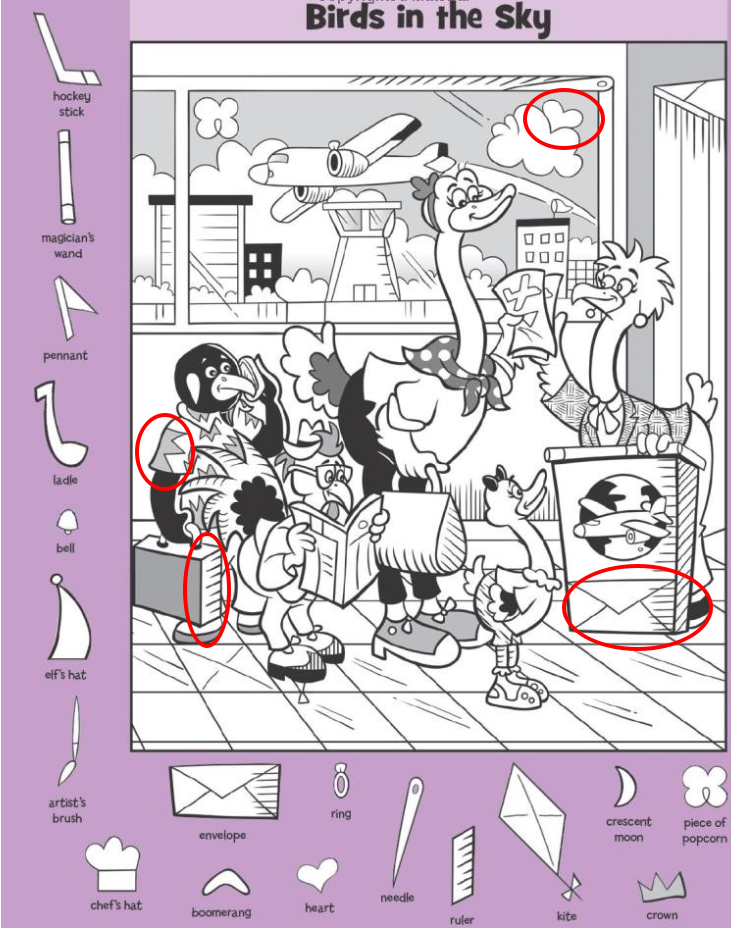
As you work through the hidden object list, each discovery brings a small surge of accomplishment. You spot the envelope tucked into a corner. You recognize the crescent moon hidden in plain sight. You finally identify the elusive ring.
When you locate the final object, the sense of completion feels earned.
You trained your focus. You resisted distraction. You sharpened your observation skills.
In a world filled with rapid content consumption, that kind of mindful engagement feels refreshing.
Conclusion
This “Birds in the Sky” hidden object puzzle proves that powerful visual content does not rely on bright colors or dramatic effects. It thrives on thoughtful design and a deep understanding of human perception.
By blending lively cartoon birds with cleverly disguised everyday objects, the illustration transforms into an interactive challenge. It invites readers of all ages to slow down, observe carefully, and enjoy the process of discovery.
You begin with curiosity. You continue with concentration. You finish with satisfaction.
And along the way, you learn that sometimes the most fascinating discoveries are not far away in the sky, but hidden quietly within the details right in front of you.