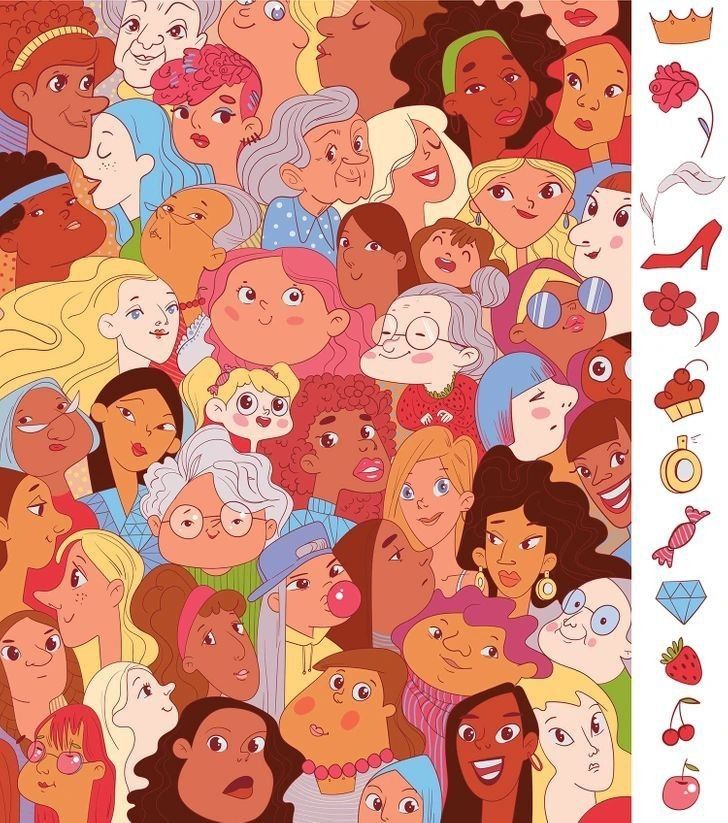
At first glance, this vibrant illustration looks like a joyful collage of women’s faces. Different ages, hairstyles, expressions, and skin tones blend together in a lively mosaic. Some women smile confidently. Others look thoughtful or playful. A few wear glasses. One blows a bubble with gum. Another tilts her head with curiosity.
It feels like a celebration of personality and diversity.
But look closely at the right side of the image and you will notice something else. A vertical strip displays a collection of small objects. A crown. A rose. A high heel. A flower. A cupcake. A ring. A candy. A diamond. A strawberry. Cherries. An apple.
This is not just an illustration. It is a hidden object puzzle cleverly woven into a colorful portrait.
Your challenge is simple. Find every object hidden among the faces.
Simple does not mean easy.
Why Hidden Object Puzzles Captivate the Human Brain
Hidden object puzzles transform a static image into an interactive experience. Instead of casually admiring the artwork, you actively search. Your eyes move from face to face. You compare shapes to the small icons on the side. You question whether a curve is just hair or part of a crown.
Your brain shifts from appreciation to investigation.
That shift is powerful. It increases focus. It slows down scrolling. It encourages deeper engagement with the image.
When you hunt for hidden shapes, you become part of the artwork rather than just a viewer.
The Psychology of Visual Search and Pattern Recognition
Your brain processes faces incredibly fast. Humans are wired to recognize facial features instantly. Eyes, noses, lips, and hairlines form patterns you interpret within milliseconds.
This puzzle uses that ability against you.
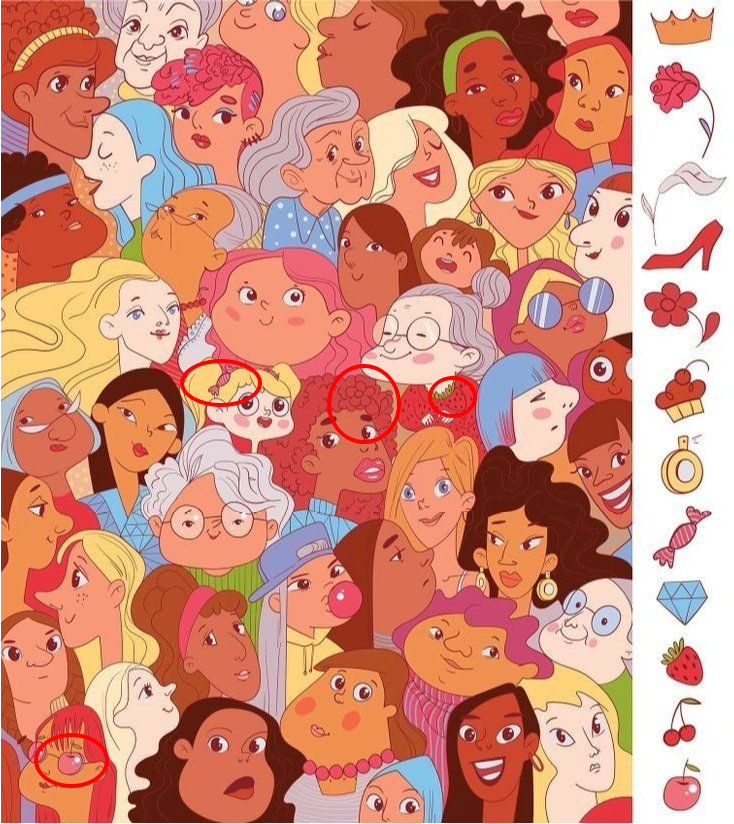
Because you focus on recognizing faces, you may overlook small embedded shapes. A diamond might blend into a necklace highlight. A strawberry could hide in a cluster of curls. A ring might merge with a circular earring. A cupcake shape might disguise itself in a hairstyle.
Your mind prioritizes the bigger picture and ignores subtle details.
To succeed, you must reverse that instinct.
How the Colorful Collage Creates Perfect Camouflage
The illustration uses bold colors and smooth outlines. Each face features unique tones and expressions, yet they blend seamlessly together. Hair flows into neighboring shapes. Accessories overlap. Shadows and highlights create additional curves.
This complexity provides ideal hiding spots.
A crown might disguise itself as a decorative hair accessory. A rose could merge into a pattern of curls. Cherries might resemble part of a blush detail. An apple might blend into warm red hues in clothing or background elements.
Because everything feels cohesive, no object looks out of place.
That subtle integration increases the challenge.
Why This Puzzle Appeals to a Wide Audience
The image celebrates diversity in age, style, and personality. Young girls appear alongside elderly women. Some faces are bold and confident. Others appear gentle and thoughtful. The illustration feels inclusive and positive.
This universal appeal makes the puzzle accessible to all age groups. Children can enjoy spotting simple shapes like fruit or candy. Adults can appreciate the artistic detail and hidden complexity.
Families and friends can challenge each other to find the objects faster. It becomes a shared experience rather than a solitary task.
The Engagement Power of Interactive Visual Content
From a digital publishing perspective, hidden object puzzles are incredibly effective. They increase time spent on page naturally. Instead of scanning quickly, readers pause and concentrate.
They revisit sections of the image multiple times. They double check details. They compare the object list carefully.
This prolonged attention creates a richer user experience. People feel invested because they are actively participating.
Interactive visual content encourages organic sharing as well. Viewers enjoy challenging others by asking whether they found all the objects.
Why Camouflage Works So Well in Busy Illustrations
Camouflage thrives in crowded compositions. When many shapes overlap, it becomes easier to hide additional elements within them.
In this faces collage, hairlines curve into one another. Earrings echo circular patterns. Lips create heart shaped outlines. Shadows form subtle triangular spaces.
Each of these areas can conceal an object without disrupting the image.
Your brain initially accepts these shapes as part of the design. Only careful observation reveals their true identity.
The Emotional Satisfaction of Discovery
Every time you locate a hidden object, you feel a small sense of achievement. You notice the diamond hidden in plain sight. You identify the candy tucked into a curve. You finally spot the elusive crown.
These small victories accumulate.
The process becomes less about finishing quickly and more about enjoying the search.
In a world filled with rapid content consumption, this slow engagement feels refreshing.
How Hidden Object Games Sharpen Focus
Beyond entertainment, puzzles like this strengthen visual discrimination skills. They encourage you to pay attention to fine details. They reward patience.
By training your eyes to recognize subtle differences in shape and outline, you enhance your observational ability in everyday life.
Whether reading, designing, or problem solving, this skill matters.
The collage of faces becomes more than art. It becomes a training ground for awareness.
Conclusion
This colorful hidden object puzzle proves that captivating content does not need dramatic action or flashy effects. It relies on thoughtful design and an understanding of how people see.
By blending a vibrant celebration of women’s faces with cleverly concealed everyday objects, the illustration transforms into an interactive challenge. It invites viewers to slow down, observe carefully, and enjoy the thrill of discovery.
You begin with admiration for the artwork. You continue with curiosity. You finish with satisfaction.
And along the way, you discover that sometimes the most fascinating details are not separate from the picture. They are woven seamlessly into it, waiting for you to truly look.