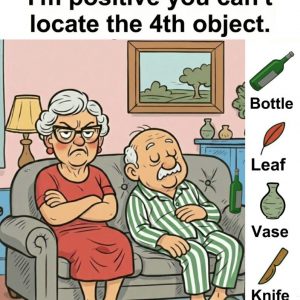
At first glance, this scene looks like a simple cartoon moment in a peaceful park. Two elderly men sit quietly on a wooden bench along a tree lined path. Each man leans forward slightly, resting his hands on a walking cane. Their expressions seem thoughtful, almost distracted, as if they are observing the world passing by.
A young woman in a purple dress walks confidently along the path, her bright appearance creating a sharp contrast against the calm green surroundings. Tall trees frame the walkway, and sunlight filters through the leaves, giving the park a relaxed afternoon atmosphere.
But this illustration hides a clever challenge.
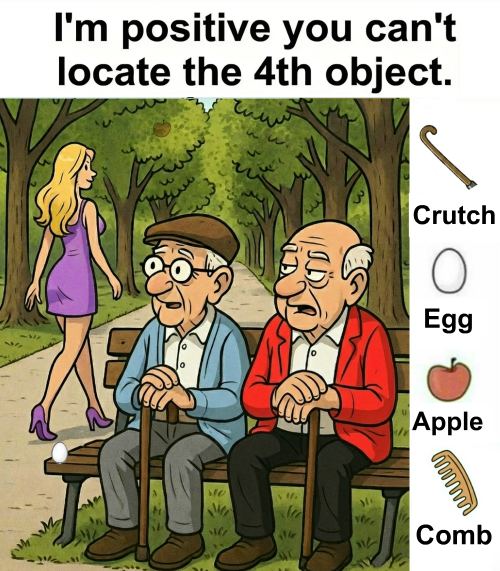
At the top of the image, a bold sentence appears. I’m positive you can’t locate the 4th object. Suddenly the peaceful park transforms into a hidden object puzzle. On the right side of the image, four items are listed. Crutch. Egg. Apple. Comb.
Your task is simple to understand but surprisingly difficult to complete. You must find each of these objects hidden somewhere inside the illustration.
Some may appear obvious. Others may blend perfectly into the scene. And one of them may seem almost impossible to locate at first glance.
Why Hidden Object Puzzles Challenge Your Brain
Hidden object puzzles work because they challenge the way your brain naturally interprets images. When you look at a picture, your mind quickly assigns labels to what it sees. Bench. Trees. People. Path.
Once those labels form, your brain stops analyzing details. It assumes it understands the image completely.
But hidden object puzzles rely on the details your brain normally ignores. Shapes hide within outlines. Curves blend into clothing. Straight lines merge with background elements.
To solve the puzzle, you must stop looking at the scene as a story. Instead, you must examine it as a collection of shapes and lines.
This shift from storytelling to observation is the secret to finding the hidden objects.
The Park Setting Creates the Perfect Distraction
The park environment in this illustration looks calm and simple. The path stretches into the distance. Trees create a natural frame around the scene. The bench sits comfortably beneath the shade.
At first glance, nothing seems complicated.
But that simplicity is exactly what makes the puzzle challenging. When there are fewer objects in an image, your eyes relax. You assume there are fewer places to hide things.
In reality, the artist uses everyday shapes to disguise the hidden objects.
The curve of a cane might resemble part of a crutch. The outline of a tree branch might mirror the teeth of a comb. A rounded detail might secretly form the shape of an egg or an apple.
Everything depends on how closely you look.
Understanding the Shapes of the Hidden Objects
To find each object successfully, you must first understand its outline.
A crutch usually features a long straight body with a curved top designed to support the arm. Look for shapes that resemble this structure along the bench, the trees, or the path.
An egg is defined by a smooth oval form. Scan the image for gentle curves without sharp edges. Sometimes this shape hides inside clothing folds, decorative elements, or small background details.
An apple appears as a rounded shape with a small stem at the top. Look for circles or near circular outlines combined with a short line.
A comb has multiple thin teeth arranged in a row. That pattern of repeating lines may appear in unexpected places such as tree bark textures, shadows, or design elements.
The key is to search for silhouettes rather than literal objects.
How to Search the Image Effectively
Many people fail hidden object puzzles because they search randomly. Their eyes jump from one corner of the image to another without a clear plan.
A better strategy is to divide the illustration into sections.
Start with the top left corner of the scene. Study the trees carefully. Examine the leaves and branches. Move slowly toward the center where the path continues into the background.
Next examine the characters themselves. Look closely at their clothing, their canes, and the bench they sit on. Small shapes can hide within outlines that your brain usually ignores.
Finally move to the lower portion of the image. The bench legs, the ground beneath the characters, and the shadows around them can contain cleverly hidden forms.
Take your time. The hidden objects do not reveal themselves instantly.
Why the Fourth Object Feels Impossible
The message at the top claims that you cannot locate the fourth object. This statement is not just part of the puzzle. It is part of the psychology behind it.
When someone tells you that something is difficult or impossible, your brain begins to doubt itself. You expect the puzzle to be unsolvable, which makes you less confident during the search.
But the truth is simple.
The fourth object is not impossible to find. It is simply well disguised.
Hidden object puzzles rely on visual camouflage. Lines blend together. Shapes overlap. Familiar objects hide inside unfamiliar patterns.
Once your eyes adjust to looking for outlines rather than objects, the hidden shapes begin to reveal themselves.
The Puzzle Is Perfect for Sharpening Observation Skills
Beyond entertainment, puzzles like this help strengthen important mental abilities. They train your eyes to notice details that others overlook. They improve patience and concentration. They encourage problem solving and pattern recognition.
Children enjoy the challenge because it feels like a treasure hunt inside a picture. Adults appreciate the puzzle because it forces the brain to slow down and focus.
In a world filled with fast moving screens and constant distractions, a simple hidden object puzzle can feel surprisingly refreshing.
It invites you to pause and truly observe.
The Moment Everything Clicks
Every hidden object puzzle contains a moment when the solution suddenly becomes obvious. You stare at the image for several minutes without success. Then, without warning, a shape stands out clearly.
It feels almost magical.
The comb you could not see suddenly appears within a pattern of lines. The apple shape reveals itself in a place you overlooked again and again.
That moment of discovery is what makes these puzzles so satisfying. It reminds you that careful observation always pays off.
Conclusion
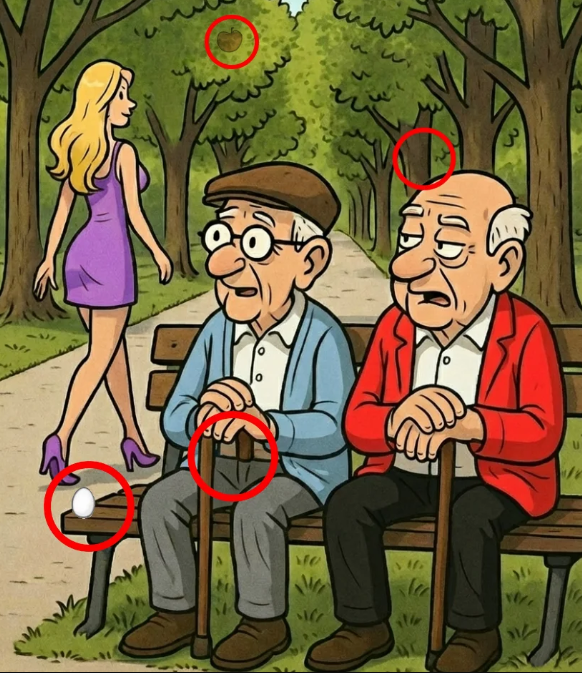
This park bench hidden object puzzle transforms a peaceful cartoon scene into a clever visual challenge. Two elderly men resting in a quiet park, a passing pedestrian, and a calm tree lined path all combine to create the perfect disguise for four hidden shapes.
The objects crutch, egg, apple, and comb hide within outlines and patterns that blend seamlessly into the illustration. By focusing on shapes rather than labels and by scanning the image methodically, you can uncover each hidden item.
Take another careful look at the bench, the canes, the trees, and the path. Study every curve and every line.
The fourth object is not missing.
It is simply waiting for your eyes to recognize it.