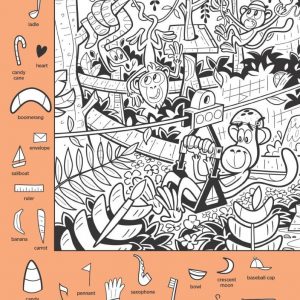
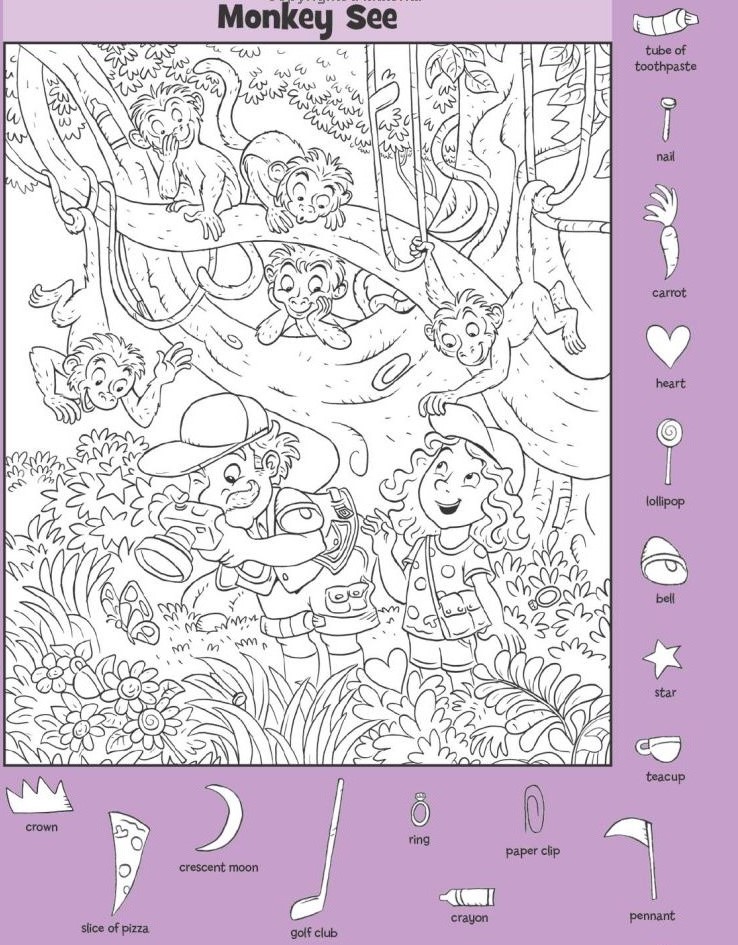
Hidden object puzzles are more than simple games. They are playful brain workouts that sharpen observation, encourage patience, and reward curiosity. The image above, titled Monkey See, transforms a lively jungle illustration into an engaging visual challenge. At first glance, it appears to be a cheerful scene filled with playful monkeys, curious explorers, and lush greenery. But look closer and you’ll realize something exciting: dozens of everyday objects are cleverly hidden throughout the jungle.
Your task is simple but surprisingly tricky. Using the list of items shown along the side and bottom of the puzzle, you must search the illustration and find each hidden shape. Some objects blend perfectly into tree branches, leaves, and vines, while others disguise themselves among flowers and jungle details. The result is a delightful puzzle that invites viewers of all ages to slow down, explore carefully, and enjoy the thrill of discovery.
Let’s dive deeper into what makes this jungle puzzle so engaging and how you can improve your hidden-object skills.
Jungle puzzles and the magic of visual discovery
The scene centers around a playful jungle environment where monkeys swing through branches and interact with curious visitors. Two explorers stand in the foreground, observing the monkeys while surrounded by dense vegetation. One explorer holds a camera, capturing the moment as the monkeys perform their playful antics.
At first, the illustration feels like a simple cartoon adventure in the forest. But this is exactly where the puzzle becomes interesting. Hidden within the leaves, vines, and branches are objects that don’t normally belong in the jungle.
A lollipop might appear along the curve of a vine. A heart shape might hide within the leaves. A golf club might blend into the shape of a branch.
These objects are not randomly placed. Puzzle artists design them carefully so that they merge naturally with the environment. The challenge lies in separating the hidden outlines from the surrounding shapes.
Why hidden object puzzles challenge the brain
When we look at an image, our brains process information quickly. We recognize patterns and identify familiar objects almost instantly. In this puzzle, your brain first notices the monkeys, the explorers, and the jungle setting.
Once the brain understands the scene, it often stops searching for additional details.
Hidden object puzzles disrupt this automatic process. They force the brain to slow down and analyze the picture more carefully. Instead of focusing on the story of the image, you begin to examine individual shapes and outlines.
This mental shift activates different cognitive skills, including pattern recognition and visual discrimination.
It’s like turning a picture into a treasure map where every leaf could hide a clue.
Exploring the hidden objects in the Monkey See puzzle
The puzzle provides a list of items to find, displayed along the sides and bottom of the image. These silhouettes act as guides, helping you recognize the shapes hidden within the jungle scene.
Some objects are everyday household items. For example, you might search for a tube of toothpaste, a paper clip, or a teacup.
Other shapes are playful or unexpected, such as a slice of pizza, a crown, or a crescent moon.
You might also notice shapes like a carrot, star, bell, or lollipop. Each object appears as a simple outline, but inside the jungle illustration they become cleverly disguised.
For example, a curved vine might form the shape of a candy-like spiral lollipop. A cluster of leaves might outline a star. A tree branch might resemble the handle of a golf club.
The more closely you examine the scene, the more hidden surprises you discover.
Techniques artists use to hide objects
Puzzle designers rely on several clever techniques to conceal shapes within illustrations.
One method involves blending objects into natural elements. A vine might curve in the same shape as a hidden object, making it difficult to distinguish.
Another technique uses overlapping lines. Two different shapes might combine to form the outline of a hidden object.
Artists also use negative space, which refers to the empty areas between objects. Our brains often ignore these spaces, but they can form recognizable shapes when viewed carefully.
These techniques work together to trick the viewer’s perception. The hidden object remains visible, yet the brain overlooks it until the moment of discovery.
How to improve your hidden object puzzle skills
If you enjoy puzzles like this, a few simple strategies can make them easier to solve.
First, study the silhouettes provided in the clue list. Instead of thinking about the object itself, focus on its outline. Notice its curves, angles, and proportions.
Second, search the image systematically. Divide the illustration into sections and examine one area at a time. This prevents you from repeatedly scanning the same spots.
Third, pay close attention to intersections where lines cross. Hidden objects often appear where branches, vines, or leaves overlap.
Another helpful technique is changing your viewing perspective. Sometimes stepping back from the image or tilting your head slightly can reveal shapes that were difficult to see before.
Finally, be patient. Hidden object puzzles reward careful observation rather than speed.
The mental benefits of visual puzzles
Beyond entertainment, puzzles like this offer valuable cognitive benefits.
They improve attention to detail by training the brain to notice subtle shapes and patterns. Over time, this skill carries over into everyday observation.
They also strengthen problem-solving abilities. When searching for hidden objects, the brain continuously evaluates possibilities and adjusts strategies.
For children, puzzles support visual development and concentration. For adults, they provide a relaxing mental challenge that keeps the mind active.
In a fast-paced digital world, hidden object puzzles offer a refreshing opportunity to slow down and focus.
The thrill of finding the hidden shapes
Anyone who has solved a hidden object puzzle knows the excitement of finally spotting a cleverly hidden item.
You might stare at a cluster of leaves for several minutes without seeing anything unusual. Then suddenly, your brain connects two lines and recognizes the outline of a star or a golf club.
The shape becomes obvious.
Once you see it, you wonder how you ever missed it in the first place.
That moment of discovery is what makes puzzles like this so satisfying. Each hidden object becomes a small victory for your observation skills.

Conclusion
The Monkey See jungle puzzle transforms a lively cartoon scene into an engaging visual adventure. Monkeys swing through branches while explorers observe the action, but beneath the playful illustration lies a collection of cleverly hidden objects waiting to be discovered.
From everyday items like toothpaste and paper clips to playful shapes like stars, lollipops, and pizza slices, each object blends seamlessly into the jungle environment.
Solving the puzzle requires patience, sharp observation, and a willingness to explore every corner of the image. But that challenge is exactly what makes hidden object puzzles so enjoyable.
So take another look at the jungle scene.
Somewhere among the vines, leaves, and mischievous monkeys, the hidden objects are already waiting for you to find them.