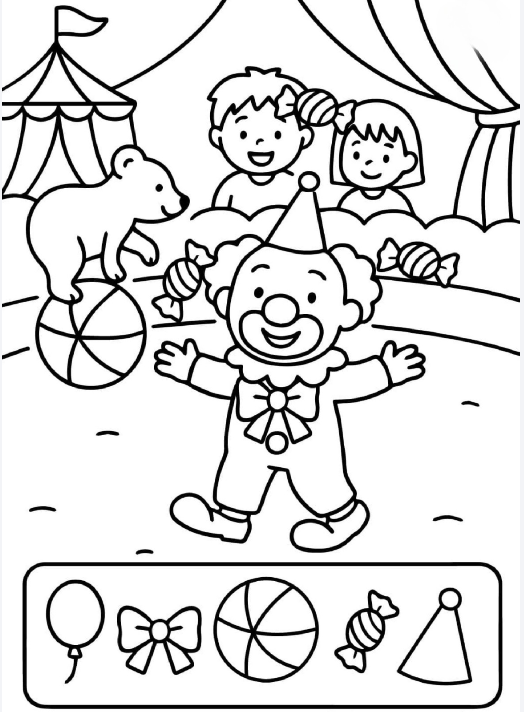
At first glance, this black and white illustration looks like a simple children’s coloring page. A cheerful clown stands in the center of a circus ring with arms wide open. Behind him, two smiling children peek over a soft barrier. To the left, a playful bear balances carefully on a large striped ball. Candy pieces float around the scene, and a circus tent rises in the background.
It feels lighthearted, friendly, and innocent.
But then you notice something important at the bottom of the image.
A row of small icons appears inside a box. A balloon. A bow. A beach ball. A wrapped candy. A party hat.
This is not just a coloring page. It is a hidden object puzzle designed to sharpen observation skills and keep young minds engaged.
The mission is simple. Find each shape hidden somewhere in the picture.
Simple rarely means effortless.
Why Hidden Object Puzzles Capture Attention Instantly
Hidden object puzzles work because they transform passive viewing into active exploration. Instead of just admiring the clown and the circus setting, you start searching for specific shapes. You scan the bear’s ball. You examine the folds of the circus tent. You inspect the clown’s costume carefully.
Your brain switches from observation to investigation.
That shift creates focus.
When you look for a balloon shape, you compare every round curve in the illustration to the icon below. When you search for a bow, you analyze the clown’s collar and the children’s hair accessories. When you hunt for candy, you examine the floating shapes carefully.
The image becomes interactive.
The Psychology Behind Visual Search Games for Kids
Children naturally love patterns and repetition. A hidden object puzzle taps directly into that instinct. It turns learning into play.
In this circus scene, the shapes are not hidden in dark corners or disguised beyond recognition. Instead, they blend naturally into the artwork. A balloon may resemble part of the background design. A beach ball might mirror the bear’s balancing ball. A party hat could echo the clown’s hat shape.
Because the illustration uses simple line art, the challenge focuses on shape recognition rather than color contrast.
That makes it ideal for young learners.
How the Circus Theme Enhances Engagement
The circus setting adds excitement and movement to the puzzle. A balancing bear, a smiling clown, and cheerful children create a story. The tent curves upward like a stage for imagination.
This storytelling element increases immersion.
When children feel like they are inside a playful circus world, they engage longer. They are not just looking for shapes. They are participating in the scene.
The floating candies add another layer of detail. Some resemble the wrapped candy icon at the bottom. Others appear slightly different, encouraging closer inspection.
The bow icon may mirror the decorative bow on the clown’s outfit. The balloon icon might resemble rounded shapes hidden in plain sight.
The more you look, the more you notice.
Why Coloring Pages and Hidden Object Games Work Together
This illustration doubles as a coloring page and a visual puzzle. That combination increases its value dramatically.
First, children can search for shapes. Then, they can color the entire scene. This extended engagement encourages creativity and concentration.
Parents and teachers often look for activities that combine entertainment with learning. A circus themed hidden object coloring page checks both boxes. It improves visual discrimination skills while encouraging artistic expression.
That dual function makes it ideal for classrooms, homeschooling, and family activity time.
The Educational Benefits of Hidden Object Puzzles
Hidden object puzzles do more than entertain. They strengthen cognitive skills.
When children search for a balloon shape, they practice visual comparison. When they identify a bow hidden within a costume, they refine pattern recognition. When they scan the entire page for repeated shapes, they develop sustained attention.
These skills support reading, writing, and problem solving later in life.
The circus clown puzzle becomes more than a game. It becomes a training ground for focus.
Why Simple Line Art Increases the Challenge
At first glance, black and white line art seems easier than colorful illustrations. In reality, it can increase difficulty.
Without color cues, children rely entirely on shape. A circle must be recognized as a balloon only by its outline. A triangular shape must be identified as a party hat based on structure rather than shading.
This sharpens attention to detail.
It also makes the puzzle timeless. The absence of color allows every child to interpret and personalize the scene differently once they begin coloring.
The Joy of Discovery
Every time a child finds one of the hidden shapes, a small sense of accomplishment follows. They point to the page proudly. They announce their discovery. They feel successful.
This positive reinforcement encourages continued engagement.
The clown’s open arms and smiling face reinforce that joyful atmosphere. The entire scene celebrates fun and curiosity.
That emotional tone matters. When children associate learning with joy, they become more eager to participate.
Conclusion
This adorable circus clown hidden object puzzle proves that meaningful engagement does not require complexity. It relies on thoughtful design, playful storytelling, and clever integration of simple shapes.
By blending a cheerful circus scene with a shape finding challenge, the illustration invites children to slow down and observe carefully. It strengthens attention, enhances pattern recognition, and encourages creativity through coloring.
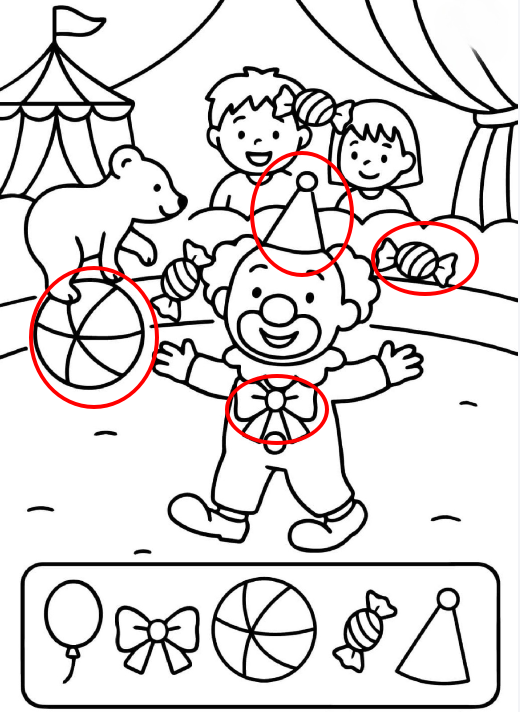
You begin by spotting a balloon. You continue by finding a bow and a beach ball. You finish with the satisfaction of discovering every hidden shape.
And along the way, you realize that sometimes the greatest fun comes not from the spotlight in the center ring, but from the small details waiting quietly to be found.