At first glance this illustration looks like a playful adventure story frozen in time. A group of explorers climbs through a rugged mountain landscape filled with rocks winding paths and dramatic peaks. One character carefully studies a map while another balances an unusual load on their back. A raccoon wearing hiking gear inspects the ground with a magnifying glass as if searching for clues. The entire scene feels lively curious and full of personality.
But then your attention shifts to the border surrounding the drawing.
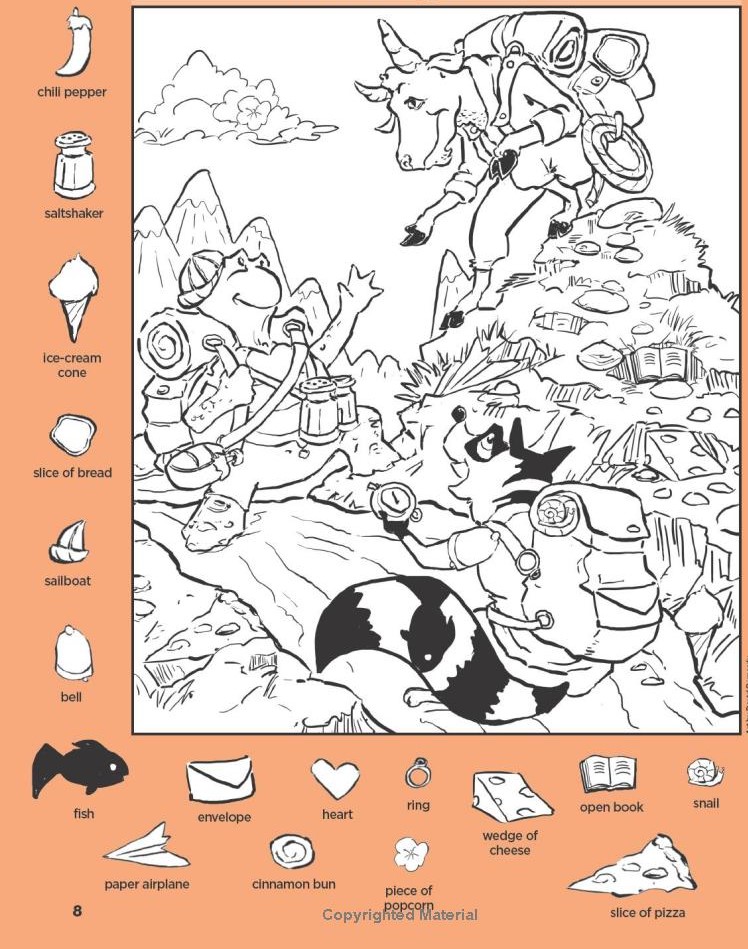
Suddenly the image becomes something more than a cartoon. Along the sides and bottom of the illustration you see a list of small objects. A chili pepper. A saltshaker. An ice cream cone. A slice of bread. A sailboat. A bell. A fish. An envelope. A heart. A ring. A wedge of cheese. An open book. A snail. A paper airplane. A cinnamon bun. A piece of popcorn. A slice of pizza.
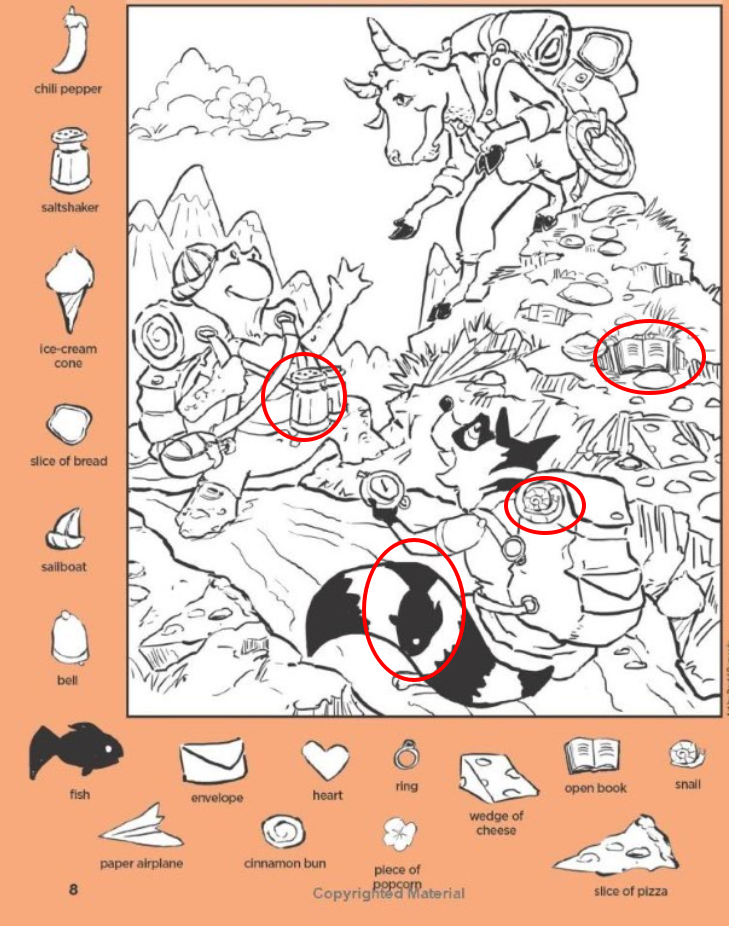
All of these items are hidden somewhere inside the detailed drawing.
This turns a simple illustration into an interactive visual challenge.
Hidden object puzzles and why people love them
Hidden object puzzles have fascinated people for generations. They combine art observation and curiosity into a single activity. Instead of just looking at an image you actively explore it.
The moment you realize there are hidden items scattered throughout the scene your brain switches modes. You stop seeing the drawing as a whole and begin studying the tiny details. You look at rocks differently. You examine the folds of clothing. You analyze shapes inside clouds and mountains.
Your eyes become detectives.
And that is exactly why these puzzles are so engaging.
The psychology behind searching for hidden shapes
There is a simple reason puzzles like this capture attention so effectively. Humans naturally seek patterns. Our brains constantly scan the world trying to organize shapes into recognizable objects.
When you finally spot something that was hiding in plain sight your brain rewards you with a sense of satisfaction. That feeling is small but powerful. It encourages you to keep looking for the next discovery.
Think of it like treasure hunting inside a drawing. Each hidden object feels like a tiny prize waiting to be uncovered.
The mountain adventure scene that hides more than you expect
This particular puzzle uses a lively outdoor setting to disguise everyday items. The illustration shows explorers navigating rocky terrain surrounded by mountains clouds and winding trails. Their backpacks ropes and equipment add texture to the scene.
All those lines curves and shadows create perfect hiding spots.
A shape that first appears to be part of a rock might resemble something familiar when viewed differently. A curve within a cloud might form a recognizable outline. Even the folds of clothing or the details of hiking gear can disguise unexpected objects.
The artist carefully blends the hidden items into the environment so they feel like natural parts of the drawing.
Nothing looks out of place at first.
That is what makes the puzzle so challenging.
Why simple objects become difficult to find
It might seem easy to locate items like a bell or a sailboat. After all these objects have distinctive shapes. But when those shapes blend into other lines they become surprisingly hard to notice.
Your brain tends to label things quickly. It sees a group of lines and decides they belong to a rock or a backpack. Once your mind assigns that label it rarely questions it again.
Hidden object puzzles work by taking advantage of that habit.
They encourage you to slow down and question what you see. That rock might not just be a rock. That curve might not only be a cloud.
When you start examining the image with fresh curiosity new shapes suddenly appear.
Why people share puzzles like this online
Visual challenges like this one perform extremely well on websites and social media platforms because they invite participation. Instead of simply reading or watching content people interact with it.
They search for items. They compare results with friends. They challenge others to find objects they missed.
That interaction naturally increases engagement.
Someone might spend several minutes scanning the drawing carefully. Then they might return later to search again for items they did not find the first time. This repeated attention keeps the puzzle interesting and memorable.
The longer people explore an image the more invested they become in solving it.
The benefits of slowing down and observing details
Hidden object puzzles may seem like simple entertainment but they also strengthen useful skills. Searching for small details trains visual awareness and patience. It encourages careful observation instead of quick glances.
In daily life we often rush through information. We skim articles scroll through images and move on quickly. Activities like this puzzle break that habit.
They remind us to slow down and look carefully.
When you study the image closely you start noticing details that would otherwise disappear into the background. That ability to focus deeply can be valuable in many areas of life from creative work to problem solving.
Why this puzzle feels like a story
Another reason the illustration works so well is that it feels like a narrative rather than a random picture. The explorers appear to be on a journey through the mountains. Their equipment suggests adventure discovery and teamwork.
The raccoon with a magnifying glass adds a playful element that makes the scene feel alive.
Because the characters look engaged in their own exploration you feel invited to join them. Instead of just solving a puzzle you become part of the adventure.
Each hidden object becomes another clue in the landscape.
How to approach the challenge
If you are looking at the illustration now take a moment to scan it slowly. Begin with the larger shapes before focusing on smaller details. Notice patterns in rocks backpacks and clouds.
Look at the edges of objects where lines intersect.
Sometimes hidden shapes appear when two elements overlap. A curve from one object combined with a line from another may form something recognizable.
If you cannot find an item right away do not rush. Move your eyes across the scene gradually and return to areas that seem ordinary.
The most surprising discoveries often appear in places that initially looked unimportant.
Final thoughts
This mountain themed hidden object puzzle transforms a simple drawing into a fascinating visual challenge. By blending everyday items into a lively adventure scene the artist invites viewers to explore every corner of the illustration.
The puzzle rewards patience curiosity and careful observation. Each item you discover feels like uncovering a tiny secret hidden inside the artwork.
More importantly the experience reminds us how powerful focused attention can be. When we slow down and truly observe our surroundings we begin to notice details that were always there waiting to be seen.
Take another look at the scene.
Some of the objects may already be visible once you shift your perspective. Others may still be hiding among the rocks clouds and gear of the explorers.
The adventure now belongs to you.