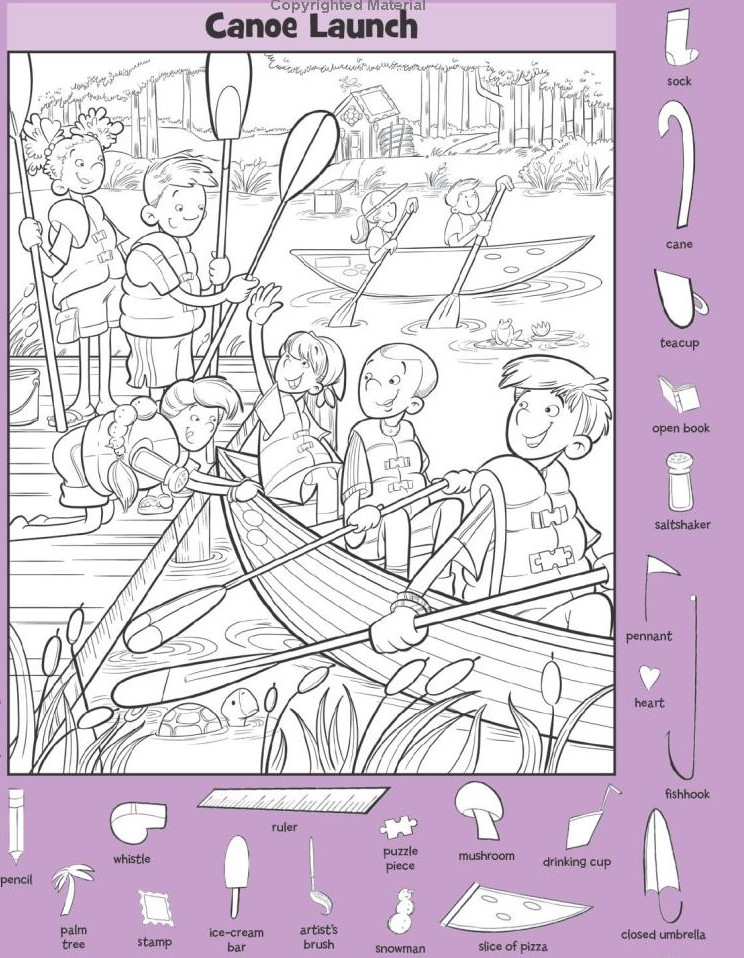
Outdoor adventures often bring excitement, teamwork, and unforgettable memories. Imagine a peaceful lakeside scene where children gather at a dock, ready to launch their canoes and explore the water. The atmosphere feels lively and adventurous. Paddles move through the water, friends laugh together, and nature surrounds the entire scene.
But this cheerful illustration hides more than just a story about canoeing.
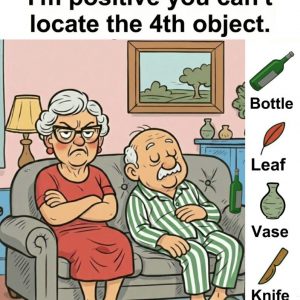
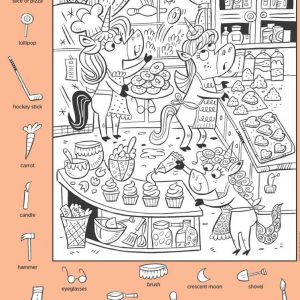
Look closely and you will discover that the image is actually a hidden object puzzle. Inside the busy lakeside environment, dozens of objects are cleverly hidden within the lines and shapes of the drawing. Around the border of the illustration, small icons show the items you need to find. These icons act as clues that guide your search through the picture.
What seems like a simple outdoor adventure suddenly becomes a fun visual challenge.
Why hidden object puzzles capture attention so easily
Hidden object puzzles are popular because they change the way we look at images. Normally, our brain identifies the main elements in a picture very quickly. When you look at this illustration, you instantly recognize children, canoes, paddles, water, and a wooden dock.
Your brain labels these elements and assumes it understands the entire scene.
However, hidden object puzzles interrupt that process. They encourage you to slow down and examine every detail. Lines that appear decorative might actually form the outline of a hidden object. Shapes that seem ordinary might secretly resemble something completely different.
The puzzle transforms passive viewing into active exploration.
Instead of simply looking at the image, you start searching for patterns and outlines. Every corner of the picture becomes a possible hiding place.
Exploring the canoe launch adventure scene
The illustration shows a group of children preparing for a canoe adventure. Several kids sit inside a canoe while others stand on the wooden dock helping launch the boat into the water. Everyone wears life jackets, ready for a safe and exciting trip across the lake.
Two children paddle a canoe in the background, moving gently across the water. Trees and plants line the shore, creating a peaceful natural setting. The scene feels energetic yet relaxing at the same time.
Near the water, small animals such as a turtle and frog add charming details to the environment. Tall grasses and reeds grow along the edge of the lake.
At first glance, the drawing appears to focus entirely on outdoor fun and teamwork.
But if you look more carefully, the lines forming the paddles, the dock, and even the water plants may hide unexpected shapes.
Understanding the hidden objects in the puzzle
Along the sides and bottom of the image, a collection of small icons shows the objects hidden inside the illustration. These icons represent items you must locate somewhere in the canoe scene.
Some objects look familiar and simple. For example, you might see shapes representing a sock, a cane, or a teacup. Others include items such as an open book, a saltshaker, and a small pennant flag.
You may also notice shapes representing a heart, a fishhook, or even a closed umbrella.
Additional clues include objects like a pencil, a whistle, a ruler, and a puzzle piece. There are also playful shapes such as a mushroom, an ice cream bar, a slice of pizza, and a snowman.
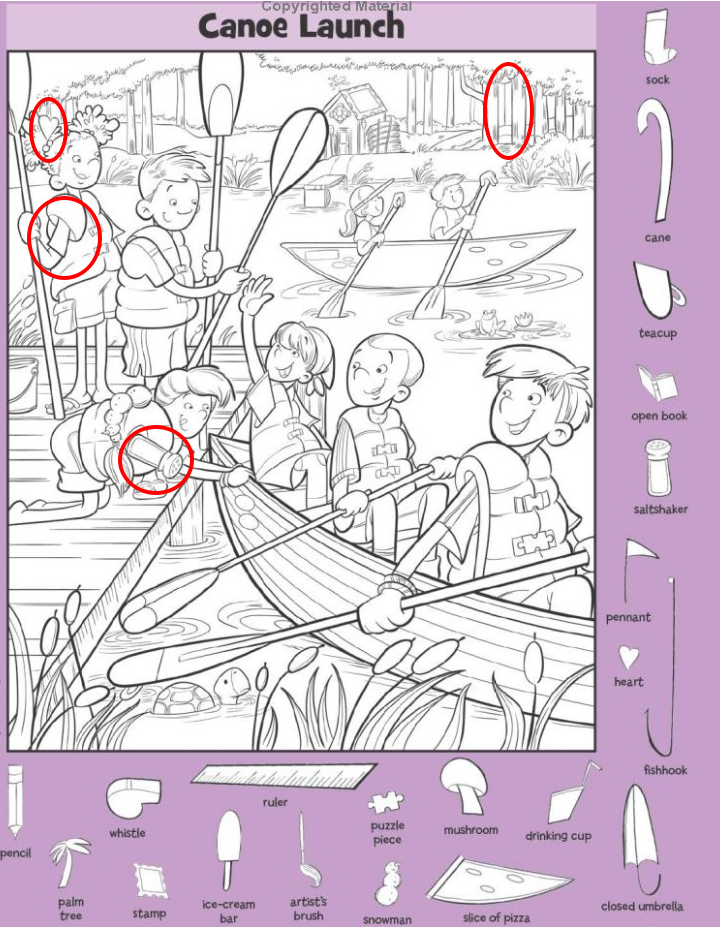
Each object appears somewhere within the illustration, cleverly blended into the outlines of the environment.
Sometimes the object forms part of a paddle or blends into the lines of the dock. Other times it may appear within the reeds near the water or hidden among the children’s clothing.
The challenge is to match the shapes shown in the clues with the outlines hidden in the drawing.
How hidden objects blend into everyday illustrations
Puzzle artists rely on visual camouflage to hide objects effectively. Instead of drawing the object clearly, they embed its shape into another part of the illustration.
For example, the curve of a paddle might create the outline of a fishhook. A group of plants might form the shape of a mushroom. The folds in a life jacket might resemble the outline of a teacup or a puzzle piece.
Sometimes the hidden object appears in negative space. Negative space refers to the empty area between two shapes. Our brains usually ignore these spaces, but puzzle designers use them creatively.
When you begin looking for shapes instead of objects, you start noticing patterns you previously overlooked.
Strategies to find hidden objects more easily
Solving a hidden object puzzle requires patience and careful observation. Many people start by scanning the picture randomly, hoping a shape will jump out at them.
However, a more effective strategy involves working methodically.
First, study the icons around the border of the image. Memorize their outlines and focus on their unique shapes.
Next, divide the illustration into sections. Begin searching from the top left corner and move slowly across the picture. Pay attention to outlines and intersections where lines meet.
Focus on shapes rather than colors or characters. The hidden object often appears where two lines create a familiar silhouette.
Another useful technique involves changing perspective. Sometimes tilting your head slightly or stepping back from the image helps reveal patterns that were difficult to see before.
Why puzzles like this are great for children and adults
Hidden object puzzles provide more than simple entertainment. They help strengthen important mental skills.
For children, puzzles encourage patience and concentration. Kids learn to examine details carefully instead of rushing through a task. This improves visual discrimination, a skill that helps children recognize differences between shapes and letters.
Adults also benefit from these puzzles.
Searching for hidden objects activates the brain’s pattern recognition abilities. It keeps the mind engaged and provides a relaxing mental challenge. Many people enjoy puzzles as a break from digital distractions because they encourage focused thinking.
In addition, puzzles like this promote curiosity and creativity. Each discovery feels like solving a tiny mystery hidden inside the picture.
The exciting moment of discovery
Anyone who has solved a hidden object puzzle knows the thrilling moment when a shape suddenly appears. You might examine the same part of the drawing several times without noticing anything unusual.
Then suddenly the lines connect in your mind.
What once looked like a random curve now forms the outline of a recognizable object. The hidden shape becomes obvious, and you wonder how you missed it before.
This moment of discovery creates a small sense of victory. It keeps people coming back to puzzles again and again.
Conclusion
The canoe launch hidden object puzzle turns a peaceful lakeside adventure into an exciting visual challenge. Children preparing to paddle across the water create a lively scene filled with details and natural surroundings.
Hidden within the illustration are dozens of everyday objects cleverly disguised among the lines and shapes. From simple items like socks and books to playful shapes like mushrooms and ice cream bars, each object waits patiently to be discovered.
By studying the clues carefully and exploring the image step by step, viewers can uncover each hidden outline. These puzzles sharpen observation skills, improve concentration, and provide a fun mental workout for both kids and adults.
Take another careful look at the paddles, the dock, and the tall grasses near the water.
Somewhere in those lines, the hidden objects are waiting for you to find them.