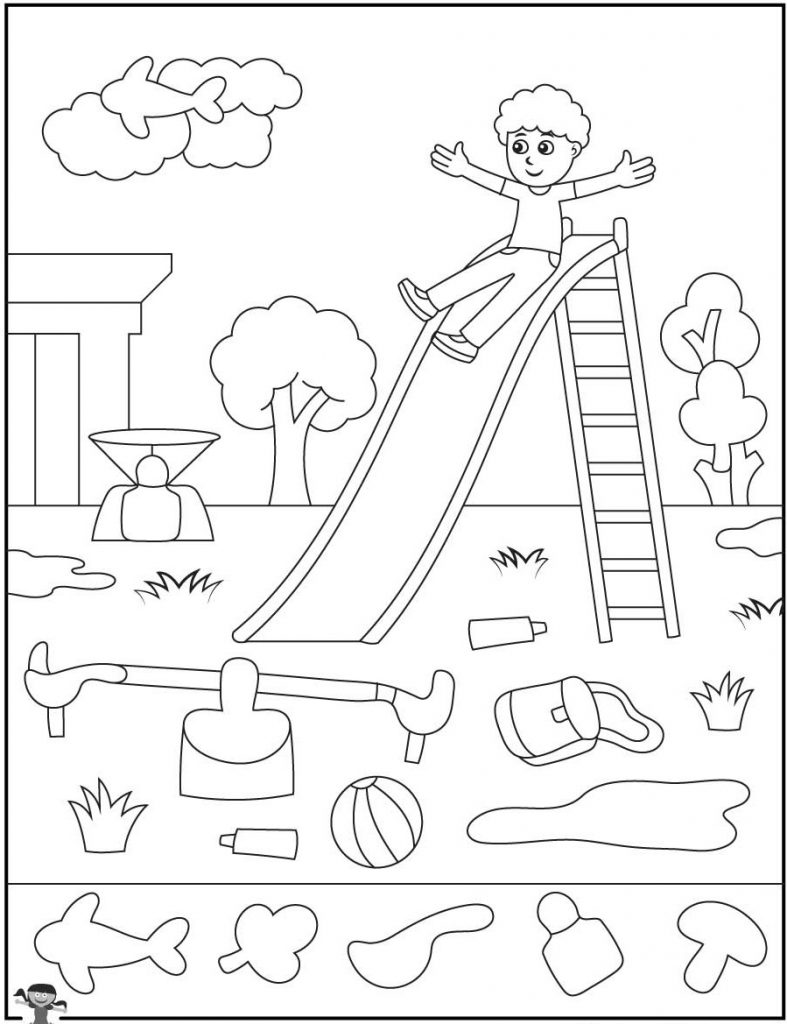
At first glance, it looks like a simple playground coloring page. A cheerful child slides down a tall slide, arms wide open, enjoying a carefree day at the park. A seesaw rests nearby. A ball sits on the grass. Trees sway in the background. Even an airplane floats peacefully among the clouds.
It feels innocent. Relaxing. Straightforward.
But look again.
This playful illustration is actually a cleverly designed hidden shape puzzle. Scattered throughout the scene are specific silhouettes you must find—subtly blended into the playground equipment, grass, puddles, and sky.
Think you can spot them all?
Why Hidden Shape Puzzles Are So Addictive
There’s something magnetic about a visual challenge. The moment you realize an image contains hidden objects, your brain shifts gears. You stop passively looking and start actively searching.
Hidden object puzzles tap into one of our strongest cognitive instincts: pattern recognition. We are wired to detect familiar shapes, especially when they are slightly disguised.
That’s why puzzles like this playground scene are so captivating. The setting feels simple, but your brain quickly realizes it needs to work harder than expected.
And once you start, you don’t want to stop until you find every last hidden shape.
A Closer Look at the Playground Scene
The illustration centers around a child happily sliding down a playground slide. Beneath the slide, small details fill the space: grass patches, a puddle, a water bottle, a backpack, and a ball.
In the background, trees and clouds create soft outlines. An airplane shape appears among the clouds.
At the bottom of the image, a row of silhouettes shows the shapes you need to locate. These include abstract forms such as an airplane, a clover-like shape, a curved object, a bottle-shaped outline, and a mitten-like form.
The challenge lies in finding those exact shapes hidden within the larger drawing.
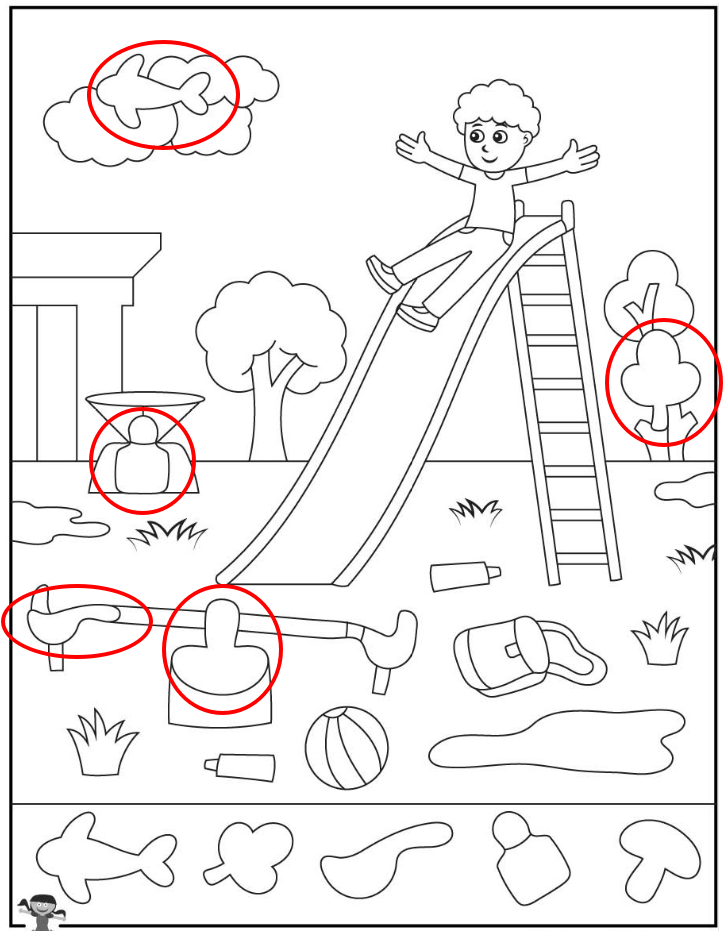
They are not floating independently. They are embedded into other elements.
The airplane might form within the cloud contours.
The clover could be disguised among tree leaves.
The bottle shape may blend into playground equipment.
The curved object might appear as part of the slide’s edge.
The genius of this puzzle is subtlety.
Why Your Brain Misses What’s Right in Front of You
When you first look at the image, your brain labels it quickly: slide, child, seesaw, trees, clouds.
Once labeled, your mind stops analyzing individual lines.
This mental shortcut saves energy in everyday life—but it works against you in hidden object puzzles.
To succeed, you must override automatic recognition and focus on raw shapes.
Instead of seeing “tree,” study its outline.
Instead of seeing “cloud,” examine its curves carefully.
Instead of seeing “slide,” analyze its edges and angles.
The hidden shapes are often formed by overlapping lines or negative space between objects.
You’re not just searching for items—you’re retraining your brain to see differently.
How Hidden Object Puzzles Strengthen Cognitive Skills
These puzzles aren’t just entertaining. They sharpen important mental abilities.
They enhance:
Visual attention
Detail orientation
Spatial reasoning
Cognitive flexibility
Pattern detection
When you look for the mitten-shaped silhouette, your brain scans for rounded tops and inward curves. When searching for the airplane, it identifies wing-like extensions.
Each object activates a different recognition pathway.
This constant switching improves mental agility.
Why Black-and-White Designs Increase Difficulty
The playground illustration uses simple line art without color. That choice makes the puzzle significantly harder.
Without color contrast, nothing stands out automatically. Every shape shares the same visual weight.
You must rely purely on contour recognition.
That’s why you may overlook shapes that are technically obvious.
Color often guides attention. Without it, your brain must work harder to separate elements.
And that’s exactly what makes this puzzle such a powerful brain teaser.
Tips to Find All the Hidden Shapes
Feeling stuck? Try these simple strategies:
Focus on one shape at a time.
Divide the image into small sections and scan slowly.
Look for partial matches instead of full outlines.
Pay attention to negative space between objects.
Change your viewing distance—step back and look again.
Sometimes the shape appears rotated or flipped. Your brain expects it upright, so it misses it.
Shift your perspective, and suddenly it becomes visible.
Why Playground-Themed Puzzles Have Universal Appeal
Playground scenes evoke nostalgia. They remind us of carefree childhood days. That emotional connection makes the puzzle more inviting.
Children enjoy searching for shapes because it feels like a game. Adults enjoy the challenge because it sharpens focus.
It’s simple enough for kids, yet tricky enough to test adults.
That balance makes playground puzzles especially engaging for families.
The Satisfaction of Finding the Final Shape
There’s always one silhouette that feels impossible to locate.
You scan the image repeatedly. You start doubting whether it’s truly there.
Then, without warning, your brain connects the lines.
And there it is.
That final discovery delivers a burst of satisfaction. It feels like solving a miniature mystery.
Your brain rewards you with a sense of accomplishment.
That emotional payoff is what keeps hidden object puzzles timeless and shareable.
Why These Visual Challenges Thrive Online
Hidden object puzzles perform extremely well on digital platforms because they are:
Family-friendly
Visually simple
Interactive
Easy to understand
Non-controversial
They encourage comments and engagement naturally. People love asking friends, “Did you find them all?”
Because the content is wholesome and appropriate for all audiences, it aligns perfectly with platform standards and community guidelines.
Conclusion
This playful playground hidden shape puzzle transforms a simple park scene into a clever visual challenge. By embedding specific silhouettes within everyday elements like slides, clouds, and grass, the illustration forces viewers to slow down and analyze every detail.
The difficulty doesn’t come from complexity—it comes from perception. Our brains prefer shortcuts, but puzzles like this demand intentional observation.
When you shift from casually viewing the scene to actively studying shapes, the hidden forms begin to reveal themselves.
So take another careful look at the slide, the trees, the seesaw, and even the clouds.
Every shape is there.
You just have to see it.