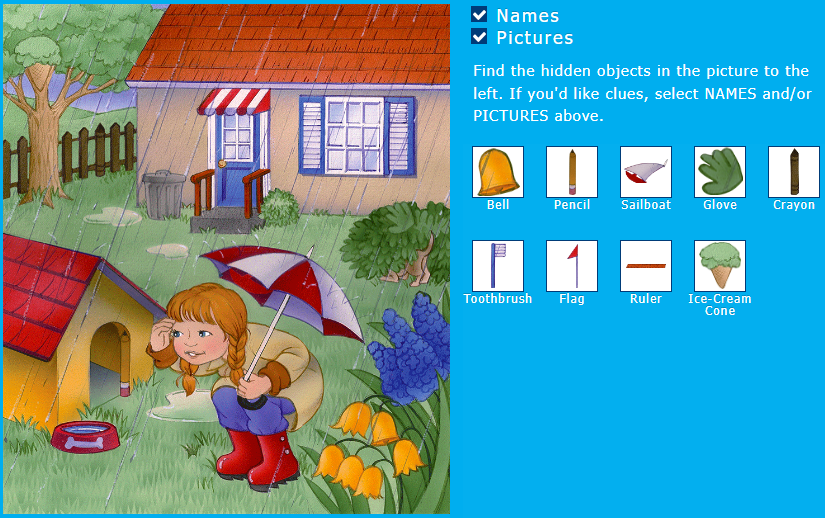
At first glance, it’s a sweet, peaceful rainy afternoon. A young girl in bright red boots crouches near a doghouse, holding a red-and-white umbrella while rain gently falls around her. A cozy house sits in the background. Flowers bloom beside the fence. Everything feels calm, playful, and innocent.
But look closer.
This charming illustration is actually a cleverly designed hidden object puzzle. Scattered throughout the backyard scene are everyday items disguised within natural shapes. Your challenge? Find them all.
The list includes a bell, pencil, sailboat, glove, crayon, toothbrush, flag, ruler, and ice-cream cone. Each object blends seamlessly into the environment, hiding in plain sight.
It sounds easy—until you start searching.
Why Hidden Object Puzzles Are So Captivating
Have you ever noticed how quickly your brain locks into a challenge? The moment someone says, “Find the hidden objects,” your attention sharpens.
Hidden object puzzles work because they transform passive viewing into active investigation. You stop simply looking at the picture and start analyzing it.
You scan the rooflines.
You inspect the garden flowers.
You examine the edges of the doghouse.
Suddenly, what looked like a simple rainy day becomes a detailed treasure hunt.
That mental shift—from casual observation to focused searching—is what makes these puzzles so engaging.
The Backyard Scene: Cozy Yet Cleverly Designed
This image feels warm despite the rain. The girl’s red boots pop against the green grass. The umbrella adds contrast. The yellow flowers and purple shrubs bring the yard to life.
But hidden object designers are masters of disguise. They don’t randomly drop items into the scene. Instead, they embed them into natural outlines.
The sailboat might form from roof angles and fence lines.
The ruler could blend into a straight edge on the house siding.
The ice-cream cone might be hidden among the flowers.
The toothbrush could disguise itself within vertical shapes like window frames or garden posts.
Because the items match the visual style of the drawing, they don’t stand out immediately.
And that’s the genius of it.
Why Your Brain Struggles to See What’s There
Your brain is built for efficiency. When you see a house, you label it instantly. When you see flowers, you categorize them as plants.
Once labeled, your brain stops analyzing individual lines and shapes.
Hidden object puzzles disrupt that shortcut system.
To find the glove or crayon, you must ignore what the object “is” and focus on what it “looks like.”
That means examining:
Curves
Straight lines
Sharp angles
Negative space between shapes
Instead of seeing “umbrella,” you study the pattern of its stripes. Instead of seeing “grass,” you inspect each blade’s outline.
This switch from recognition mode to analysis mode is what makes the puzzle both difficult and rewarding.
How Visual Puzzles Strengthen Your Brain
Hidden object challenges are more than entertainment—they’re mental workouts.
They improve:
Attention to detail
Visual memory
Pattern recognition
Spatial awareness
Cognitive flexibility
When searching for the bell, your brain scans for rounded shapes with small handles. When looking for the pencil, it searches for elongated forms with pointed ends.
Each object activates a different recognition pathway in your mind.
Over time, this strengthens your ability to detect subtle differences in complex visuals.
Why Rainy Scenes Make Perfect Puzzle Settings
Rain adds dynamic visual texture. The falling streaks create vertical lines that can easily disguise straight objects like rulers or pencils.
The umbrella introduces curves and bold stripes.
The flowers add petal shapes that resemble cones or flags.
The fence creates repetitive vertical elements perfect for hiding slender objects.
Every detail in the scene serves a dual purpose: storytelling and camouflage.
That’s what makes this puzzle so clever.
Tips to Find All the Hidden Objects
If you’re stuck, try these simple strategies:
Search for one item at a time.
Divide the image into sections and scan slowly.
Look for partial outlines rather than complete objects.
Focus on unusual shapes within familiar objects.
Change your viewing distance—step back and look again.
Often, the object isn’t fully drawn. It might be formed by the combination of two separate elements.
The trick is to stop expecting perfection. Hidden objects often rely on suggestion rather than detail.
Why These Puzzles Perform So Well Online
Hidden object puzzles thrive in digital spaces because they are:
Family-friendly
Visually engaging
Interactive
Easy to understand
Safe and appropriate for all audiences
They naturally encourage engagement. People comment things like:
“I found eight, but I can’t see the ruler!”
“The toothbrush was the hardest!”
“Did you notice the sailboat near the roof?”
That interactive element drives shares and conversations.
And because the content is wholesome and non-controversial, it aligns well with major platform guidelines and audience expectations.
The Emotional Reward of Finding the Last Item
There’s always one object that feels impossible to locate.
You scan the image repeatedly. You doubt yourself. You question whether it’s really there.
Then suddenly—you see it.
And once you see it, it feels obvious.
That moment of clarity creates a burst of satisfaction. Your brain registers success and rewards you with a small dopamine release.
That positive reinforcement is why hidden object puzzles are so addictive. They create small victories that feel meaningful.
Conclusion
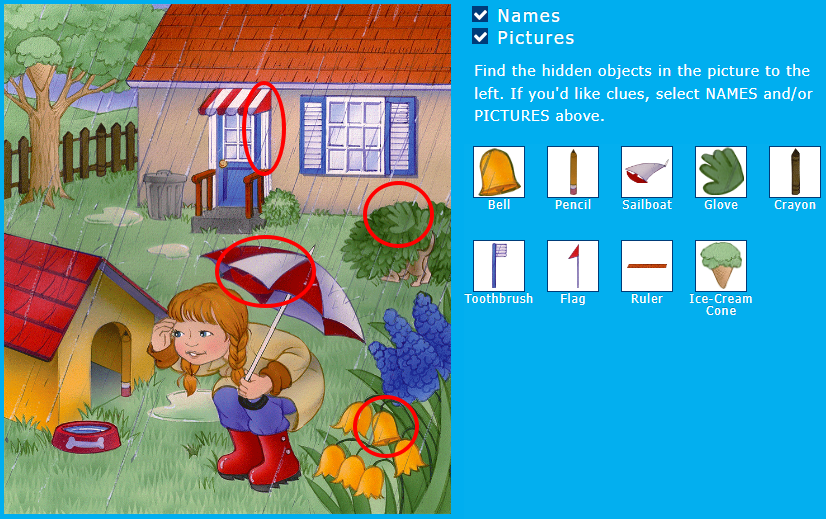
This rainy backyard hidden object puzzle transforms a gentle afternoon scene into a playful mental challenge. By disguising everyday items like a bell, pencil, sailboat, glove, and ice-cream cone within natural elements of the illustration, it forces viewers to slow down and examine every detail.
The difficulty doesn’t come from clutter or complexity—it comes from perception. Our brains prefer shortcuts, but puzzles like this demand careful observation.
When you shift from casually looking to actively analyzing shapes, the hidden objects begin to reveal themselves.
So take another careful look at the umbrella, the flowers, the fence, and even the falling rain.
Every object on the list is there.
You just have to see it.