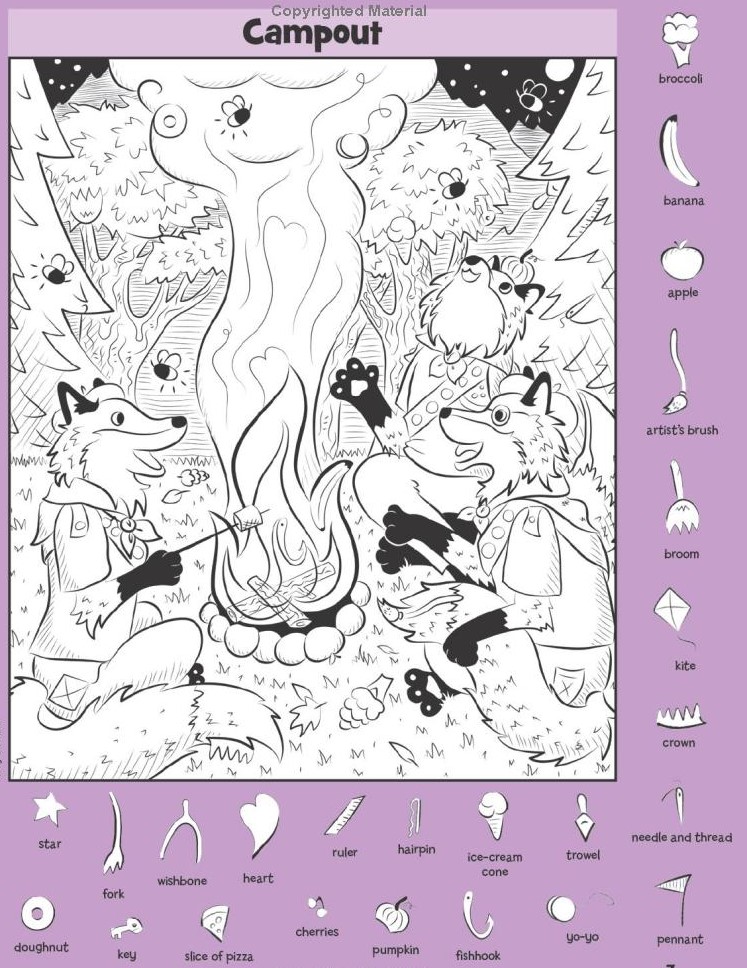
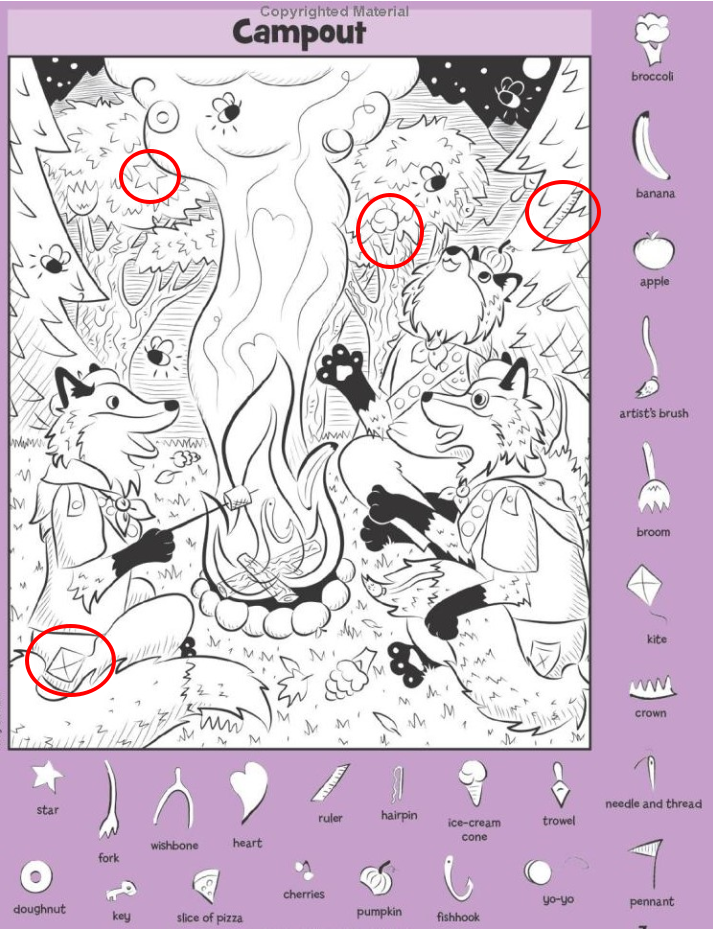
At first glance, this charming black and white illustration feels like a peaceful night in the woods. Three cheerful forest animals sit around a crackling campfire beneath tall trees and a starry sky. Flames dance upward, marshmallows roast on sticks, and the mood feels warm and friendly.
But this is not just a cozy campfire scene.
Surrounding the image is a long list of everyday objects. Broccoli. Banana. Apple. Artist’s brush. Broom. Kite. Crown. Star. Fork. Heart. Ruler. Hairpin. Ice cream cone. Trowel. Needle and thread. Doughnut. Key. Slice of pizza. Cherries. Pumpkin. Fishhook. Yo yo. Pennant.
Your mission is simple. Find them all.
And that is where the real adventure begins.
Why Hidden Object Puzzles Keep Readers Engaged
Hidden object puzzles transform a passive image into an interactive experience. Instead of simply admiring the illustration, you participate. You search. You compare shapes. You examine every branch, flame, and shadow.
In this campout puzzle, the woodland setting works as perfect camouflage. Trees twist upward in organic curves. Leaves overlap in layered clusters. Smoke rises in soft swirls. These natural lines create dozens of hiding spots.
Your brain must decide whether a curve belongs to a flame or resembles a banana. Whether a pointed edge is a leaf or a pennant. Whether a small circle is a decoration or a doughnut.
That split second of decision making activates your focus.
The Psychology Behind Visual Search Challenges
When you look at a forest scene, your brain quickly categorizes it. Trees. Animals. Fire. Grass. You process it as a whole before examining details.
Hidden object puzzles challenge that habit.
The objects listed along the border do not belong naturally in a woodland camp setting. That is what makes the search intriguing. A broccoli shape might blend into treetop foliage. A ruler could disguise itself within straight tree bark lines. A fishhook might curve subtly among twigs.
Your mind must slow down and question what it sees.
Instead of accepting shapes at face value, you analyze them. You compare them to the small reference icons. You begin to notice patterns you missed at first glance.
This shift from scanning to observing creates engagement.
How the Campfire Scene Elevates the Difficulty
The central campfire provides both warmth and complexity. Flames flicker in irregular curves. Smoke spirals upward in soft waves. Stones circle the fire in uneven shapes.
Each of these elements offers opportunities for disguise.
A heart shape could hide in a puff of smoke. A fork might align with tree branches. A crown might merge with jagged leaf edges. A needle and thread could blend into fine lines of grass.
The artist uses consistent line weight and monochrome design to level the playing field. No color highlights guide you. Every object shares the same visual style.
You rely entirely on shape recognition.
Why This Puzzle Appeals to All Ages
One of the strengths of this campout hidden object puzzle is its universal charm. The forest animals feel friendly and approachable. The scene suggests storytelling and adventure without any conflict.
Children can enjoy the imaginative woodland theme. Adults can appreciate the challenge of spotting subtle shapes. Families can turn it into a collaborative activity by dividing the list and comparing discoveries.
Because the content is wholesome and creative, it fits comfortably within educational environments and family friendly digital spaces.
It invites curiosity without pressure.
The Engagement Benefits of Interactive Visual Content
From a digital perspective, hidden object puzzles naturally increase time spent on the page. Readers cannot rush through them. They must examine the illustration carefully.
Instead of scrolling past in seconds, visitors linger. They revisit sections they thought they had already explored. They double check corners and edges.
This extended attention enhances user experience. People feel mentally involved rather than passively entertained.
Content that encourages active participation creates deeper engagement and stronger connection with the page.
Why Camouflage Works So Effectively in Nature Scenes
Nature provides ideal hiding spots because it is already complex. Leaves overlap. Branches twist. Shadows create abstract shapes.
In this puzzle, a yo yo might hide within circular patterns in the trees. A pumpkin could resemble a rounded rock. Cherries might merge with clustered berries in foliage. A trowel might blend into the ground near the fire.
Your brain tends to accept these shapes as natural parts of the forest. That automatic acceptance makes the puzzle more challenging.
To succeed, you must override that instinct and question every detail.
The Quiet Satisfaction of Finding the Final Object
As you work through the list, each discovery brings a small spark of satisfaction. You spot the key hidden among roots. You recognize the doughnut tucked into a tree hollow. You finally locate the elusive fishhook.
When you complete the list, the sense of accomplishment feels earned.
You trained your focus. You resisted distraction. You saw beyond the obvious.
In a fast paced world filled with fleeting content, that steady concentration feels refreshing.
Why Hidden Object Puzzles Strengthen Observation Skills
Beyond entertainment, puzzles like this sharpen attention to detail. They encourage mindful viewing. You learn to look twice before assuming.
This skill extends beyond the page. Strong visual observation improves reading comprehension, design awareness, and even problem solving.
The campout theme reinforces this idea beautifully. Just as campers must pay attention to their surroundings in the woods, you must pay attention to visual details in the illustration.
It becomes a playful metaphor for awareness.
Conclusion
This campout hidden object puzzle proves that captivating content does not require bright colors or dramatic action. It relies on thoughtful design and an understanding of how people perceive shapes.
By blending a warm woodland scene with cleverly disguised everyday objects, the image transforms into an interactive adventure. It invites readers of all ages to slow down, search carefully, and enjoy the process of discovery.
You begin with curiosity. You continue with focus. You finish with accomplishment.
And along the way, you discover that sometimes the most rewarding journeys are not about moving forward, but about looking closer at what is already right in front of you.