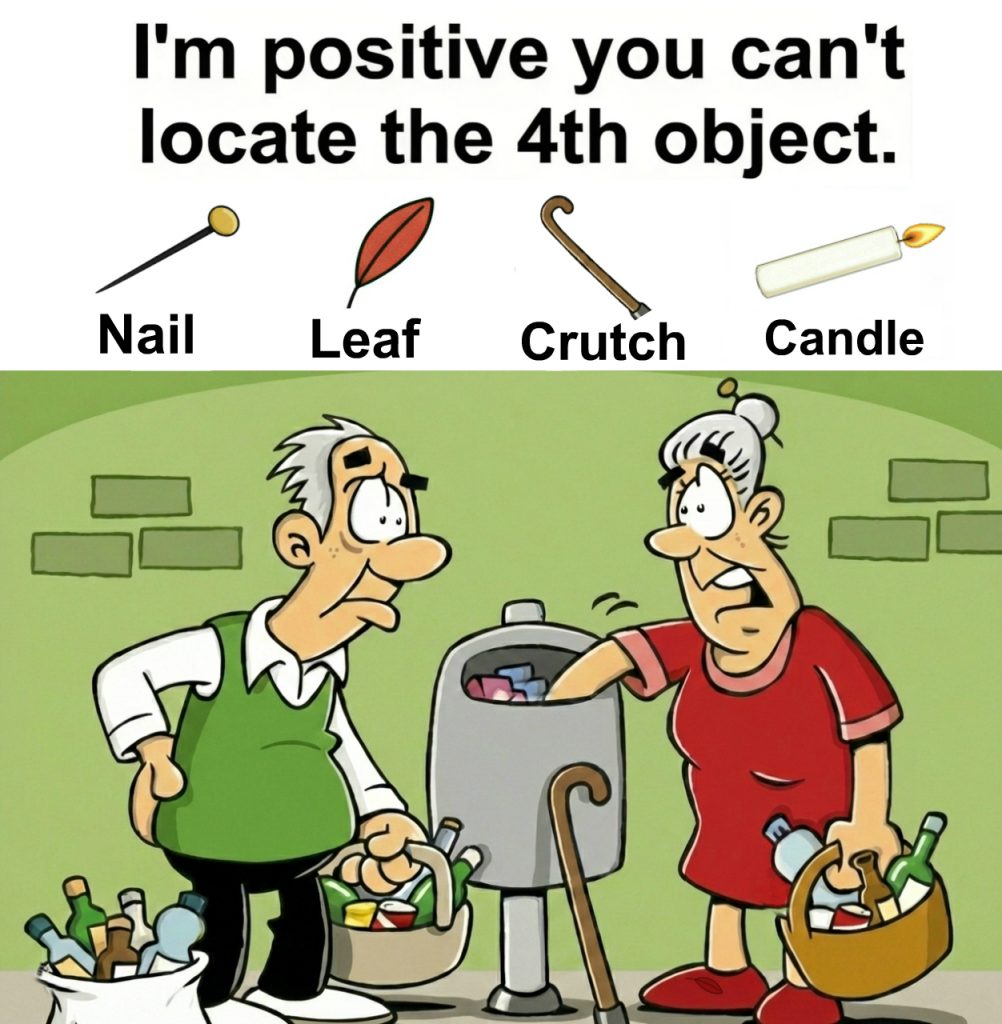
Hidden picture puzzles do not need bright colors or busy landscapes to hook your attention. Sometimes, all it takes is a simple scene, a bold challenge, and a few cleverly hidden objects to completely derail your confidence. The image in front of you proves that point perfectly. Two older adults stand in a trash room, arms full of bottles, staring at a bin with puzzled expressions. Above them sits a daring statement telling you that you cannot locate the fourth object. It feels almost insulting. And that is exactly why you keep looking.
This puzzle works because it feels ordinary. Almost boring at first. Then it quietly flips the switch in your brain and refuses to let go.
Why simple scenes make the hardest hidden picture puzzles
The biggest mistake people make with hidden picture puzzles is assuming complexity equals difficulty. In reality, the opposite is often true. When a scene looks simple, the brain relaxes. It assumes nothing tricky is happening. That is when the puzzle strikes.
This trash room scene uses a minimal background and familiar objects. Bricks. Bottles. A trash bin. Two characters. Nothing feels crowded. Nothing screams distraction. And yet, that fourth object stays stubbornly invisible.
The lack of visual noise forces your brain to rely on assumptions instead of scanning carefully. You think you know what you are looking at, so you stop truly looking. That is the trap.
The psychological power of a bold challenge
The sentence at the top does more than introduce the puzzle. It provokes you. It dares you. Humans hate being told they cannot do something, especially something that looks easy.
That single line instantly transforms a casual image into a mission. You want to prove it wrong. You slow down. You zoom in mentally. You re scan the same areas again and again.
This is a classic attention hook. The challenge feels personal, which increases engagement and time spent staring at the image.
Objects that hide through misdirection, not camouflage
The listed objects look simple. A nail. A leaf. A crutch. A candle. Each one is instantly recognizable on its own. That familiarity works against you.
Your brain searches for a candle shape. You expect wax. You expect flame. But the puzzle does not hide objects by copying them exactly. It hides them by borrowing parts of other shapes.
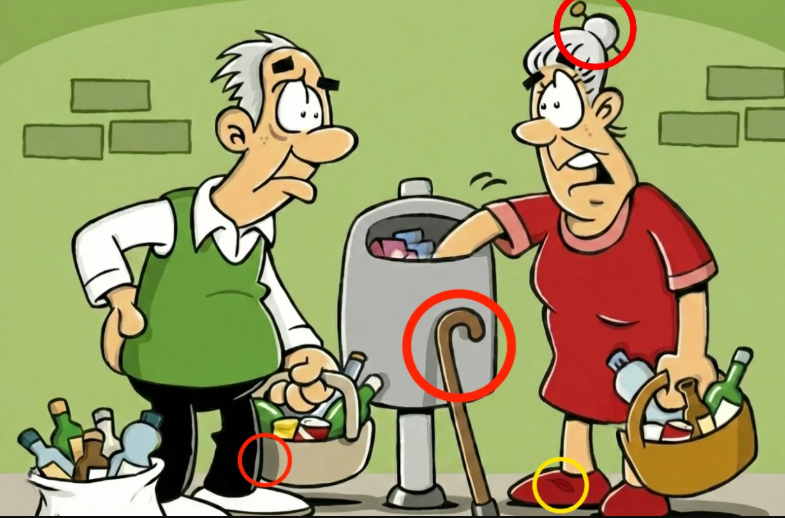
The crutch blends into posture and shadows. The leaf echoes curves already present. The nail borrows straight lines from edges. The candle becomes the ultimate trickster, hiding where you least expect it.
Nothing is invisible. Everything is disguised through suggestion. That is why this puzzle feels frustrating in the best possible way.
Why this puzzle keeps users staring longer than expected
Hidden picture puzzles like this one create a loop. You think you almost have it. Then doubt creeps in. You start over.
Each pass across the image reveals something new. A line you ignored. A curve that suddenly feels intentional. A shadow that now looks suspicious.
This slow burn engagement is gold for attention. Users do not bounce. They stay. They commit. They want closure.
That behavior is exactly what high performing content thrives on.
The role of humor in lowering mental defenses
The characters in the image look confused and slightly overwhelmed. Their expressions mirror the viewer’s own growing frustration. That shared emotion adds humor.
Humor lowers resistance. Instead of feeling stupid for missing the object, users laugh and keep going. The puzzle feels playful instead of punishing.
That emotional safety keeps people engaged longer and makes the experience enjoyable even when it is challenging.
Why older characters increase relatability
Using older adults in the scene is a subtle but smart choice. It broadens appeal beyond children. Adults see themselves in the image.
The setting feels real. Taking out bottles. Sorting trash. Dealing with everyday routines. That realism grounds the puzzle.
When a puzzle feels connected to real life, users invest more attention. They do not treat it like a toy. They treat it like a test of perception.
Why minimal color palettes increase difficulty
This image avoids bright colors and busy textures. The muted tones force the brain to rely on shape and outline instead of contrast.
Without strong color cues, the eyes must work harder. That increases cognitive engagement and slows scanning speed.
The result is deeper focus and longer interaction time.
Why this type of content performs so well with ads
Hidden picture puzzles naturally extend session duration. Users do not scroll past them. They stop and stare.
Longer time on page increases ad visibility without forcing clicks. Because the content feels family friendly and neutral, it attracts a wide range of advertisers.
The calm environment makes ads feel less intrusive. They exist alongside the challenge instead of interrupting it.
This combination supports higher RPM without harming user experience.
Evergreen content that never loses relevance
Trash rooms do not age. Human routines do not change. The challenge remains just as effective years later.
This puzzle does not depend on trends, seasons, or news cycles. It depends on human perception, which stays flawed and fascinating forever.
That evergreen nature makes it ideal for long term traffic and consistent monetization.
Why frustration actually increases satisfaction
The longer it takes to find the final object, the better it feels when you do. That delayed reward releases a stronger sense of satisfaction.
This puzzle understands that principle. It withholds the win just long enough to make it meaningful.
That emotional payoff is what makes users share the puzzle, challenge friends, and return for more.
A smart fit for a high value content strategy
Hidden picture puzzles like this one offer rare efficiency. One image generates minutes of attention.
They require no instructions. No reading commitment. No learning curve. Anyone can start instantly.
When paired with thoughtful descriptive writing, they become powerful engagement tools rather than simple games.
For publishers, this means longer sessions, stronger engagement signals, and sustainable monetization built on genuine user interest.
Conclusion
The hidden picture puzzle set in a quiet trash room proves that simplicity can be the most deceptive challenge of all. Through subtle misdirection, familiar objects, and a bold psychological dare, it forces the brain to slow down and truly see. Each missed detail sharpens focus. Each failed attempt deepens commitment. And when the final object finally reveals itself, the satisfaction feels earned. This puzzle reminds us that the hardest things to find are often hiding in the most ordinary places, waiting patiently for us to stop assuming and start looking.