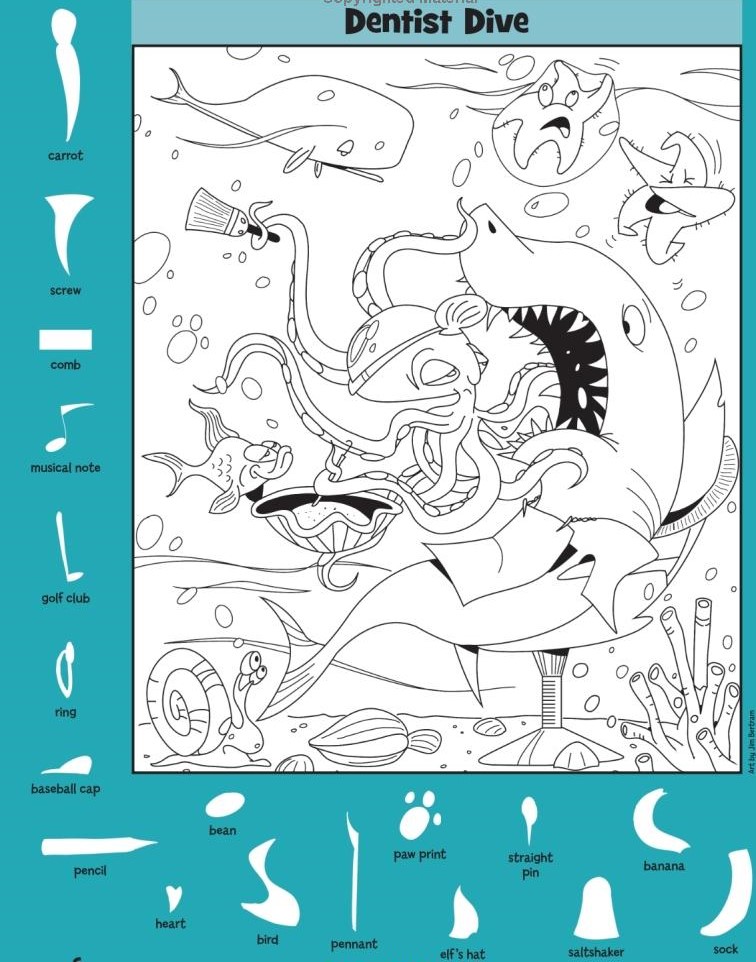
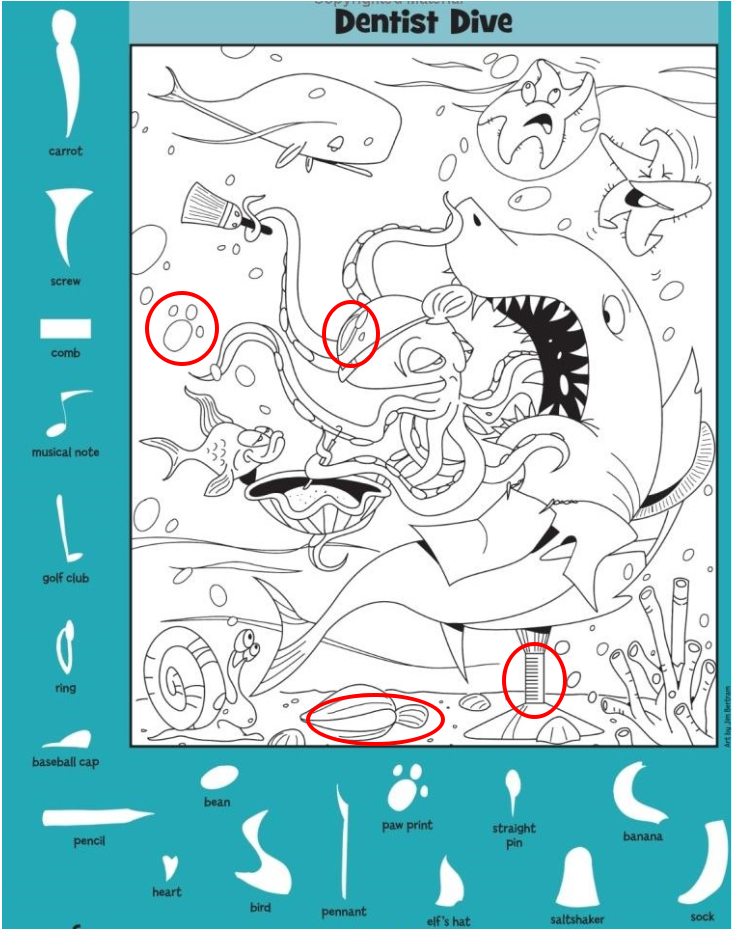
At first glance this image feels wild and playful. A shark wearing a dentist outfit. An octopus mid treatment. Fish floating by like curious patients in an underwater waiting room. It feels funny. A little absurd. But look closer and you realize this illustration is doing something clever. It is not just a cartoon. It is a hidden object puzzle designed to hook your attention and quietly sharpen your brain.
This kind of image does not ask politely for your focus. It steals it.
Why underwater scenes work so well for hidden object puzzles
Underwater environments are naturally chaotic. Bubbles drift everywhere. Creatures overlap. Plants twist and curl in unpredictable ways. That chaos creates the perfect camouflage for hidden objects.
Your brain already expects visual noise underwater. So when a comb or a carrot blends into coral or tentacles your eyes slide right past it. That is not a mistake. That is the puzzle doing its job.
The ocean setting gives the artist permission to hide almost anything anywhere.
The humor lowers your defenses instantly
A shark acting as a dentist is ridiculous in the best way. Humor relaxes the mind. When you laugh or smile your brain shifts into a more open and curious state.
That relaxed state makes you more willing to explore details. You are not rushing. You are enjoying the scene. While you enjoy it the puzzle quietly challenges your perception.
Funny visuals make hard puzzles feel easy even when they are not.
Why line art makes your brain work harder
This image uses black and white line art instead of color. That choice matters. Without color cues your brain cannot rely on contrast. It must rely on shape recognition instead.
Every curve every bubble every tooth outline competes for attention. Objects hide by mimicking the flow of the drawing rather than standing out.
Line art puzzles slow you down. And slowing down is where real focus begins.
Every object list is a mental contract
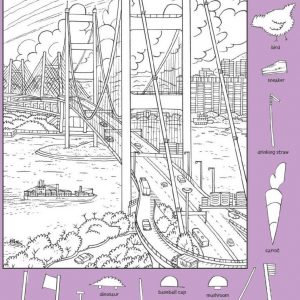
The objects listed around the border set a clear goal. Find the carrot. Spot the screw. Locate the musical note. Identify the ring.
Once your brain reads that list it locks onto the task. Each object becomes a target. Your eyes start scanning in patterns whether you realize it or not.
This clear objective keeps engagement high and frustration low.
Why absurd object placement keeps puzzles addictive
A banana underwater. A baseball cap near coral. A salt shaker drifting by a fish. None of it makes sense. And that is exactly why it works.
Your brain looks for logic. When logic fails it searches harder. The absurdity forces you to abandon assumptions and truly observe.
Hidden object puzzles thrive when expectations break down.
The secret role of motion illusions
Even though the image is static it feels like it moves. Bubbles rise. Tentacles curl. Fish swim. That illusion of motion pulls your attention across the scene repeatedly.
Each pass reveals new details. Each detail becomes a potential hiding place.
Movement keeps your eyes cycling instead of settling.
Why this puzzle appeals to both kids and adults
Kids love the silly characters and exaggerated expressions. Adults appreciate the challenge and clever design. That crossover is powerful.
Content that works across age groups performs better online. It stays relevant longer and attracts wider audiences.
That broad appeal also increases time spent on page which advertisers love.
How puzzles like this improve real world focus
Solving a puzzle like this trains visual discrimination. You learn to separate signal from noise. You practice patience. You resist distractions.
Those skills transfer directly into daily life. Reading. Driving. Working. Even relaxing.
It is brain exercise disguised as play.
Why underwater themes boost dwell time
Ocean imagery triggers curiosity. Humans naturally want to explore the unknown. Underwater scenes feel mysterious and limitless.
That sense of depth makes viewers linger. They scan deeper. They zoom in. They double check areas they already passed.
Longer dwell time means stronger engagement and better performance metrics.
Why hidden object puzzles monetize so well
These puzzles create natural pauses. Moments where the user stops scrolling. Moments where ads load without interrupting the experience.
Because the content is engaging ads feel less intrusive. That balance leads to higher click through rates and stronger RPM without aggressive placement.
Engagement first always wins.
The brilliance of visual storytelling
This image tells a complete story without words. A shark dentist. An octopus patient. Sea creatures reacting with surprise and curiosity.
That narrative keeps the puzzle from feeling mechanical. You are not just searching. You are watching a scene unfold.
Stories anchor attention better than instructions ever could.
Why completion feels so satisfying
Each object you find releases a small reward in your brain. A sense of progress. A spark of success.
When you complete the list that satisfaction multiplies. You solved it. You noticed what others might miss.
That feeling keeps people coming back for more puzzles again and again.
Conclusion
The Dentist Dive underwater puzzle succeeds because it blends humor chaos and challenge into one irresistible visual experience. It turns a silly scene into a powerful focus tool and transforms observation into play. By using line art absurd storytelling and clever object placement it captures attention without demanding effort. Whether you solve it quickly or take your time exploring every bubble the puzzle delivers something rare in digital content genuine engagement that feels effortless and fun.