This image opens a window straight into childhood wonder. A young space explorer sits confidently at a control panel, gazing out through a round spacecraft window where planets drift quietly and stars sparkle like scattered secrets. A small robot companion stands nearby, loyal and curious, ready for discovery. At first glance, it looks like a simple coloring page. Look closer, and it becomes something much more powerful. This is a hidden object puzzle wrapped in a space adventure, designed to spark imagination, strengthen focus, and turn quiet moments into meaningful play.
This kind of image works because it blends learning and creativity without ever feeling like a lesson. It invites the viewer in gently, then keeps them engaged longer than expected.
Why space themes instantly capture attention
Space is pure curiosity. It represents the unknown, the future, and endless possibility. Children naturally lean toward it, and adults still feel its pull. Planets, stars, and spacecraft awaken a sense of exploration that few other themes can match.
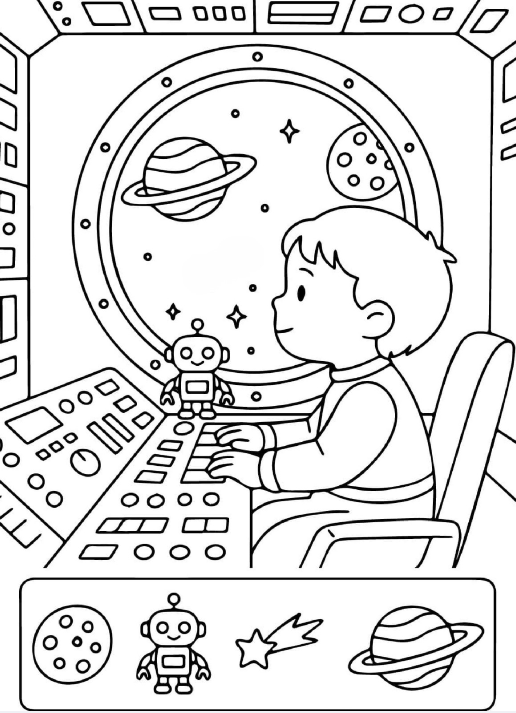
In this image, the spacecraft window becomes the emotional center. It frames the universe like a picture within a picture. That framing guides the eye and encourages slow observation, which is essential for hidden object puzzles.
The scene feels calm, not chaotic. That balance makes the challenge enjoyable instead of overwhelming.
The child explorer as a mirror for the viewer
The character in the chair is not rushing. He is focused, relaxed, and confident. His posture tells a story of control and curiosity, not stress. That matters more than it seems.
When a viewer sees calm focus, the brain mirrors it. You settle in. You take your time. You begin to look carefully at the details around the control panel, the robot, and the view beyond the window.
This subtle emotional cue transforms the puzzle into a mindful activity rather than a frantic search.
How hidden objects train the brain naturally
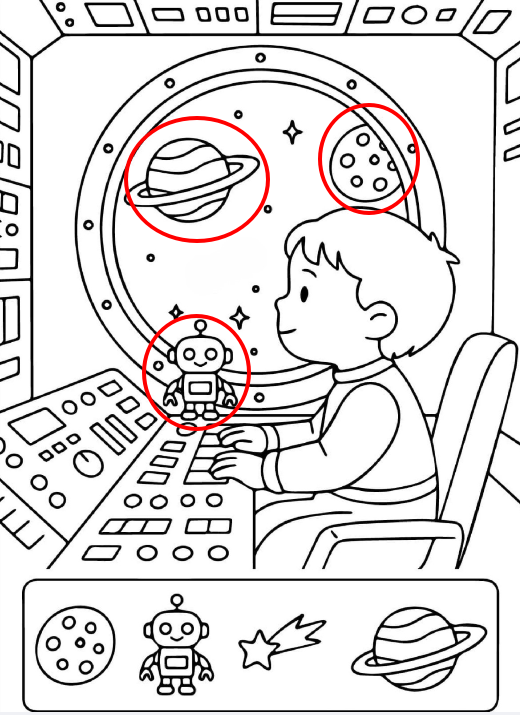
At the bottom of the page, simple shapes wait to be found. A planet. A robot. A shooting star. These objects look obvious when separated from the scene. Inside the illustration, they blend seamlessly into the environment.
That blending is the magic.
Your brain must switch from recognizing objects by meaning to recognizing them by shape. You stop thinking planet and start thinking circle with rings. You stop thinking robot and start thinking square body with small arms.
This shift strengthens visual discrimination, pattern recognition, and attention to detail without the viewer ever realizing they are practicing a skill.
Why black and white line art improves engagement
Coloring pages remove distractions. Without color, the brain focuses on structure. Lines, curves, spacing, and proportion take center stage.
This makes the hidden object challenge more rewarding. You are not relying on bright colors to guide you. You are using observation and patience.
Once coloring begins, another layer of engagement appears. As areas fill with color, hidden shapes emerge or disappear, depending on how carefully you choose your palette. The page evolves with every decision.
That sense of control keeps people engaged far longer than expected.
The role of the robot in the scene
The robot is small, friendly, and non threatening. It adds personality without stealing attention. For children, it becomes a companion. For adults, it becomes a nostalgic nod to classic space stories.
Visually, the robot introduces clean geometric shapes that echo the hidden object challenge. Circles, rectangles, and lines repeat throughout the image, subtly training the eye to spot similar forms elsewhere.
The robot is not just cute. It is functional to the puzzle design.
Why this image supports learning without pressure
There are no instructions shouting for attention. No loud cues. No timers. The image invites exploration at the viewer pace.
That matters for learning. When pressure disappears, curiosity grows. Children try again without fear of failure. Adults stay engaged instead of feeling tested.
This type of puzzle supports fine motor development through coloring, cognitive growth through searching, and emotional regulation through calm engagement.
It is quiet learning at its best.
How storytelling deepens focus
Every good image tells a story, even if it never uses words. Here, the story is clear. A young explorer pilots a spacecraft, observes the universe, and shares the journey with a robot friend.
As viewers search for hidden objects, they imagine the mission. Is this the first trip. Is the explorer learning the controls. Is the robot helping navigate.
That mental storytelling keeps attention anchored. The puzzle becomes part of a larger imagined experience, not an isolated task.
Why this page works across ages
For young children, the shapes are simple enough to identify with guidance. For older children, the challenge increases as they try to find all objects independently. For adults, the appeal shifts toward relaxation and nostalgia.
The design scales effortlessly. That makes it ideal for classrooms, family activities, therapy settings, and quiet time at home.
One page. Many uses.
Why space themed puzzles perform well online
Space content consistently draws interest. It pairs well with educational topics, creativity, and future focused thinking. That combination attracts parents, teachers, and curious readers alike.
Hidden object coloring pages also increase time on page. Users scroll less and engage more. That extended attention naturally supports higher quality ad placement and stronger performance without feeling intrusive.
Content that helps people slow down often performs better than content that pushes urgency.
The calming effect of controlled complexity
This image strikes a careful balance. There is enough detail to explore, but not so much that it overwhelms. The control panel is busy but organized. The stars are scattered but not crowded.
That controlled complexity keeps the brain engaged without triggering fatigue. You feel productive, not drained.
It is the visual equivalent of a deep breath.
Conclusion
This Space Explorer hidden object coloring page is more than a simple activity. It is a thoughtfully designed experience that blends imagination, learning, and calm focus into a single scene. Through gentle storytelling, clean line art, and cleverly integrated hidden shapes, it invites viewers to slow down, observe closely, and enjoy the quiet satisfaction of discovery. Whether used for creative play, mindful relaxation, or educational enrichment, this image proves that the best puzzles do not rush you. They guide you, patiently, toward curiosity and joy.