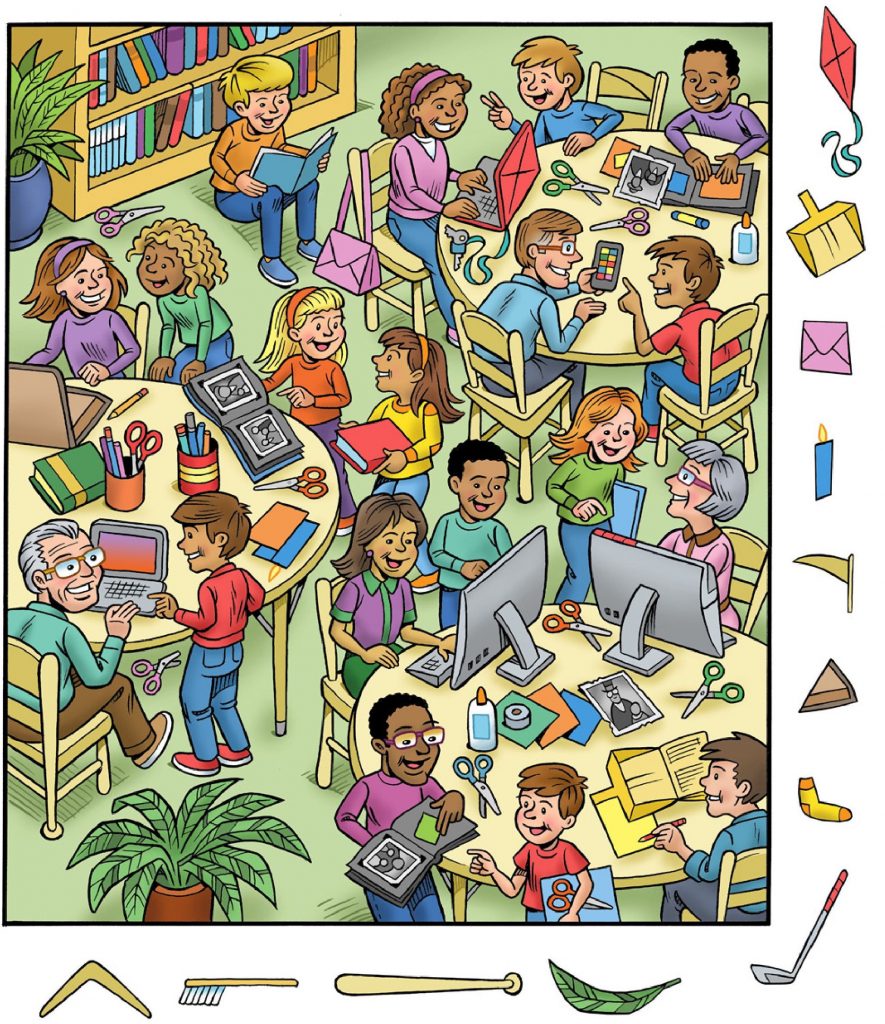
At first glance, this image feels like a warm snapshot of a perfect school day. Children laugh, share ideas, cut paper, read books, and work together around bright tables. Teachers guide gently. Bookshelves line the walls. Scissors, glue, paper, and computers fill the room with purpose. Everything feels energetic, friendly, and safe.
But this picture is not just a cheerful classroom illustration. It is a cleverly designed hidden object scene that invites your eyes to slow down and explore. Beneath the smiles and colorful activities, small objects quietly blend into the background, waiting for curious minds to discover them.
Why classroom scenes make perfect visual puzzles
A classroom is naturally busy. That is exactly why it works so well for a hidden object challenge. Your attention jumps from one child to another. You follow conversations. You notice expressions. You admire the sense of community. All of that visual storytelling distracts you from the real task.
Your brain assumes it understands what is happening. Kids are learning. Teachers are helping. Supplies are scattered everywhere. That sense of familiarity lowers your guard, making it much harder to notice objects that do not quite belong.
This image uses that effect brilliantly. The environment feels real and relatable, so your eyes skim instead of search.
A celebration of creativity in every corner
Every table tells its own story. One group flips through photo albums, sharing memories. Another experiments with colors and shapes. Nearby, children focus on screens while others cut paper or glue pieces together. Nothing feels staged. Everything feels alive.
That sense of motion is important. Static scenes are easy to scan. Active scenes force your eyes to jump constantly. While you follow one action, hidden items sit quietly just outside your focus.
The classroom becomes a playground for perception, where creativity hides secrets in plain sight.
How hidden objects blend into everyday learning tools
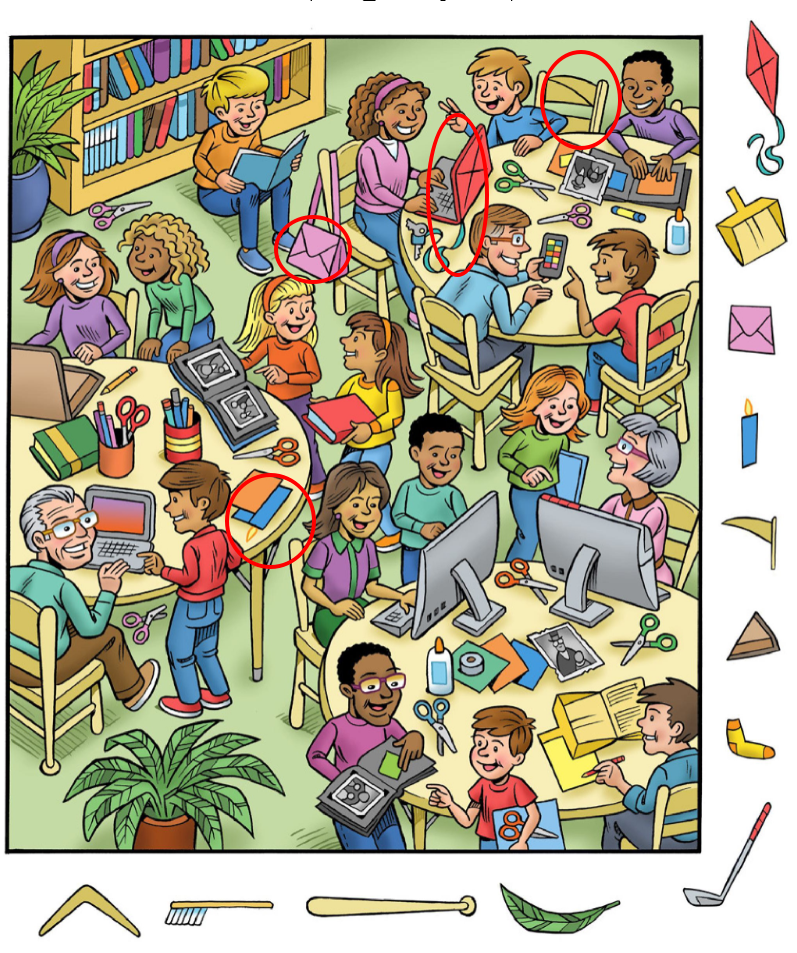
The objects hidden in this scene do not feel random. They match the classroom theme. Art supplies. Small tools. Familiar shapes. Because they belong in the environment, your brain accepts them without question.
Some shapes echo the curves of scissors. Others hide along the edges of books, leaves, or furniture. A line that looks decorative suddenly becomes something else once you notice it.
That is the trick. The image does not hide objects behind things. It disguises them as things.
Why your eyes keep missing what is right there
Human vision is selective. We do not see everything at once. We see what feels important. Faces. Movement. Bright colors. Central actions. This image places hidden objects away from emotional hotspots.
While children laugh and talk, the objects wait patiently in quieter corners. Along table edges. Near plants. Among scattered supplies. Your eyes rarely linger there unless you force them to.
That moment when you finally spot one feels almost magical. Suddenly the image changes. You realize how much you missed.
The joy of discovery keeps you engaged longer
Hidden object scenes like this work because they reward patience. Every object you find sharpens your focus. You slow down. You start scanning patterns instead of people. You notice shadows, outlines, and negative space.
This image encourages that shift naturally. It does not rush you. It invites exploration. Each discovery feels earned, not given.
That feeling keeps people looking longer than they expect. Minutes pass without notice. The classroom becomes a puzzle instead of a picture.
Why this image appeals to all ages
Children love this scene because it reflects their world. It feels playful and familiar. Adults love it because it challenges perception in a gentle, satisfying way.
There is no pressure. No timer. No score. Just curiosity. That makes it perfect for shared experiences. Parents and kids can search together. Teachers can use it as a fun classroom activity. Friends can challenge each other casually.
The image does not demand competition. It invites connection.
The subtle storytelling behind the illustration
Beyond the puzzle, the image tells a story about learning and collaboration. Different generations appear together. Adults guide without dominating. Children lead their own discovery.
That warmth makes the image feel safe. You trust it. And when you trust an image, you stop questioning what you see. That trust is exactly what allows hidden objects to disappear so effectively.
It is visual misdirection wrapped in kindness.
Why scenes like this perform so well online
People love content that makes them pause. This image does exactly that. It breaks scrolling habits. Instead of consuming information quickly, viewers engage actively.
They zoom in mentally. They point things out. They share the image with others, asking Can you find them all. That social interaction gives the image long life and wide reach.
It does not rely on shock or controversy. It relies on curiosity. That is why it works across platforms and age groups.
The moment everything clicks
At some point, something shifts. Your eyes adapt. You stop seeing children and start seeing shapes. That is when discoveries speed up.
Objects that felt impossible suddenly feel obvious. You laugh at yourself. How did I miss that. That reaction is part of the fun. It reminds you that seeing is a skill, not a guarantee.
This image teaches that lesson gently, without words.
Conclusion
This lively classroom illustration is far more than a cheerful school scene. It is a carefully crafted hidden object challenge that rewards patience, attention, and curiosity. By blending objects into a familiar and friendly environment, it turns everyday learning into a playful test of perception. The longer you look, the more you see. And once you start seeing, it becomes impossible to stop exploring every corner of the image.