Creative Kids at Work: A Delightful Classroom Drawing Puzzle That Sparks Learning and Fun
There’s something quietly magical about a classroom filled with children drawing. Pencils glide across paper, tiny hands focus on shapes and lines, and smiles appear as ideas come to life. At first glance, this black-and-white illustration shows exactly that—a group of children happily working on their drawings. But look again, and you’ll notice something more.
This isn’t just a sweet classroom scene. It’s also a cleverly designed visual puzzle that blends creativity, focus, and problem-solving into one engaging activity.
Let’s take a closer look at why this image works so well—and why puzzles like this are powerful tools for both fun and learning.
A Warm Classroom Scene That Feels Instantly Familiar
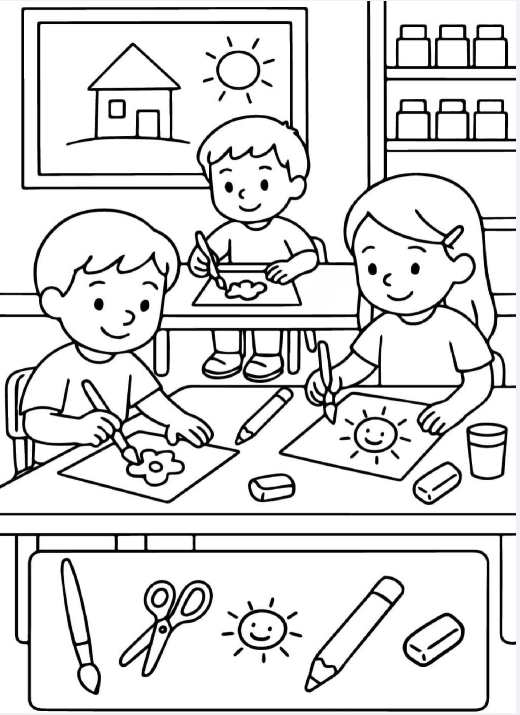
The image captures a moment most of us recognize. Three children sit at tables, drawing with care and curiosity. Their expressions feel calm and content, the kind of quiet happiness that comes from being absorbed in a creative task.
Behind them, shelves of supplies suggest structure and support. On the wall, a simple drawing of a house and sun mirrors what the kids are creating—subtle encouragement that creativity has no wrong answers.
This sense of safety and familiarity is important. When children feel comfortable, they focus better. And when focus improves, learning follows naturally.
More Than Art: A Hidden Object Challenge in Disguise
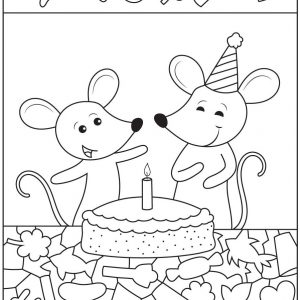
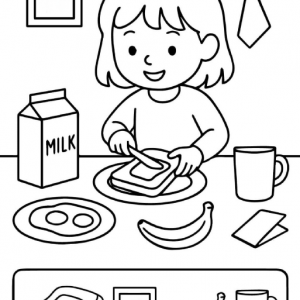
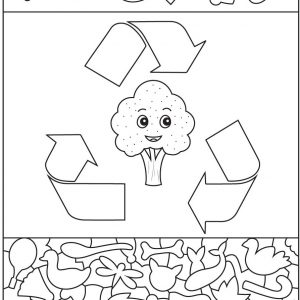
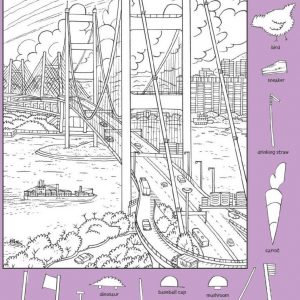
What makes this illustration special is what lies beneath the surface. At the bottom of the image, several objects appear—tools commonly found in an art room. Scissors, pencils, erasers, brushes, and shapes quietly invite the viewer to search for them within the main scene.
Suddenly, the picture becomes interactive.
The challenge encourages viewers to scan carefully, compare shapes, and spot details hiding in plain sight. Is that pencil just a pencil—or is it cleverly blended into a drawing? Does the sun appear only once, or is it repeated in another form?
This shift from passive viewing to active searching keeps the brain engaged.
Why Drawing Puzzles Are So Effective for Kids
Visual puzzles paired with familiar activities—like drawing—offer powerful benefits, especially for young minds.
They help children develop:
- Focus and sustained attention
- Visual discrimination and pattern recognition
- Fine motor awareness
- Problem-solving skills
- Patience and confidence
Best of all, these skills grow naturally. Children don’t feel like they’re being tested. They feel like they’re playing.
That’s when learning sticks.
The Power of Black-and-White Simplicity
Unlike colorful, overstimulating images, this illustration uses clean lines and minimal detail. That’s a smart choice.
Black-and-white artwork removes distractions and forces the brain to rely on shape, outline, and proportion. Children learn to recognize objects by form rather than color, strengthening visual intelligence.
It’s a bit like training wheels for observation skills—simple enough to approach, challenging enough to sharpen the mind.
How This Puzzle Encourages Creative Thinking
This image doesn’t rush the viewer. It invites curiosity.
Children might ask:
- “Why does my drawing look different from theirs?”
- “Can I find the same object twice?”
- “What if I draw something new?”
Those questions matter. They open the door to imagination, comparison, and self-expression. The puzzle doesn’t just say find the object—it quietly whispers, look closer and think differently.
That’s the foundation of creative thinking.
Perfect for Classrooms, Homes, and Quiet Time
This kind of puzzle fits beautifully into many settings:
- Classroom art lessons
- After-school activities
- Homeschool learning
- Calm screen-free breaks
- Parent-child bonding time
Teachers can turn it into a group challenge. Parents can use it as a gentle learning moment. Kids can enjoy it alone, proudly announcing each discovery.
It adapts to the environment without needing complicated instructions.
Building Confidence One Discovery at a Time
Every time a child finds a hidden object, something important happens. Confidence grows.
That small “I found it!” moment reinforces persistence and belief in their own abilities. Even mistakes become part of the process, teaching that trying again is normal and encouraged.
Over time, these small wins add up. Children become more comfortable tackling challenges—both on paper and in real life.
Why Adults Enjoy These Puzzles Too
Interestingly, adults often enjoy these puzzles just as much. Maybe more.
Why? Because they slow us down.
In a fast-paced world, searching for a simple shape in a calm illustration feels grounding. It reminds us of childhood focus, when time disappeared into crayons and paper.
That shared enjoyment makes this puzzle a rare bridge between generations.
A Smart Blend of Art, Play, and Learning
This classroom drawing puzzle works because it doesn’t force learning. It invites it.
Art draws you in. Curiosity keeps you looking. Discovery rewards your effort.
That combination is powerful. It turns a simple illustration into a tool for growth—quiet, effective, and genuinely enjoyable.

Conclusion: A Simple Scene With Lasting Impact
At its heart, this image celebrates creativity, focus, and gentle challenge. What looks like a peaceful classroom moment becomes a playful puzzle that sharpens observation, encourages patience, and sparks joy.
Sometimes, the best learning tools don’t shout for attention. They sit quietly on the page, waiting for curious eyes to notice what others might miss.
And in that moment of discovery, learning feels less like work—and more like wonder.