The Many Faces of the Mind: A Powerful Optical Illusion That Challenges How You See
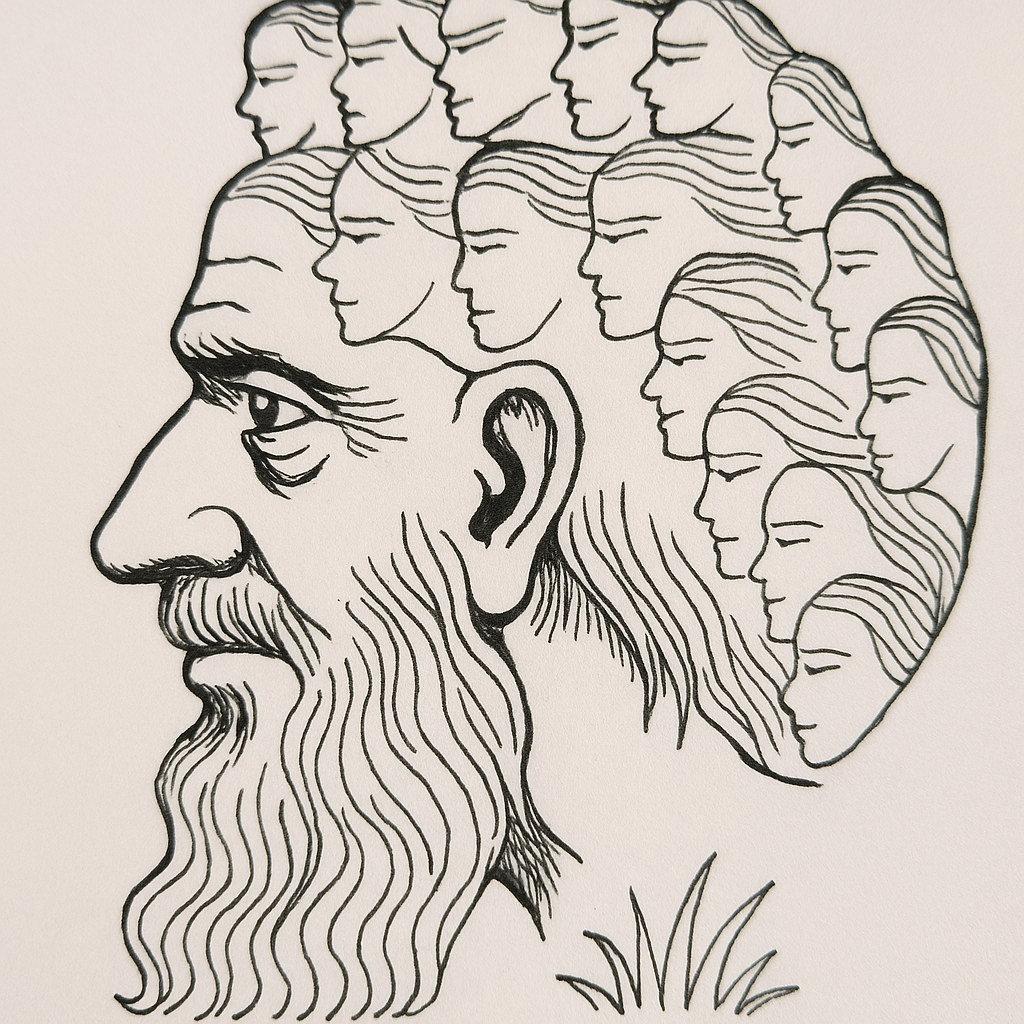
At first glance, this image feels simple. A bearded man in profile, drawn with clean black lines, gazes forward in quiet thought. Nothing flashy. Nothing loud. But then something strange happens. Your eyes hesitate. Your brain pauses. And suddenly, you see it.
One face becomes many.
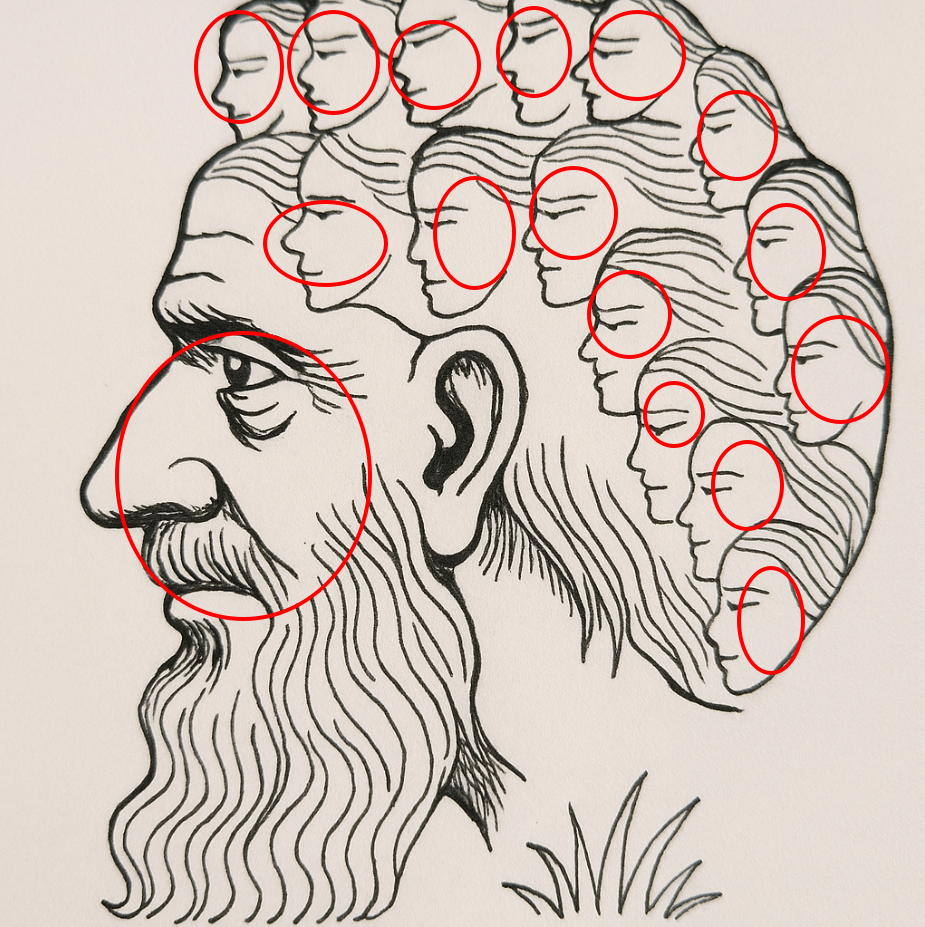
Hidden inside the head are multiple smaller faces, all facing the same direction, stacked and woven together like thoughts inside a mind. What looked like a single portrait transforms into a visual riddle about perception, identity, and awareness. This isn’t just art—it’s an optical illusion that invites you to question how deeply you’re really looking.
A Single Profile That Reveals a Crowd of Faces
The brilliance of this illustration lies in its restraint. There’s no color explosion, no chaotic background. Just line, shape, and repetition. The outer face anchors the image, giving your brain something solid to hold onto.
But within that structure, dozens of smaller profiles quietly emerge. Each face mirrors the same direction, the same calm expression, the same silent focus. They feel like echoes—thoughts repeating, memories layering, perspectives stacking inside one mind.
The illusion doesn’t jump at you. It waits patiently.
Why Your Brain Misses the Hidden Faces at First
Your brain loves shortcuts. When it recognizes a familiar object—like a human face—it stops analyzing the details and moves on. That’s efficient in daily life, but it’s exactly what this illusion exploits.
You see “a man’s profile,” and your brain checks the box. Done.
The hidden faces live inside that assumption. They use the same lines, the same curves, the same flow. Because your brain already decided what it’s looking at, it ignores the repetition hiding in plain sight.
Seeing them requires one thing: slowing down.
The Psychology Behind Optical Illusions Like This One
This illusion taps into a concept known as gestalt perception—the idea that humans naturally see wholes before parts. We prioritize the big picture over the details.
That’s why once you spot the smaller faces, you can’t unsee them. Your perception permanently shifts. The image changes, not because the drawing changed, but because you did.
It’s a reminder that reality often depends on attention, not information.
Multiple Faces as a Metaphor for the Human Mind
Beyond the visual trick, this artwork carries deep symbolic weight. One head. Many faces. One identity. Countless thoughts.
It feels like a metaphor for:
- Inner dialogue
- Conflicting perspectives
- Memories layered over time
- The many roles we play in life
Just like the faces inside the head, our thoughts often move in the same direction—yet each one is slightly different. The illustration captures that beautifully, without a single word.
It’s quiet. Thoughtful. Powerful.
Why Minimalist Line Art Makes the Illusion Stronger
Color would distract here. Texture would interfere. The artist’s choice to use simple line work is what makes the illusion effective.
Each face blends seamlessly into the next. There are no hard borders telling your brain where one ends and another begins. The illusion relies on flow, repetition, and rhythm—like a visual heartbeat.
This simplicity forces engagement. You don’t just glance. You study.
Why These Optical Illusions Hold Attention So Long
People don’t just look at this image—they linger.
First, they see one face.
Then, they notice a second.
Then, suddenly, there are many.
That discovery creates a loop of curiosity. Viewers keep scanning, counting, comparing. “How many faces are there?” “Did I miss one?” “Are they all the same?”
That kind of engagement is rare—and incredibly powerful.
Why This Image Feels Different Every Time You Look
The illusion changes depending on your focus. Some days, the outer face dominates. Other days, the inner faces pull your attention inward. That fluidity makes the image feel alive.
It’s like listening to a song and noticing a new instrument each time. The art doesn’t change—but your perception does.
That’s the hallmark of a great optical illusion.
Why Adults Are Especially Drawn to This Type of Art
This isn’t a loud illusion meant to shock. It’s a quiet one meant to invite reflection. That’s why adults connect with it so strongly.
It mirrors adult experience:
- Complexity beneath simplicity
- Depth hidden behind routine
- Thoughts layered behind a calm exterior
You don’t just see this image. You relate to it.
Why Optical Illusion Art Performs Exceptionally Well Online
From an engagement standpoint, this type of content is incredibly effective.
People zoom in mentally. They comment. They share with captions like, “How many faces do you see?” or “This messed with my brain.” That organic interaction keeps users engaged longer and more thoughtfully.
Because the content is:
- Non-controversial
- Emotionally intriguing
- Visually calming
- Universally relatable
…it creates an ideal environment for high-value ads and repeat visits.
A Masterclass in Visual Storytelling Without Words
What makes this illustration unforgettable is that it tells a story without explaining itself. There’s no caption needed. No instructions. No punchline.
The story unfolds in the viewer’s mind, at their own pace. That kind of storytelling respects the audience—and audiences respond to that.
Conclusion: An Optical Illusion That Reveals More Than Faces
This image isn’t just about hidden faces. It’s about how we see, how we assume, and how much we miss when we rush. With nothing more than ink and intention, it turns a single profile into a meditation on perception and identity.
The longer you look, the more you discover—not because the image is complicated, but because you’re paying attention.
And that’s the quiet power of this illusion. It doesn’t demand your focus.
It earns it.