Who Is the Fake Doctor? A Mind-Bending Puzzle That Tests Your Observation Skills
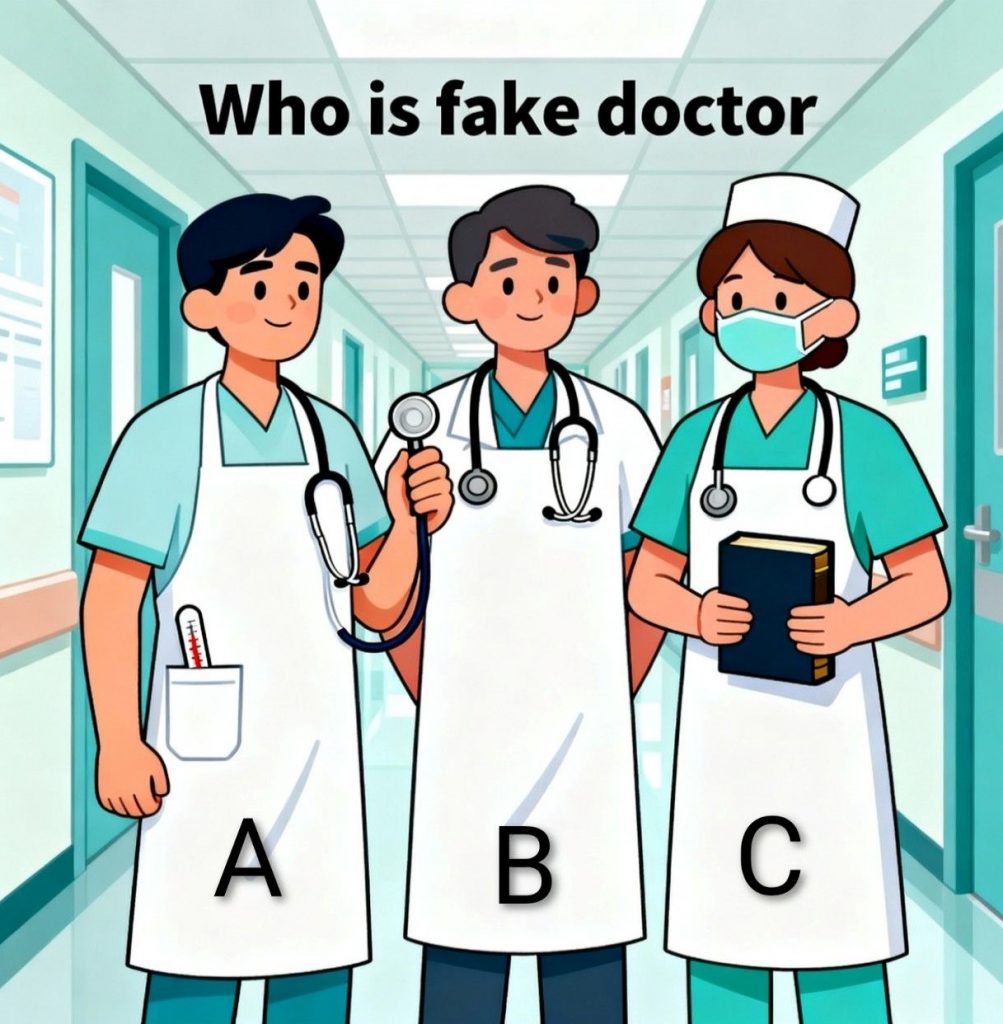
Sometimes, the most ordinary-looking images can hide the most surprising secrets. Take this clever illustration, for example—three people in white coats stand confidently in a hospital hallway. They all appear to be doctors, but the challenge asks one simple question: Who is the fake doctor?
At first glance, they all look professional—stethoscopes, scrubs, and calm smiles. But look closely, and you’ll notice that not everything adds up. This tricky puzzle isn’t just fun—it’s a great way to test your focus, attention to detail, and critical thinking skills. Ready to play detective? Let’s analyze each character and uncover who the real imposter is.
The Power of Observation: How Hidden Clues Tell the Truth
Hidden picture puzzles like this one thrive on visual misdirection. They make your brain work harder to connect clues and spot inconsistencies that don’t fit the context. The key lies in noticing small details—those subtle visual hints that reveal the truth behind appearances.
When looking at this image, your mind automatically assumes all three individuals are medical professionals. After all, they’re wearing uniforms, holding tools, and standing in what looks like a hospital corridor. But the devil, as they say, is in the details.
Let’s break it down, one “doctor” at a time.
Doctor A: The Thermometer Trick
Doctor A, standing on the left, looks confident. He’s dressed in scrubs and a white apron and has a stethoscope around his neck. But if you glance at his pocket, something feels off—there’s a thermometer sticking out of it.
Now, here’s where logic comes in. Doctors rarely carry thermometers in their apron pockets. In most clinical settings, thermometers are stored in sanitary cases or digital devices, not carried loose like pens. It’s an odd choice for a doctor’s accessory. But is that enough to call him fake? Maybe not yet. Let’s keep looking.
Doctor B: The Perfect Professional—Or So It Seems
Doctor B, standing proudly in the center, appears every bit the real deal. He’s holding a stethoscope, dressed appropriately, and exudes confidence. There’s nothing visibly strange about his attire or tools. In fact, he looks like the “ideal” doctor in a hospital illustration.
However, puzzles like these often hide their tricks in plain sight. Could it be that his confidence is a distraction? Or is he the real professional surrounded by impostors? The answer becomes clearer when we look at the third character.
Doctor C: The Book That Doesn’t Belong
Doctor C stands on the right, wearing the same green scrubs and apron as the others. She’s holding a book—and that’s where things start to look suspicious.
Look closer at the book’s cover—it’s not a medical file, not a patient chart, and not a textbook. It’s a hardcover book that looks more like a novel or a journal. Doctors typically carry clipboards, tablets, or charts, especially when walking hospital corridors—not hardbound books.
That’s not all. While she wears a nurse’s cap, her stethoscope hangs loosely and incorrectly around her neck. Combined with the out-of-place book, this raises a serious red flag.
So, who’s the fake doctor? Let’s put it all together.
The Verdict: Doctor C Is the Fake
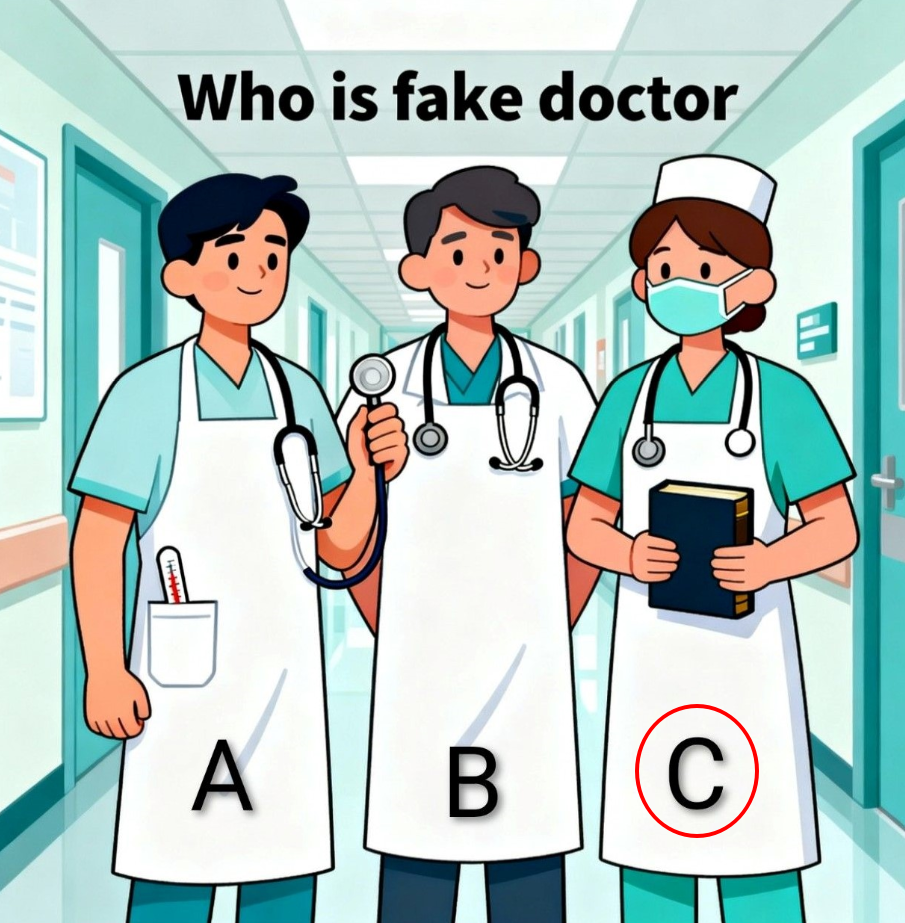
The answer is Doctor C.
Here’s why:
- The book she’s holding doesn’t belong in a hospital environment—it looks more like something from a library than a clinic.
- Her nurse’s cap doesn’t match the standard uniform of a doctor.
- The way she’s holding the stethoscope suggests unfamiliarity with the tool.
Doctor A and Doctor B may have minor quirks, but they at least carry items that fit a medical setting. Doctor C, however, stands out as someone pretending to be part of the team—someone who doesn’t truly belong in the scene.
Why Brain Teasers Like This One Boost Mental Sharpness
Spot-the-difference or “find the fake” puzzles like this aren’t just entertaining—they’re scientifically proven to improve focus and cognitive agility. When you scan an image for inconsistencies, your brain activates areas related to problem-solving, reasoning, and visual recognition.
Here’s what happens behind the scenes in your mind:
1. Improved Attention to Detail
You train your brain to look for small, often overlooked differences. This skill translates into real-life benefits, like better concentration at work or school.
2. Enhanced Memory Recall
By scanning for clues, you strengthen short-term memory—remembering what you’ve already checked and what still seems “off.”
3. Critical Thinking Practice
You start forming hypotheses (“Maybe it’s Doctor A!”), test them against visual evidence, and adjust your conclusions—a process identical to scientific reasoning.
Spotting the Fake: The Art of Visual Reasoning
This puzzle is a great example of how context clues help you think critically. Each doctor fits a stereotype—but only one has elements that don’t align with the environment. Your brain relies on pattern recognition, comparing what you expect to see with what’s actually there.
In short, it’s not about what looks right—it’s about what doesn’t.
That’s the beauty of these kinds of puzzles. They encourage you to look deeper, think harder, and question surface appearances—skills that are useful not just in games but in life itself.
How to Get Better at Solving Puzzles Like This
If you enjoy brain teasers like this, here are a few simple strategies to sharpen your observation skills:
1. Slow Down and Scan Systematically
Start from one corner of the image and move across methodically. Don’t rush—your eyes can easily skip key details if you scan too fast.
2. Compare Context, Not Just Objects
Ask yourself: “Does this object fit the setting?” Context often gives away what doesn’t belong.
3. Question the Obvious
If something seems too perfect—like Doctor B’s confident posture—it might be a red herring designed to trick you.
4. Practice Daily Observation
Try noticing small details in your surroundings—like changes in room décor or people’s accessories. It’s fun and builds real-world attentiveness.
Conclusion: The Truth Hidden in Plain Sight
So, there you have it—Doctor C is the imposter! This puzzle may look simple at first, but it’s a brilliant reminder that appearances can be deceiving. In a world where we often take things at face value, it’s refreshing to pause, observe, and think critically.
Hidden object challenges like this one keep your brain active, curious, and sharp. So next time you see a visual riddle, don’t just glance at it—study it. Who knows what secrets you might uncover with just a little more attention to detail?