The Classroom Mystery: Discovering Hidden Objects in a Back-to-School Adventure
Backpacks zipped, pencils sharpened, and the scent of fresh paper fills the air—it’s the start of a new school day. But this isn’t just any ordinary backpack scene. At first glance, this illustration seems to capture the usual chaos of school supplies: notebooks, rulers, a globe, an apple, and stacks of books. Yet, hidden among these familiar items are secret objects waiting to be found. This brain-teasing picture invites both kids and adults to pause, observe, and uncover what’s cleverly disguised within this back-to-school setting.
Let’s take a closer look at this intriguing artwork, exploring the joy of discovery, the educational value of hidden object puzzles, and the simple fun of finding what’s tucked away in plain sight.
A Backpack Full of Surprises
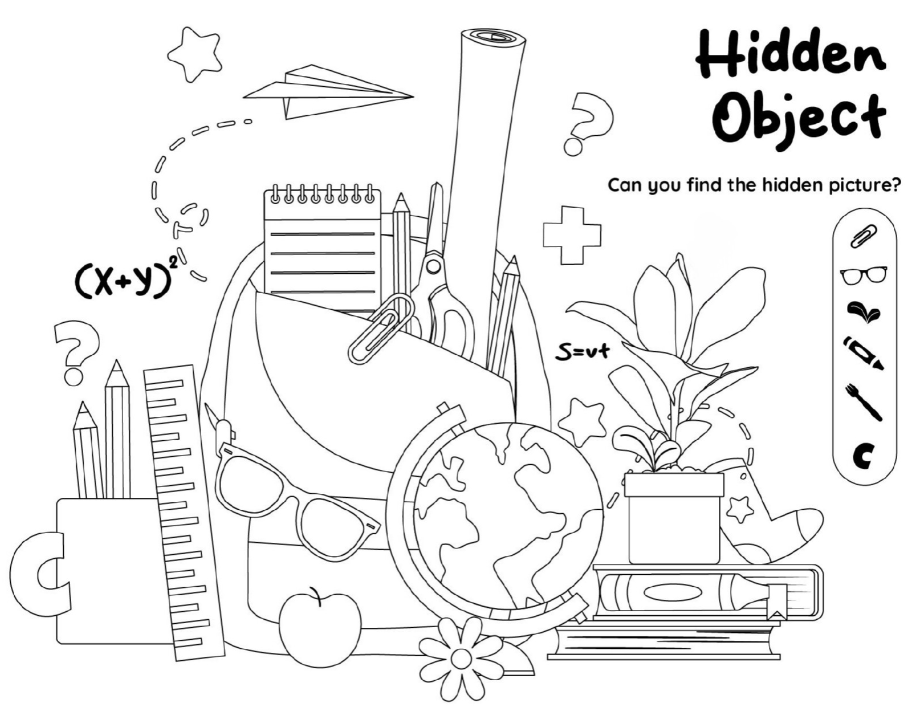
The heart of the picture is the overflowing backpack—a symbol of school life. It’s packed to the brim with everyday learning essentials: a notepad peeks out from the top, pencils stand tall beside a ruler, and scissors rest neatly against the side pocket. A paperclip, a pair of glasses, and an apple lie in front, while a potted plant and a globe add an academic yet creative touch.
But there’s more than meets the eye. Somewhere within this jumble of objects are cleverly hidden shapes—like a pen, a paper airplane, a book, and even a mysterious letter “C.” Each object blends so naturally into the drawing that it’s easy to overlook them unless you truly focus. The challenge is irresistible: Can you find them all?
The Hidden Object Challenge: A Game for Sharp Eyes
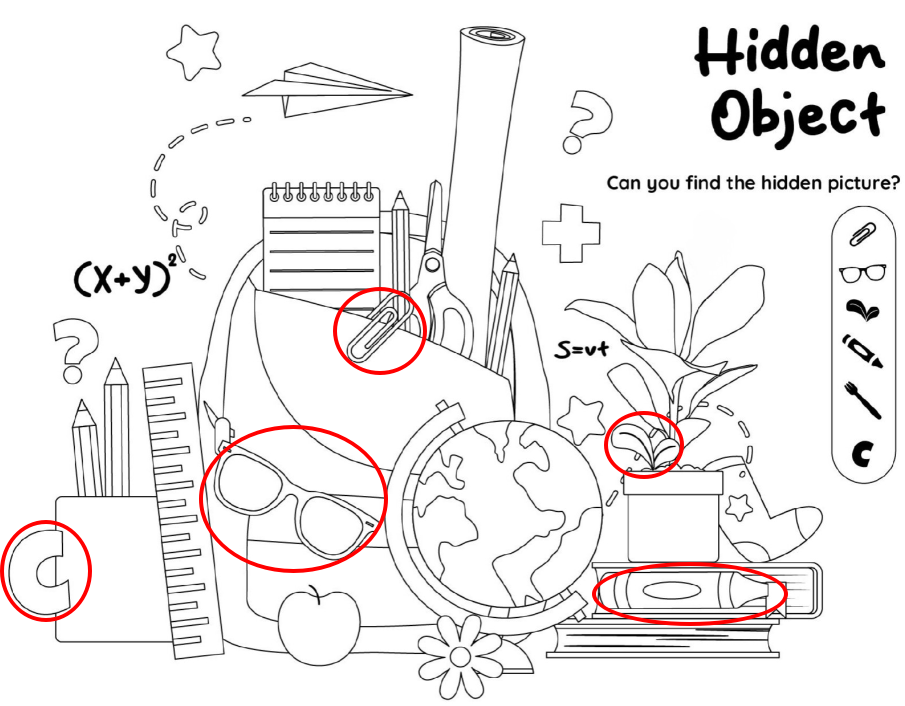
Hidden object puzzles have a timeless charm. They spark curiosity, boost concentration, and train your eyes to notice details that most people miss. In this particular scene, you’re asked to find six hidden items, each one artfully concealed within the school-themed illustration.
1. The Paperclip
Look carefully—this little metallic helper is hiding near the backpack’s pocket, drawn in such a way that it blends with the outlines of the zipper and straps.
2. The Glasses
A familiar symbol of focus and learning, the glasses sit right in the open—but the trick lies in their placement. They rest so naturally among the other supplies that they almost become invisible.
3. The Open Book
Can you spot it? It hides cleverly among the notebooks, its pages drawn in a way that mimics the lines of paper and shading of nearby items.
4. The Pen
A pen might seem too obvious to hide, but in this image, it’s merged seamlessly with the plant stems and pencil outlines.
5. The Paintbrush
Artists will love this one—it’s tucked away where creativity meets study, maybe leaning near the pot or blending into a pencil’s form.
6. The Letter “C”
Perhaps the most playful hidden object of all, the letter “C” sits quietly among the classroom chaos. It could represent “Creativity,” “Classroom,” or simply the artist’s clever wink at the word “Challenge.”
Each find offers a small burst of accomplishment—a satisfying “aha!” moment that makes you want to keep searching for more.
Why Hidden Object Puzzles Are More Than Just Fun
Sure, these puzzles are entertaining, but they’re also powerful learning tools—especially for kids. They sharpen observation skills, boost memory, and encourage problem-solving, all while keeping the experience lighthearted and enjoyable.
They Strengthen Focus and Patience
In a world filled with distractions, finding hidden objects teaches children (and adults) to slow down and pay attention. Every scan of the image encourages patience and persistence.
They Stimulate the Brain
Hidden object puzzles engage both hemispheres of the brain—logic helps you search systematically, while creativity helps you recognize patterns and visual cues.
They Encourage Curiosity and Exploration
Every discovery sparks a small sense of wonder. The mind learns that answers aren’t always obvious—they’re often hidden in the details.
They Make Learning Feel Like Play
The best kind of learning happens when it doesn’t feel like work. This school-themed image merges education with entertainment, creating a playful environment that reinforces classroom connections in a fun, stress-free way.
The Art of Observation: Finding Meaning in the Details
The brilliance of this illustration lies not just in the hidden items, but in the artistry itself. Every object represents a small part of student life—the tools of learning, curiosity, and imagination.
The notepad stands for ideas waiting to be written down. The globe symbolizes exploration beyond the classroom. The apple recalls the timeless tradition of showing appreciation for teachers. Even the plant, sitting quietly beside the books, suggests growth—intellectual, emotional, and creative.
But hidden object puzzles also remind us of something deeper: how easy it is to overlook what’s right in front of us. Just like in life, the answers often hide in the spaces we don’t pay enough attention to.
A Classroom That Invites Playful Learning
This hidden object scene feels like a miniature world of learning. It’s not just a jumble of supplies—it’s a snapshot of curiosity itself. The symbols of science, mathematics, and creativity are all present:
- The equation (x + y)² hints at the logic and problem-solving that math brings to education.
- The S = vt reminds us of the curiosity that drives scientific discovery.
- The paper airplane soaring above the backpack embodies imagination and play—the spark that makes every classroom come alive.
Every element feels purposeful, as if whispering a lesson beyond the obvious: learning isn’t limited to books and pencils—it’s everywhere around us, waiting to be discovered.
The Joy of Discovery: Why We Love Finding Hidden Things
Why do people love hidden object games so much? Because they awaken a sense of adventure. It’s the thrill of uncovering the unseen, the delight of realizing that there’s more to an image—or to life—than what meets the eye.
Finding hidden items feels satisfying because it mirrors the process of discovery itself. Whether it’s solving a math problem, uncovering a scientific truth, or realizing something about yourself, the feeling of “I found it!” never loses its magic.
In this school-themed puzzle, that joy is doubled. Not only do you get the thrill of finding hidden objects, but you also reconnect with the excitement of learning—the wonder that every child feels at the start of a new school year.
Conclusion: Learning Hidden in Plain Sight
This hidden object illustration is more than a fun back-to-school puzzle—it’s a celebration of observation, curiosity, and the joy of learning. Beneath its playful surface lies a simple but powerful message: sometimes the most valuable lessons are hidden in plain sight, waiting for us to slow down and notice them.
So take one more look at the picture. Search the backpack, scan the books, peek behind the plant. You might just find more than hidden objects—you might rediscover the childlike curiosity that makes learning, and life, an endless adventure.