Which Person Won’t Fall From the Tree? A Logical Puzzle Explained
Understanding the Puzzle Scenario
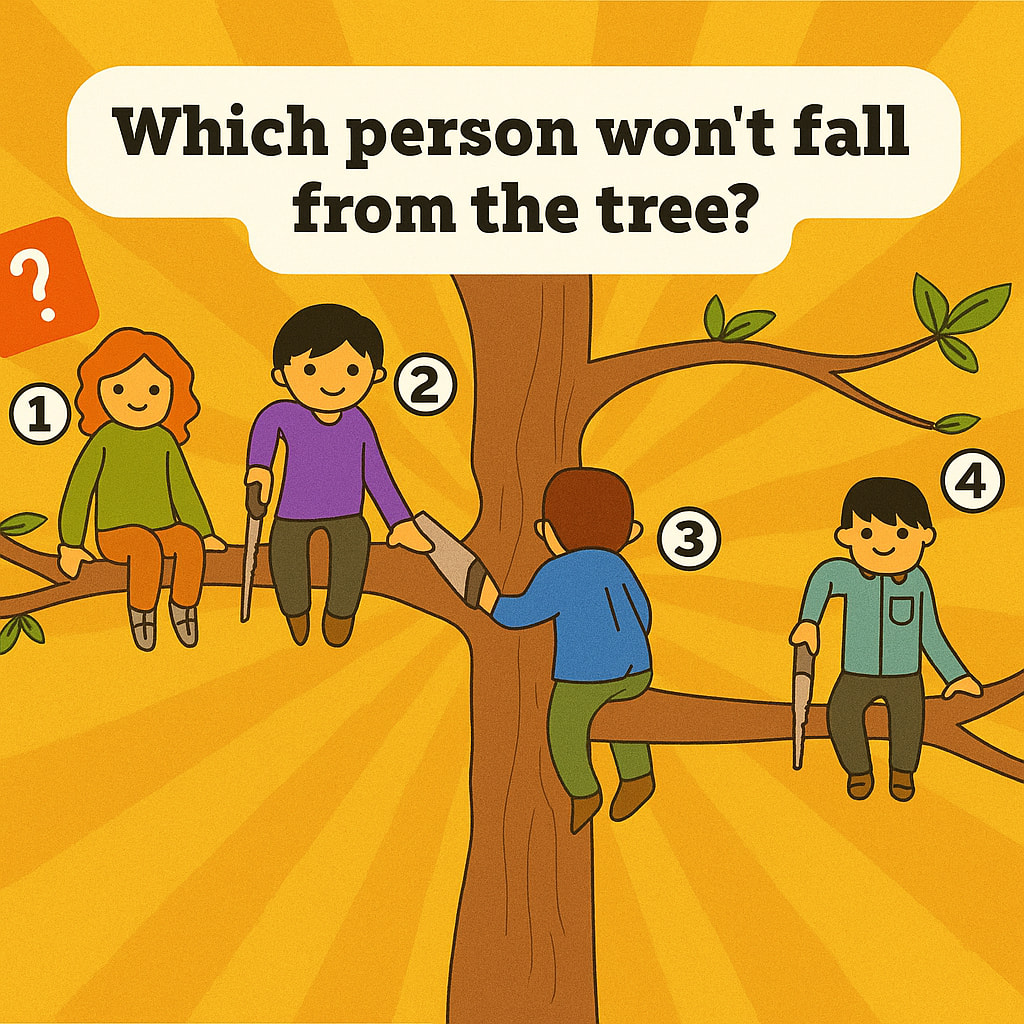
Have you ever encountered one of those deceptively simple brain teasers that hooks you in with a single glance? Picture a sturdy tree branch with four friends perched on it. Each holds a saw and appears to be cutting the very wood they sit on. The burning question: Which person won’t fall from the tree when the branch give way? At first, it seems like a trick question, but once you break down each action, the answer unveils itself. This puzzle isn’t just about sawing wood—it’s about exercising your mind, spotting hidden details, and learning logical reasoning in a fun, playful way.
Meet the Four Tree Climbers
Let’s introduce our four “branch experts.” Person 1 sits on the far left, legs dangling, hands resting on the wood—no saw in sight. Person 2, next to them, grips a saw and slices into the branch to their left. Person 3, seated near the tree trunk, saws the thick branch extending to the right. Finally, Person 4 sits on the far right, also sawing the branch to their right. Each posture and saw placement holds a clue. By examining who’s cutting which piece of wood, you can determine whose seat remains intact when all is said and done.
Analyzing Each Person’s Actions
Who’s in danger of plummeting? Let’s break it down:
- Person 1 isn’t using a saw, so the wood beneath them starts solid—but the branch directly supports Persons 2 and 3 as well. If that main limb detaches due to other cuts, Person 1 loses their foothold.
- Person 2 hacks at the left section of the branch. When they finish, that segment will drop, and they’ll go with it. That leaves the central trunk and right section still attached, but Person 2 is definitely out.
- Person 4 is cutting the rightmost branch. Once that slice is complete, they’ll lose their perch and tumble down. So they’re also headed for a fall.
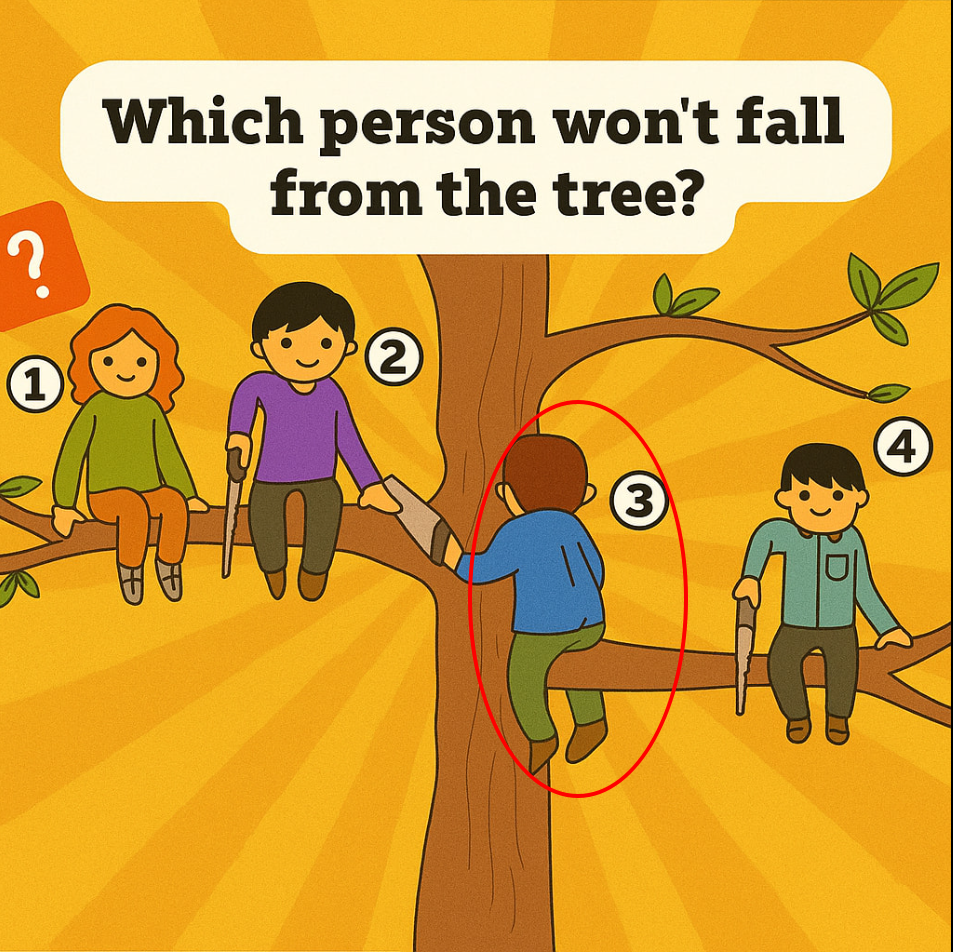
- Person 3 sits snug against the tree trunk, sawing the pathway leading to Person 4. When Person 4’s branch finally gives way, it detaches in front of Person 3—but Person 3’s section remains anchored to the trunk. That means they’ll stay put, safely perched on the main stem.
Why Person 3 Stays Safe
You can think of the tree branch like a bridge with four stepping stones. If you remove the first stone, everyone standing beyond it loses support and plunges. But if you remove the last stone, only the person standing there falls—the others remain firmly on solid ground. Person 3 is effectively on the “zeroeth” stone: the tree trunk itself. Even though they’re cutting the branch leading out from their position, they’re seated on the core structure. So when that outer branch tumbles away, Person 3 stays anchored to the trunk, just as if you’d removed the final link in a chain without disturbing the links closer to the handle.
Key Principles of Logical Thinking
What makes this puzzle tick? It relies on spatial reasoning and causal relationships. First, we identify each person’s position relative to the trunk. Next, we map which branch segment each person severs. By applying cause and effect, we deduce who loses support. This mirrors real‑world problem solving: break complex situations into smaller parts, observe their interactions, and follow the chain of events to a logical conclusion. It’s like troubleshooting why a machine stopped working: you check each component in sequence until you find the one that, when removed or damaged, triggers the breakdown.
Benefits of Brain Teasers for Cognitive Health
Engaging with puzzles like “Who won’t fall?” isn’t just a playful pastime—it’s a mental workout gym. Here’s why brain teasers deserve a spot in your daily routine:
- Sharpened Attention: You learn to focus on critical details—exactly what determines which branch stays intact.
- Enhanced Problem‑Solving: Each puzzle teaches you different strategies, from elimination to pattern recognition.
- Memory Boost: Remembering who sits where and which branch they cut trains both short‑ and long‑term memory.
- Creative Thinking: Brain teasers push you to come up with clever solutions, similar to inventing shortcuts on a maze.
Regularly challenging your gray matter can even help delay cognitive decline as you age. Think of each solved puzzle as a tiny deposit in your mental savings account.
Tips for Solving Similar Puzzles
Ready to tackle more logic teasers with confidence? Here are some pro tips:
- Visualize the Scenario: Sketch a quick diagram if the setup feels intricate. Representation often clarifies relationships.
- Work Backwards: Sometimes it helps to start with the end state (the branch broken) and trace which cut caused it.
- Use Process of Elimination: Rule out impossible scenarios first—just like we ruled out Persons 1, 2, and 4.
- Look for Anchors: Identify what stays constant (the tree trunk) so you can see which pieces move or detach.
- Take Breaks: If you hit a mental block, step away briefly. A fresh perspective often uncovers the solution.
Conclusion: From Trees to Tackling Life’s Challenges
This “who stays?” puzzle does more than entertain—it teaches us systematic reasoning, the power of diagrams, and the joy of deduction. By isolating each person’s action and mapping out cause and effect, we saw that Person 3 won’t fall because they’re cutting the branch beyond them, not under their seat. Next time you face a problem—whether it’s a puzzling riddle or a real‑world challenge—remember the tree puzzle. Break the issue into parts, track each action’s impact, and you’ll discover the right solution branch by branch.